

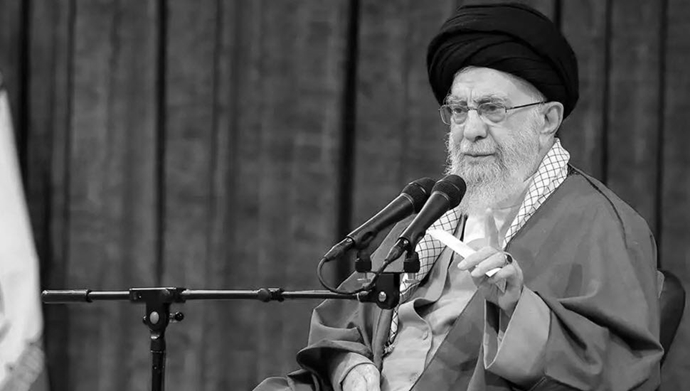

Dictators always try to cover up their collapsed image and authority with empty claims and hollow maneuvers at the end of their rule. In past decades, such political games might have briefly reassured the dictator’s courtiers and soldiers, but today, in the age of communication, they quickly become a source of ridicule for others.
Iranian regime supreme leader Ali Khamenei, whose image has crumbled after failures in his strategic depth—Lebanon—and the downfall of the Assad dictatorship in Syria, is trying to project power through bluffing and empty claims. Meanwhile, various voices express concerns: one states, “Be sure that if you continue on this path, you will lose power” (Jomhouri newspaper, November 26, 2024). Another says, “The fall of Bashar al-Assad is not just a significant event for Syria but has repercussions across the Middle East. No country feels these consequences as strongly as Iran—it is a strategic and military blow to Iran” (Ham-Mihan newspaper, December 21, 2024). Yet another asks why, despite deploying 100,000 troops and spending billions of dollars, Iran failed to prevent Assad’s downfall. “What happened to the defense of the holy shrines? Was all that bloodshed in vain?” A member of the Assembly of Qom Seminary Lecturers also criticizes, saying, “The regime has made a terrible mistake and must apologize to the people—no covering it up” (Abdolrahim Soleimani Ardestani, December 18).
Nevertheless, Khamenei, with empty pockets, boasts extravagantly about the staged government rallies on the anniversary of the 1979 revolution, saying, “Where else in the world do you see such a massive march on February 11? After more than forty years since the revolution’s victory, ordinary people—not the armed forces, not officials, but the masses, the body of the nation—commemorate this day in such a grand manner, coming out in huge numbers despite all the existing problems” (February 17, anniversary of the Tabriz uprising).
We saw the same claims in the final months of the Shah’s dictatorship, just ten months before the monarchy’s downfall, when he staged a show of power. At the time (April 10, 1978), newspapers of the Shah’s regime ran bold headlines about a massive gathering of 400,000 “ordinary people” in Tabriz, hoping to revive the Shah’s shattered authority and the monarchy’s dying structure.
The state-organized demonstration in Tabriz on April 10, 1978, was staged with the army, police, and SAVAK agents in plain clothes, while at the same time, regime officials were in a race to purchase real estate in California as they prepared to flee the scene.
Now, the mullahs’ regime is also at the end of the line, witnessing the defection of IRGC members and regime officials as they scramble to secure the wealth and fortunes they amassed by trampling on the people. Reports of their corruption, theft, and plunder emerge daily, and the exposure of Khamenei’s officials’ corruption on social media has become a major challenge for him. In his February 17 speech, Khamenei commented, “A soft threat means manipulating public opinion, creating division, and sowing doubt in the fundamental principles of the Islamic Revolution—this is a soft threat.”
Since the Iranian people made their stance against the regime’s “fundamental principles” clear four decades ago—on September 27, 1981, when PMOI militants chanted “Death to Khomeini” for the first time—Khamenei’s reference to “doubt in fundamental principles” likely pertains to regime insiders who have lost faith after the collapse of Tehran’s “strategic depth.” Their sentiment echoes that of a fleeing IRGC commander from Syria, who lamented last month, “We were hit, we lost, and we lost badly! We lost! We were hit, and it was very hard for us.”