

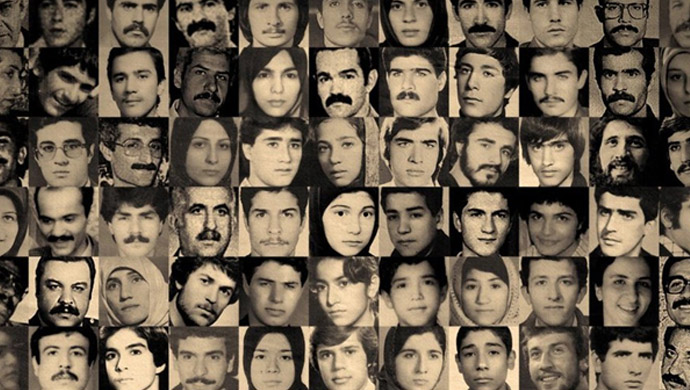

In 1988, when the founder of mullahs’ regime, Ruhollah Khomeini, ordered the massacre of political prisoners affiliated with the People’s Mojahedin Organization of Iran (PMOI/MEK), he thought that he would get rid of his main opposition and alternative once and for all. He did not expect this crime against humanity to trigger a justice-seeking movement that would last for decades and spread across the world.
According to a fatwa by Khomeini, anyone who insists on support for the MEK was to be wiped out and destroyed, and the name of those freedom fighters would never be mentioned in any part of the world.
Following Khomeini’s order, in July and August of 1988, every day, thousands of political prisoners were hanged in prisons across Iran. What became known as the 1988 massacre resulted in the execution of more than 30,000 political prisoners, most of whom were members and supporters of the MEK.
The regime went to extreme measures to hide this heinous crime against humanity, burying the bodies in unmarked mass graves, keeping families in the dark about the fate of their loved ones, threatening parents to not hold funerals for their children, and later destroying any possible evidence of the mass murders.
On the 35th year of the massacre of political prisoners, on Tuesday, July 18, 2023, a parliamentary conference was held in the British Parliament with the presence of UN Special Rapporteur on Iran affairs, Javaid Rehman, and the participation of representatives of both the House of Commons and Lords from all parties.
In this meeting, representatives of the House of Lords including Lord David Alton, Lord Stuart Pollock, Lord Singh and several members of the House of Commons, as well as Professor Eric Haynes and Professor Sarah Chandler and representatives of the families of the massacre victims spoke.
During his speech, Professor Rehman condemned the lack of accountability of the leaders and officials of the regime for the crimes committed in Iran and the continuation of impunity. He also called for an international investigation into the massacre of thousands of political prisoners in 1988.
“The mass executions of 1988 have been followed by state authorities refusing to publicly acknowledge the killings and to disclose the fate of those killed and the location of their remains to victims’ families and subjecting families to threats, harassment, intimidation and attacks,” he said. “There has thus been the determination of the Iranian government to hide these massacres through false narratives and statements, distortion of historical data, and active harassment of survivors and family members of victims, as well as by hiding the evidence, such as the destruction of mass graves. Systematic concealment of the fate of the victims, not providing the location of their remains, or not providing family members information about the causes of their deaths is deeply troubling. Such concealment, in my judgment, constitutes enforced disappearances and a crime against humanity.”
Lord David Alton, who moderated the first part of the conference, referring to the nationwide uprising of the Iranian people to achieve a democratic republic, asked the UK government to support the referral of the regime’s human rights case to the UN Security Council for punitive measures.
MP Bob Blackman said, “The fact that one of the notorious and documented perpetrators of the 1988 massacre is now president of Iran highlights the extent of the problem and the urgency of securing accountability. Ebrahim Raisi was previously the head of the judiciary in 2019 when the Iranian authorities crushed another popular uprising through mass arrests and killing 1500 people. This underlines one other crucial problem in Iran: that the Judiciary is part of the domestic repression and cannot be trusted or expected to deliver justice for the victims.”
The parliamentary conference in England is the continuation of the movement for accountability that the Iranian Resistance has been pursuing for years. Khomeini never thought that his crimes would continue to haunt his regime for years to come. When he gave the order for the killings, he did not even listen to Hossein Ali Montazeri, his heir apparent, who said that the MEK would not be destroyed by killing them. At the time, Khomeini said, “Mercy to the [MEK] is simple-minded…”.
In the continuation of the conference, Dr. Tahar Boumedra, director of the organization Justice for the Victims of the 1988 Massacre in Iran (JVMI), referring to Khomeini’s criminal goals for the massacre and genocide of the Mojahedin pointed out that Khomeini’s 1988 fatwa has never been rescinded.
He added that according to the UN Working Group on Enforced or Involuntary Disappearances (WGEID), the 1988 massacre also qualifies as “enforced disappearance,” and as such, it is an ongoing crime.
On July 3, during the Free Iran World Summit 2023, Mrs. Maryam Rajavi, the president-elect of the National Council of Resistance of Iran, said, “The spirit of countless victims, whose identities and resting places remain unknown, continues to live on throughout the country, cultivating the seeds of rebellion and revolt because of their sacrifice.
“The fact that the Iranian people consider the mullahs their most callous enemy is a direct byproduct of the sacrifices made by these victims.
“The Call for Justice Movement advances the struggle anchored in the indomitable spirit of ‘standing one’s ground.’ This principle holds the key to resisting the forces of oppression and destruction and is pivotal to advancing the revolution.
“Standing one’s ground is the secret to defeating Khomeini and his ideology. It has been instrumental in the survival of the PMOI from its founder Mohammad Hanifnejad’s era to the present day.”