

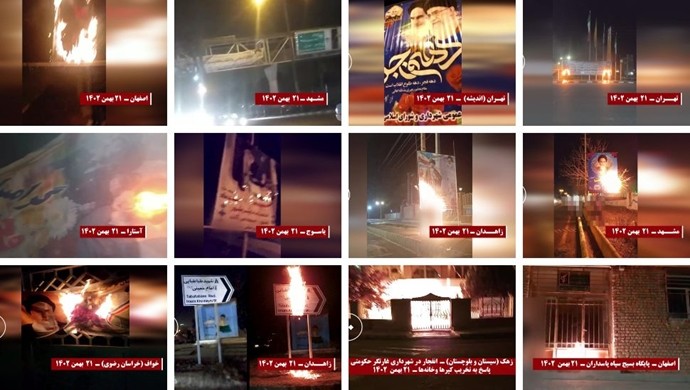

As the Iran begins its new year, reflections on the tumultuous events of the previous year reveal a nation on the brink of significant transformation. Ali Khamenei, the Supreme Leader of the Iranian regime, initially dedicated this period to suppressing the spirit of uprising and opposition. However, the path he charted to achieve this ominous goal failed, paving the way for what some expect to be a crucial revolution akin to the 1979 revolution.
Khamenei’s strategy of confrontation, aimed at stifling the emerging uprisings and anti-regime protests, had the reverse effect of strengthening the spirit of opposition and rebellion in the Iranian population. Increased repression failed to quell the flames of opposition within Iranian society, which remained vibrant and defiant.
The regime’s attempts at political cleansing, aimed at producing a completely subservient parliament, were thwarted by a widespread boycott of the elections, turning it into a public referendum that voted for regime change. Furthermore, instead of bridging internal divisions, Khamenei’s first stance after the elections focused on ending what he described as provocations and hostilities favored by enemies, highlighting the regime’s unstable situation.
This instability mirrors the last months of the Shah’s rule and reminds even those familiar with the regime of the conditions that led to the 1979 revolution. Elite guests on state television expressed their concerns, regretting that “the voice of the Iranian nation’s revolution” was heard too late.
A university professor compared the current situation to the 1970s, pointing to systematic neglect that allowed revolutionary conditions to ferment without any attention. Another academic saw today’s Iran reflecting the pre-1979 revolutionary era, citing worsening inequality and the absence of dialogue platforms as catalysts for potential unrest.
“Firstly, Iran entered this predicament in the seventies. Systematic neglect by the legal, nationalist, and reformist elites—typically characterized by their thoughtful, strategic, and non-revolutionary political approach—turned politics into a matter of dignity, inevitably leading to the waves of revolutionary conditions,” Massoud Ferasatkhah told the state-run Khabar Online on March 14. “Hence, predicting the arrival of ‘the revolution,’ he said: ‘If this situation continues, it is not unlikely that the Iranian people will be the first to want to carry out two revolutions within five decades.'”
Even members of the regime recognize these similarities and warn of the severe risks of uprising and revolution. One example is a symbol of the security apparatus who, despite using little rhetorical revolution, cited the pre-revolution period to say that a radical transformation in the country was necessary, and continuing this transformation is the people’s responsibility: “What caused the 1979 revolution and still plagues society today is increasing inequality; in the years leading up to the revolution, inequality was at its highest, and there was no organization for dialogue.”
Thus, despite challenges and difficulties, the year 1402 ended with a promising message for the Iranian people, characterized by national campaigns, heralding the prospects of significant transformation. In these circumstances, the echoes of democratic revolution, born from the 1979 revolution, are heard more clearly with the dawn of the new year. This prospect brings joy and hope to some, while instilling fear and anxiety in others, underscoring the nation’s charged anticipation for change.