

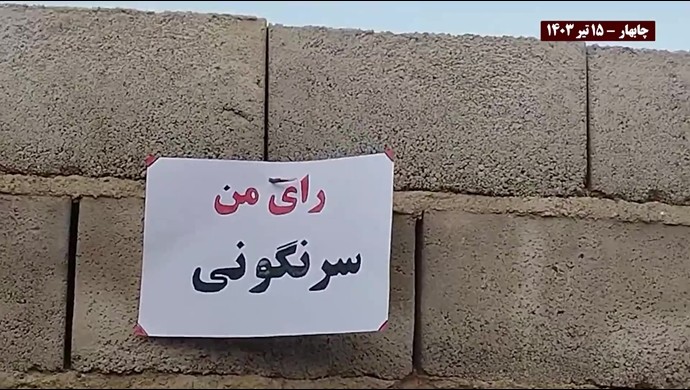

On July 5, Iran’s regime held the second round of its sham presidential election after facing a decisive boycott by 88% the Iranian people in the first round, held on June 28. Iranian regime supreme leader Ali Khamenei was forced to admit to the widespread boycott of the first round of the farcical presidential election and tried again to use the regime’s non-existent “honor” to rally the regime’s base to vote in the runoff election. But again, the people of Iran turned the election into a referendum, voting “no” to the entire regime with a massive and unprecedented boycott.
The Social Headquarters of the Mojahedin in the country monitored 2,000 fixed polling stations, sampled based on recommendations from experts.
Direct and continuous observations by PMOI Resistance Units and supporters for 16 hours across 31 provinces, including 248 cities and 60 villages, were conducted, and videos of all the stations are available.
According to the report from the Social Headquarters of the Mojahedin in the country, the number of voters in 58,640 fixed and mobile polling stations over 16 hours amounted to approximately 5,530,000. This figure includes invalid and blank ballots as well as the votes of those who were forced to vote for any reason.
Thus, the maximum participation in the second round of the sham election was about 9 percent of eligible voters, and 91 percent of the Iranian people boycotted the sham presidential election.
Khamenei, who had decided to restore “honor” and cover up his double defeat in the second round by inflating the number of participants through fraud and figure manipulation, shamelessly began laying the groundwork at the start of the voting and claimed that this time the level of “people’s enthusiasm and interest” would be higher than before. It is unclear how this news of “people’s enthusiasm and interest” reached him when there was still no sign of the ballot boxes and polling stations.
However, reports sent from some areas of Tehran to the Ministry of Interior indicate that the number of voters was lower than in the first round of voting. One of the officials at the Rasool Akram Mosque polling station in Tehran reported to the Ministry of Interior that at most times, there were no more than four people at the polling station, there were no young people among the voters, and participation in this round was half of the previous round. The polling station on North Allameh Street in Saadat Abad was closed due to lack of activity from 11 AM. Polling stations in districts 1 and 2 of Tehran were empty.
According to the report to the Provincial Election Headquarters from the polling station official at Bab al-Havaej station in Ardabil, the participation level was “very low and weak” compared to the first round.
One of the officials at the polling stations in Mashhad said that no one had come to vote even in the border villages.
In Birjand, the polling station that was the busiest during the first round of voting was closed at 3 PM this time due to low turnout. In Urmia, three polling stations were closed at noon today for the same reason. In Zahedan, thousands of worshipers passed by the polling stations indifferently after leaving the prayer hall.
In the cities of Qaemshahr, Arak, Dorud, Eslamabad-e-Gharb, Amol, Mamasani, Farsan, Hafshejan, Zahedan, Boumehen, Bukan, Mahabad, Pakdasht, Someh Sara, Talesh, Qom, and Ahvaz, there were either no voters in the afternoon or the number of visitors at polling stations was very few.
One of the police personnel in Qazvin wrote on their Telegram: “I am a police officer in Qazvin. From morning until 3 PM while on patrol, I can boldly say I have never seen the city like this; Qazvin has become a ghost town, not a soul in sight.”
In Dastgerd prison in Isfahan, prisoners refused to vote despite threats from regime authorities. Prisoners in Kahnuj and Lahijan were threatened that they must vote, and in Evin prison, prisoners in wards 4, 6, 8, and the women’s ward refused to vote.
In Hamedan, it was rumored among the inmates that if they did not vote, their monthly rations of rice, oil, sugar, and 6 million rials in cash would be cut off.
In Tehran, at Dey Hospital, patients were told that to avoid problems, they just needed to drop a ballot in the box, but only five Basij members voted.
While the regime tries to keep up appearances by inflating numbers, even state media admitted to the cold and frozen atmosphere of the second round of voting. The state-run Dideban Iran website wrote on July 5: “It seems that the past week’s reformist propaganda has not been able to break the ice for many election boycotters, and it is unlikely that the figures announced by the Ministry of Interior tomorrow will show a significant increase in voter turnout.”
Thus, the people of Iran, by boycotting the election farce across the country, delivered a hard slap and a double defeat to the regime. As Maryam Rajavi, the President-elect of the National Council of Resistance of Iran (NCRI), said, “This [boycott] represents a universal ‘no’ to religious despotism, a decisive vote by the Iranian people to overthrow regime and to establish a democratic republic.”