


There is a lot of talk about the meaning of Ali Khamenei’s purge of Iran’s universities by excluding thousands of professors and academic staff and replacing them with 15,000 figures who are aligned with the regime.
In this regard, Mohammad Reza Tajik, the former head of the Presidential Strategic Research Center, has words that are worth pondering.
Tajik, whose statements were included in an interview with the state-run Jamaran website (belonging to Hassan Khomeini), considered the “radical removal of professors as a sign of desperation” by the regime and said, “This is a desperate regime that is frightened of anything.”
In response to the question of what is the purpose of these measures and the elimination and purification of university professors, Tajik said, “It is completely clear that this is a big and strategic project aimed at survival… Only a panic about survival can be the motive in the formulation and implementation of such plans.”
Tajik warned, “This road is the road of no return, no ending, and bad outcome… This road does not lead to survival and the elevation of power, this road leads to the terrible valleys of destruction.”
Tajik added, “The concentration and purification and internalization of power, which began a few years ago, is based on a great fear of survival.”
The author of the article referred to the different dimensions and aspects of this “great survival-oriented fear” and wrote, “He is afraid of slapping and getting slapped, afraid of a picture on the wall, afraid of the harmless, afraid of the harasser…”
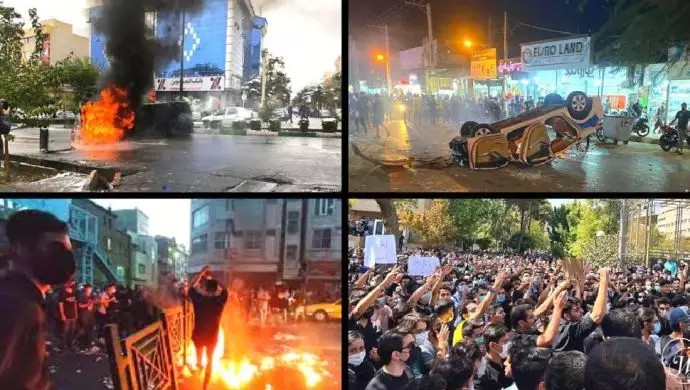
Referring to the fact that “fear” exists not in the minds of rulers but in the context of society, he adds, “The fear of an upcoming event is always visible in the discussions of some people in power, where they feel that they will face a new uprising in the future… For the time being, all their efforts are focused on the importance of getting through this period safely.”
Tajik warns, “The process of movements and uprisings in our society today has a tendency to become radicalized.” Then, in response to the question that will they reach to goal that are aiming at? He writes, “As [poet] Ismail Khoei said, the regime ‘has sown a harvest of hatred to reap a harvest of anger’. They are unaware of the fact that this latent anger and hatred will open up somewhere and permeate through an opening, and they will face a phenomenon that does not fit into any of their analytical and estimation frameworks.”
The Iranian Resistance had previously said that by appointing Ebrahim Raisi as his regime’s president, Khamenei is effectively shooting himself in the foot. The goal to consolidate power within his own faction has not served the purpose that Khamenei had hoped for.
Indeed, the Supreme Leader selected Raisi for closing the endless gaps hoping to block the upcoming uprisings. But Khamenei has effectively dug the grave of his own regime, and like a scorpion being surrounded by fire, the regime will finally sting itself. Nothing but the fear of an uprising explains the presidency of Raisi, whose main achievement is the execution of thousands of PMOI members in 1988. Even Hossein Ali Montazeri, the former successor of regime founder Ruhollah Khomeini had warned in 1988 that Raisi was among those who committed the biggest crime in this regime and in the future, and his name will be written among the criminals of history.