

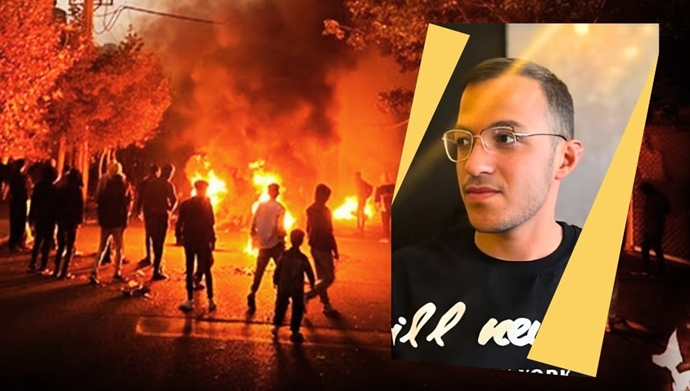

The scene has seared itself into the conscience of Iran: a 20-year-old student, Ahmad Baledi, engulfed in flames, yet still lunging to defend his mother from the attacks of Iranian regime thugs.
His tragic death on November 11, days after he set himself on fire to protest the destruction of his family’s humble food stall, has become far more than a personal tragedy. It is a political earthquake that has exposed the mortal fear at the heart of the clerical regime. The regime’s panicked, two-faced reaction—swinging from brutal threats to the clumsy dismissal of scapegoats—is definitive proof that it has lost control in the face of a nation’s explosive anger.
Phase one of panic: the iron fist fails
The regime’s initial response was predictable: brute force. On November 7, the judiciary in Khuzestan issued an official statement, threatening that any individual or group who tried to “exploit this incident to disrupt calm and security” would be dealt with harshly. But decades of oppression have rendered such threats meaningless. The people are no longer afraid. This was powerfully demonstrated by Ahmad’s father, who defiantly declared, “We will not hold a funeral or accept the body until” the mayor and another official are removed from the city.
November 11—Ahvaz, southwest Iran
At the funeral of 20-year-old student Ahmad Baledi, who died after self-immolating in protest of the destruction of his family’s stall by city and police forces, mourners expressed anger and grief.
His father declared: “I won’t take my son’s body… https://t.co/q6IpmuhgD6 pic.twitter.com/BPIxKOanY8— People's Mojahedin Organization of Iran (PMOI/MEK) (@Mojahedineng) November 12, 2025
The regime’s own state-run media has been forced to acknowledge this reality. On November 12, the Etemad newspaper warned that a “significant portion of unemployed youth have a feeling of ‘having reached the end of the line.’ This means the people are past their breaking point, and you should not expect threats and intimidation to prevent an explosion.”
Phase two of panic: the ‘safety valve’ ploy
With its intimidation tactics failing, the terrified regime was forced to “switch gears.” It abandoned its iron fist for a clumsy strategy of deception and appeasement, designed to release public pressure. First, regime President Masoud Pezeshkian made a vulgar attempt to offer condolences to the family and promise an investigation. Then, fearing the spread of protests, the provincial governor announced the resignations of the Ahvaz mayor, a district mayor, his deputy, and an executive official. This is a classic dictatorial tactic: creating a “safety valve” by sacrificing disposable, low-level pawns to absorb public anger and protect the true criminals at the top. This is not justice; it is a cynical maneuver to prevent the fire that consumed Ahmad from spreading to the entire system.
The real culprit and the inevitable reckoning
But the Iranian people will not be fooled. The revolutionary youth of Iran know full well that the prime suspect in this case is not some local bureaucrat, but Ali Khamenei himself. It is his corrupt mafias that plunder the nation’s wealth, driving families like the Baledis to utter destitution. The flames that consumed Ahmad’s body are a symbol of the fire that the Iranian people will soon use to burn down Khamenei’s entire house of oppression and his “spider’s web” of power.
Salute to Ahmad Baledi, the brave son of the people of Ahvaz, who lost his life in protest against the inhuman and plundering clerical regime. The newly released reports and videos of his self-immolation have stirred widespread outrage, exposing the deliberate and conscious role…
— Maryam Rajavi (@Maryam_Rajavi) November 12, 2025
The resignation of a mayor and the dismissal of a few other officials is not enough. As Mrs. Rajavi, the president-elect of the National Council of Resistance of Iran (NCRI) said after the tragic death of Baledi, “The principal culprit behind this and hundreds, indeed thousands, of other atrocities across our enchained homeland is Ali Khamenei himself, who for decades has spared no crime or act of plunder to preserve the vile rule of Velayat-e Faqih.”