

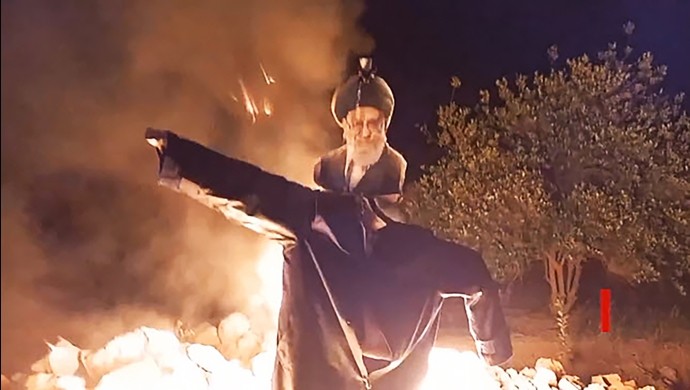

The Iranian regime’s admission in official statistics that the sham presidential elections on June 28 witnessed the “lowest participation” in the regime’s history marked a catastrophic defeat for the entire regime and for Iranian regime supreme leader Ali Khamenei personally. This was because Khamenei had begged and insisted on “high participation” the most and even secured cooperation from previous regime presidents and disenchanted officials such as Hassan Rouhani, Mohammad Khatami and Ali Larijani.
Three days before the elections, Khamenei said, “The high participation that we insist on is because the most important effect of high participation is the pride of the Islamic Republic. In any election where participation has been low, the tongues of the enemies and envious of the Islamic Republic have been unleashed. They have blamed us. When participation is high, the tongues of the slanderers are silenced. They cannot blame us. They cannot rejoice. We do not want to make the enemy happy. This is why I insist on high participation.”
The desperate Supreme Leader, on the morning of the elections, did not miss the opportunity at the ballot box and emphasized that participation “is an absolute necessity… The survival of the Islamic Republic, the strength of the Islamic Republic, the dignity of the Islamic Republic, and the reputation of the Islamic Republic in the world depend on the presence of the people.”
However, the people of Iran struck Khamenei and all the factions of the clerical government with the hammer of a crushing boycott so hard that he was forced to admit “the lowest participation” in his official statistics, and regime media reflected this with phrases such as “complete collapse,” “vote drought,” and “unexpected participation.”
On July 1, the state-run Ebtekar newspaper wrote, “The voter turnout in the March parliamentary elections was reported to be only 41 percent, and in Tehran, the turnout was only 24 percent, which is the lowest in the history of the Islamic Republic. This is the third time in the past four years, including two parliamentary elections and one presidential election, that the voter turnout has been less than 50 percent. Therefore, considering the decline in voter turnout and the three protest movements between 2017 and 2019 across the country, the decline in election participation will put the Iranian political system in a legitimacy crisis.”
Etemad newspaper, with a veiled reference to Khamenei’s last plea on the morning of June 28, warned: “On June 28, the flag of diversity and competition was raised, but the banner of bringing the masses to the scene was grounded, and the election, with its dual nature, changed the course of Iranian politics… With this event, although Pasteur [the presidential palace] is handed over to a new figure, the alarm of the blazing fire within society brings double the concern. In any case, the paradox and duality of Iranian democracy in the June 28 election ended with the Islamic Republic of Iran receiving a greater warning than before due to the absence of the masses.”
A day after the regime’s catastrophic defeat, Maryam Rajavi, the President-elect of the National Council of resistance of Iran (NCRI(, at the Free Iran Global Summit, said: “This election reflects the clerical regime’s utter political and strategic desperation. A bloodthirsty mullah and five criminal IRGC members epitomize above all, the regime’s empty hands in this final stage. The statistics and even the number of invalid votes showcase the regime’s declining social base.
“Direct monitoring and observation from the beginning to the end of the so-called voting, from 8 am to 12 am at over 14,000 polling stations by the PMOI sympathizers, indicate that the boycott struck a sledgehammer blow to the regime, with 88 percent of Iranians abstaining from the fraudulent elections. Only 12 percent of eligible voters –fewer than 7.4 million people– turned out. This figure includes those who voted voluntarily, those who were coerced to the ballot box through various schemes, and those who cast invalid or blank ballots.
“This overwhelming abstention represents the Iranian people’s decisive rejection of dictatorship and their clear vote for the regime’s overthrow, signaling the impending victory of a free Iran under a democratic republic.”