

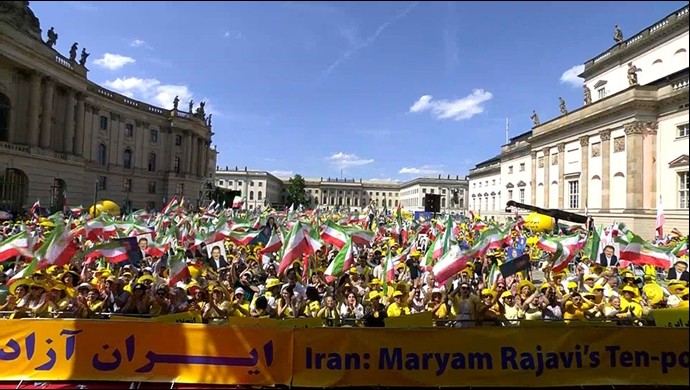

The holding of the Free Iran World Summit just one day after the Iranian regime’s disgraceful failure in the sham presidential elections displayed the two sides of Iran to the world. On one side, there is the religious fascism that has reached the end of its line and has been boycotted by 88% of the Iranian people. On the other side, there is a shining resistance that, with its magnificent rally and summit, managed a real display of the will of the Iranian people. This summit encompassed all components of the Iranian resistance, from the heroic Resistance Units inside Iran to the large demonstration of freedom-loving Iranians and Resistance supporters in the streets of Berlin to the participants in the Free Iran World Summit, from the long and brilliant lineup of speakers and international figures to messages of support from various points and thousands of people who participated live.
The Image of Free Iran
The 88% boycott of the farce election reflects the heartfelt desire of the Iranian people for change. The essence of this change is the overthrow of religious fascism with all its factions. The vanguard and guide of real change in Iran is a democratic alternative embodied by the Ten-Point Plan of Mrs. Maryam Rajavi, the president-elect of the National Council of Resistance of Iran (NCRI). This plan has been supported by a majority of 34 legislative assemblies and over 4,000 elected representatives of the people from the United States, United Kingdom, Canada, Australia, Latin American countries, Europe, Arab, and African countries, as well as many international personalities and former world leaders. This represents a high ceiling of credibility, recognition, and international acceptance and popularity. As Alexandra Acosta, the U.S. Secretary of Labor (2017-2019), said, the Iranian resistance has formed a democratic shadow government beyond just being an opposition.
Therefore, both the problem and the solution are clear. The people do not want this evil regime; what they want is a free Iran without torture and execution, a democratic republic with the separation of religion and state, gender equality, and autonomy for oppressed nationalities.
What is the Obstacle?
The main obstacle to change in Iran is the policy of appeasement with the mullahs’ regime, which has made the world less safe and has come at a heavy cost to the people of Iran and the regime.
While this policy pretends to oppose the clerics’ warmongering and terrorism in the Middle East and the world, it builds the engines for their drones and supplies them with parts. It defies its own court rulings by generously handing over terrorist diplomats and the executioner of the 1988 massacre to the Iranian regime. Despite the Iranian Resistance repeatedly exposing the regime’s secret nuclear sites, it paves the way for them to build an atomic bomb by granting large concessions. Despite the IRGC’s notorious role in exporting terror and crisis, it avoids blacklisting it under various pretexts. Instead, it does everything it can to hinder the democratic alternative to this regime, erecting various obstacles.
The architects and proponents of this policy, by supporting religious fascism, stand on the wrong side of history. This was also the case during the time of the late Prime Minister Mohammad Mossadegh. This dirty policy will undoubtedly be judged by history.
The Right Side of History
Although appeasing governments hinder change in Iran for the sake of unearned benefits, many honorable individuals and conscientious voices from Europe, America, Australia, Canada, Arab, and Islamic countries stand with the Iranian resistance. Their support statements were presented to Mrs. Rajavi at the Free Iran World Summit.
They, like Former Italian Prime Minister Matteo Renzi, consider the freedom of Iran a “moral duty.” They believe that the Iranian resistance fights not only for the people of Iran and not just for the Middle East but for the entire world because dictatorship is a threat to the whole world.
They find their cultural roots in the values of Maryam Rajavi’s Ten-Point Plan; values that, according to Former US Special Envoy for Northern Ireland Mitchell Reiss, “are enshrined in the US Constitution and the Universal Declaration of Human Rights, appealing to people everywhere who cherish freedom and democracy.”
They, like Former Romanian Prime Minister Petre Roman, believe that “When diplomacy is a mask devoid of moral values, then behind the mask is cowardice and vested interest. And the result is never good, neither for the people, nor for the countries. That’s the case right now in Iran.
Like German MEP Niels Goekeng, they acknowledge the Iranian people’s desire for change and their boycott of the regime’s sham elections. Accordingly, they believe that “democratic countries must support them. We must end the trade with death. The EU must follow a stronger policy against the regime, recognize the right of the Iranian people to oppose the dictatorship, and recognize the NCRI as the opposition because the Ten-Point Plan is a new basis for a democratic Iran. That is the Iran we all envision and would like to create together.”
Like Former Prime Minister of Iceland Geir Haarde, they emphasize that “appeasement has not worked. Not in this case, not ever,” and “the struggle for freedom and democracy in Iran is a universal fight for human rights and dignity, for the protection of our own justice and democratic systems, and it’s time for the free world to support the legitimacy of the NCRI and its Resistance Units.”
They see this resistance as the true voice of Iran and, like Ambassador Robert Joseph, Former US Under Secretary, Arms Control and International Security, believe that “It is the duty of all civilized nations to support the Iranian people in their fight for freedom… The entire international community must stop being the lifeline that sustains the evil oppression of the Persian nation for far too long… All nations should demonstrate political support for the democratic opposition and advocate for a free, democratic, secular, and non-nuclear Iran, as outlined in the Ten-Point Plan.”