

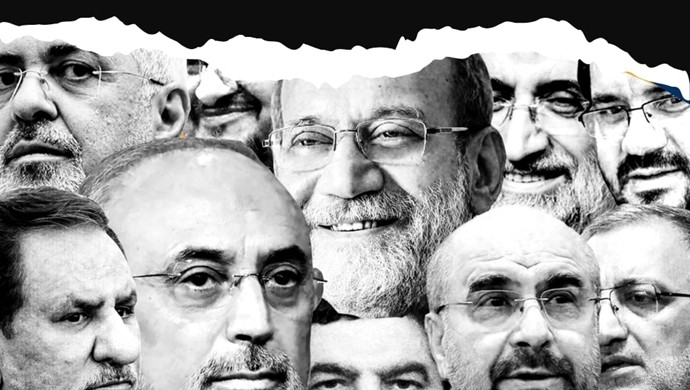

Iranian regime supreme leader Ali Khamenei had been preparing for the rise of Ebrahim Raisi since 2019, when he called for the assembly of a “Young Hezbollahi Government.” Through a well-planned and long-term process, and by eliminating all internal factions, he placed Raisi in the presidential seat.
Khamenei knew that his regime would face severe storms, which could only be countered by a completely obedient pawn who had burned all bridges behind him. This was the only way to confront popular uprisings and extend the regime’s survival.
However, Raisi’s sudden death overturned all the arrangements Khamenei had made, leaving him unprepared amid the widespread crises facing the regime.
As a result, a severe blow was dealt to the entire governing system. Initially, Khamenei claimed it was not very significant and “would not disrupt the country’s affairs,” but it soon became clear that the issue was much more extensive, amounting to a “major shock” to all pillars of the regime.
On June 5, the state-run Ham-Mihan newspaper wrote, “The martyrdom of the late Mr. Raisi and the power vacuum in the position of the country’s second-in-command caused a major shock to all areas related to governance.”
For this reason, the apparent order and planned “purification” of his regime quickly unraveled, and all the political vultures within the regime, whom Khamenei thought he had controlled for at least another year until the end of Raisi’s first term, came out of their nests.
From former president Mahmoud Ahmadinejad, a troublemaker whom Khamenei had temporarily silenced, to Ali Larijani, a high-profile regime politician whose disqualification in the 2021 presidential election had cost Khamenei greatly, and to Mohammad Bager Ghalibaf, who was supposed to freeze some of the regime’s legislative crises with his new position as head of the Majlis (parliament). Figures like Eshaq Jahangiri Kouhshahi (vice president of Hassan Rouhani’s government) and Abdonnaser Hemmati (former governor central bank), and individuals like the Vahid Haghanian from Khamenei’s office, former chief nuclear negotiator Saeed Jalili, Tehran mayor Alireza Zakani, and Mostafa Pourmohammadi, another key figure in the massacre of political prisoners in 1988, all rushed to register for the upcoming presidential elections.
In this regard, Abbas Moussayi, a member of the political bureau of the regime’s National Development Party, said: “This kind of mass registration is a clear sign of underdevelopment, reductionism in political affairs, political vulgarity, public ugliness, the caricaturization of the election concept, the growth of negative populism in politics, political irresponsibility, the dominance of appearance and ritualism, and in a word, the crisis of politics and political affairs.” (Chandsanieh Telegram channel, June 3, 2024)
But this vulgarity did not remain at this level and reached the very thing Khamenei feared: infighting and factional “struggles,” particularly among his own ranks. Despite Khamenei’s emphasis in his last speech at Khomeini’s tomb, urging candidates to avoid “slandering, accusing, and muckraking” that “would not harm the regime’s reputation,” the first stage of registrations was accompanied by “muckraking” between different individuals and factions.
A video of Mojtaba Zonnour a shi’a cleric was released in which he quoted the former IRGC Quds Force commander Qasem Soleimani, as saying, “If Jalili becomes president, I will not stay in Quds for even one day” (Source: Eghtesad News website, May 28).
Another round of conflict occurred between Vahid Haghanian and the IRGC-run Tasnim News Agency, indicating deep contradictions within the closest layers around the Supreme Leader’s household.
Ghalibaf’s candidacy also revealed other contradictions within the Majlis (parliament).
On June 5, Fararu news website quoted Gholam Ali Jafarzadeh Imenabadi, a former parliament member, posted on X, “I told the independents in the Presidium election that voting for Ghalibaf is a betrayal to the system. They said he promised not to run for president. I said Ghalibaf adheres to no principles and is power-hungry…. After Ghalibaf’s registration, they said we made a mistake”
This level of “muckraking” following Khamenei’s emphasis stems from the same crisis and “major shock” that has shaken the body and pillars of the regime.
Thus, it is quite clear that Khamenei has lost control, and he is facing a set of contradictions, each of which could spark new protests in an explosive and simmering society.
He has become much weaker with the loss of his aide, and no one pays any heed to his orders to observe “ethics” and calm the atmosphere anymore. Especially since all the candidates know that given his frail condition, the person who emerges from the ballot box might very well be Khamenei’s last president.
In the March parliamentary elections, when Raisi was still alive, Khamenei managed to get only eight percent to the polls in spite of the fraudulent statistics manipulations of his regime. And in the second round, he couldn’t muster more than three percent. Certainly, in the new round without Raisi, along with the new round of infighting, the situation will be even more disastrous for him.