

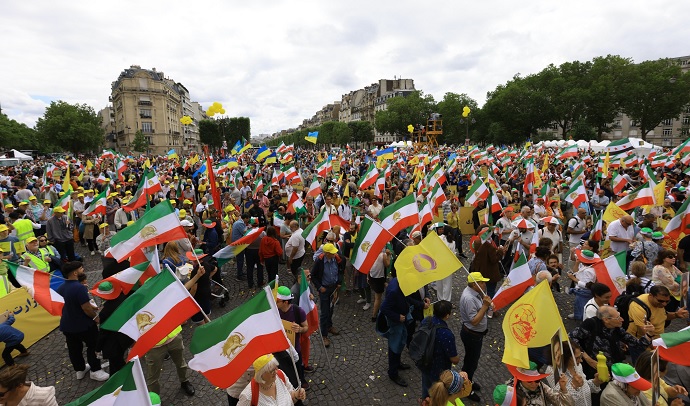

As the Iranian regime’s factions compete for the upcoming elections, the candidates inevitably acknowledge the reality of regime’s main issue: In the past 45 years, the main confrontation has been between the PMOI and the Iranian Resistance on the one side and the mullahs’ regime on the other.
In an interview with state television on June 13, Mostafa Pourmohammadi, one of those responsible for the 1988 massacre of political prisoners, whose presence in these elections to fill the void left by Ebrahim Raisi has its own special meaning, in his campaign programs, while trying to remind regime supreme leader Ali Khamenei of the service he did for the regime by massacring the PMOI, inadvertently pointed to the main issue: “I was appointed as the revolutionary prosecutor in June 1981. After that, a major mission, a major case was assigned to us in Tehran… In the last year of the war, which was 1988, there were continuous operations, the last of which was Eternal Light (Forugh Javidan). The PMOI wanted to conquer Tehran and take control. That year, according to them, they captured 2,300 of our soldiers, officers, and Basijis at the front and took them to their independent camp.”
Referring to the PMOI’s war with the regime, Pourmohammadi added: “In the recent statistics we collected, according to the organization’s own admission and all the statements issued, our information is completely accurate and reliable. Nearly 78,000 Basijis and IRGC members have been killed or injured by this organization.”
In the same program, Pourmohammadi, referring to his security, intelligence, and judicial background, assured the Supreme Leader that if he were appointed instead of Raisi, he would enhance both internal and external security.
Two days later, in another of his campaign programs, Pourmohammadi once again referred to the “activities of the Mojahedin and their depth and breadth, which was the most important issue” for the regime, and said:
“When I entered the Ministry of Interior, one of our most important issues was dealing with the activities of the Mojahedin. I became familiar with its depth and breadth during this period. I was already familiar as the Revolutionary Court dealt a lot with them… The history of the Mojahedin is really still not revealed. According to their own admission and credible documents, they killed or wounded 78,000 people, of which only 17,000 were urban assassinations, mostly carried out by the Mojahedin. In Operation Eternal Light, they wanted to reach Tehran” (Regime TV, June 15).
It is worth that after the rise of the justice-seeking movement for the victims of the 1988 massacre, Pourmohammadi noted that the regime’s existential war with the Mojahedin is still ongoing and has not yet been resolved. On July 25, 2019, he explicitly said, “We have not yet settled accounts with the Mojahedin,” and since “they are the most hostile enemies of this system, we must deal with each one of them. Unfortunately, due to the psychological atmosphere or the ignorance of some and the stupidity of others, now we are indebted? We have to answer? The criminals should come and answer… and they should be tried in court and sentenced to the maximum punishment.”
Masoud Pezeshkian, who has entered the elections with the slogan of reforms, has also acknowledged this reality and this fateful war. Wanting to recount the events at the beginning of the Iran-Iraq war, he inevitably acknowledged the participation of the PMOI in defending Iran in their independent ranks and their protest against government obstructions. In an interview with the regime’s television on June 13, he said: “When the war started, the front needed forces, we set up the Islamic Association because there was a group of Mojahedin… They were arguing, saying, ‘The country does not belong to you. We want to come and defend the country.'”
In another electoral debate, Abbas Abdi, the former deputy prosecutor of the regime, compared the disqualifications in this period to the first presidential elections in Iran after the 1979 revolution. In this comparison, he referred to the disqualification of Iranian resistance leader Massoud Rajavi by regime supreme leader Ruhollah Khomeini for political reasons and because he had a voter base, stating: “At that time, they disqualified only one person politically, and that was Massoud Rajavi. He had a different logic because Massoud Rajavi had a voter base, but the others who had a serious voter base were all approved.”
Regardless of the starting point of the speakers of these statements, one important reality is revealed among them: the PMOI have been the main alternative to the regime in the political and social arena of Iran from day one and still are today.