

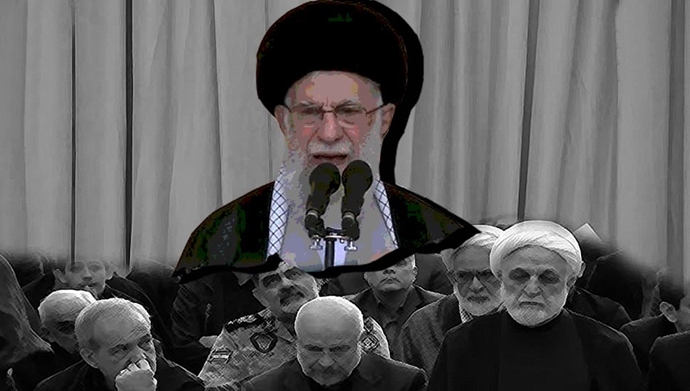

On Friday, January 31, 2025, Friday prayer leaders across various cities in Iran, who are representatives of regime supreme leader Ali Khamenei, coordinated attacks on advocates of negotiations. In Ahvaz, Abdolnabi Mousavi-Fard stated that “America’s demands are to halt the nuclear program, impose military restrictions, and cut Iran’s regional influence.” He warned negotiation supporters by reminding them of the fate of governments like Libya and Syria, adding: “Those who have buried their heads in the sand should know that these situations can also happen to Iran.”
In Sari, Mohammad Bagher Mohammadi Laini stated that naive or traitorous individuals within the country are trying to bring the regime to the negotiating table with the United States, saying: “Negotiating with Satan means surrendering to Satan.”
In Mashhad, cleric Ahmad Alamolhoda described negotiation advocates as “a group of power-seekers and opportunists from marginalized and deviant political factions” who want to “auction off the revolution.”
In addition to Khamenei’s provincial representatives, members of the regime’s parliament and state-aligned newspapers also launched fierce attacks against those advocating negotiations with the United States.
On January 29, the IRGC-affiliated newspaper Javan published an article titled “Negotiating with the Current U.S. Government Is a Double Poison,” in which it launched a barrage of insults at negotiation advocates, calling them “intimidated or infatuated with the West (West-struck),” “short-sighted comfort-seekers,” “infiltrators,” and “a domestic media network collaborating with the West,” among other labels. The article claimed: “Their argument is that the only solution… is direct negotiations with the U.S. and granting any concessions to lift sanctions.”
Khamenei’s mouthpiece, Kayhan, also published an editorial on February 30 titled “A Naive Dream or a Mercenary Approach?!” harshly denouncing those advocating negotiations with the United States.
Meanwhile, newspapers linked to the so-called reformist faction continue to push for negotiations, though they do not conceal their frustration. On January 30, the state-run daily Shargh published an article titled “Tehran’s Green Light and the West’s Blackout,” detailing multiple instances where Iranian officials—including Majid Takht-Ravanchi, Javad Zarif, Masoud Pezeshkian, Kazem Gharibabadi, and Mohammad Reza Aref—had signaled willingness to negotiate. The article highlighted a statement by Mohammad-Reza Aref, Pezeshkian’s Vice President, who declared: “There is no solution for saving the country other than dialogue.” Shargh then expressed disappointment, noting that “there is no sign of how Tehran-Washington interactions and negotiations will take place under the Trump administration.”
In addition to the so-called reformists within the regime, some figures from the hardline principlist faction—who previously derided negotiations as “begging diplomacy”—are now signaling willingness to negotiate. Among them, Hamid-Reza Haji Babaee, Deputy Speaker of the regime’s parliament, stated, “We are open to negotiations and have no enmity or war with the United States.” He added, “Our country is the first nation that believes in negotiations! We are willing to negotiate with any country in the world except the Zionist regime, even the United States.”
Interestingly, amid this “begging diplomacy,” both supporters and opponents of negotiations are justifying their stance by referring to Khamenei. On January 28, Khamenei made an ambiguous statement, saying: “We must be careful about who we are dealing with, who we are negotiating with, and what we are talking about.”
Regime officials and state-affiliated writers unanimously acknowledge in their statements that expressing willingness to negotiate does not benefit the regime and merely reflects its desperation and weakness. On December 8, 2024, Kayhan described requests for negotiations from regime officials as “a recipe for surrender disguised as negotiations with America.” The article further characterized negotiation advocates as a group that is “either asleep, drunk, or insane.”
Abolfazl Zohrevand, a former regime diplomat and a current member of the parliament’s National Security and Foreign Policy Commission, described the regime’s desperation and calls for negotiations in a televised interview on January 29. He stated: “The relationship between sanctions and our demands is like George Floyd’s neck under the knee of an American police officer, who says, ‘I will only lift my knee so you can take a breath,’ but nothing actually changes. Even if they provide guarantees on these last two or three remaining clauses, I say go ahead and sign, but this will only be the beginning of your troubles. Therefore, we must move past FATF and similar issues, as JCPOA 2 would be dangerous for us.”