

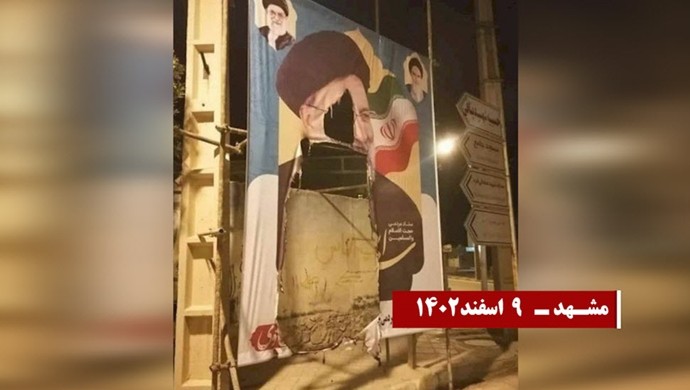

In a stunning admission that peels back the Iranian regime’s facade of control, a senior cleric has publicly confirmed the effectiveness and organizational capacity of the People’s Mojahedin Organization of Iran (PMOI/MEK)’s Resistance Units. During a speech riddled with fear and paranoia, Ahmad Khatami, a member of the powerful Assembly of Experts and Guardian Council, inadvertently detailed the tactics of the resistance network, revealing the regime’s profound anxiety over a “swift overthrow” orchestrated from within.
His remarks, delivered to a group of Basij paramilitary members in Varamin on June 5, represent a dramatic departure from the regime’s long-standing narrative that dismisses internal dissent as sporadic, unorganized rioting. Instead, Khatami’s words paint a picture of a theocracy haunted by a disciplined and effective opposition network that is fully organized and is successfully breaking the climate of fear.
A stunning admission of organized resistance
In his speech, Khatami, visibly agitated and at one point confusing the protest year of 2022 with 2021, gave a surprisingly detailed account of the Resistance Units’ methods. He described how activists were being directed to carry out specific acts of defiance and document them.
“The 2021 sedition, the 2021 unrest, was for a swift overthrow, it was overt,” he exclaimed. “The slogans that they told the poor people to write in the streets and alleys… ‘if you write such-and-such slogan in the alleys, take a picture and send it to us’.”
This description is a direct acknowledgment of the decentralized, cell-based structure of the Resistance Units, whose members carry out acts of defiance like writing anti-regime slogans and displaying images of Resistance leaders in public spaces and organizing protests. By confirming that these actions are coordinated and documented, Khatami validates the PMOI’s strategy of persistent, visible opposition. He went on to explicitly name the source of the regime’s fear: “The agents and operators of these were the monafeghin (a derogatory term for the PMOI). The anti-people monafeghin, the murderous monafeghin, they were their agents.”
From denial to panicked confession
For years, the Iranian regime has attempted to portray popular protests as either foreign-backed conspiracies with no internal base or the work of scattered, leaderless mobs. Khatami’s speech signals a critical shift in this narrative. His admission that the protests are part of a coordinated campaign for a “swift overthrow” is a confession that the regime now faces a real, organized domestic threat with the capacity to topple it.
In a desperate attempt to externalize this internal threat, Khatami made the outlandish claim that “America spent a year’s budget of a country on this unrest.” While a baseless piece of propaganda, this hyperbole reveals the magnitude of the threat as perceived by the regime. They see the Resistance Units not as a minor nuisance, but as a challenge so significant that they have to go to extra lengths to discredit them through washed out lies. This is an implicit admission of the Resistance’s strategic depth and impact.
The IRGC’s media echoes the alarm
Khatami’s panic is not an isolated incident; it reflects a broader anxiety gripping the regime’s security apparatus. The Islamic Revolutionary Guard Corps (IRGC) has voiced identical fears through its official media outlets.
In an article published by its Fars News Agency on May 28, the IRGC warned that the PMOI is actively working to foster dissent. “Evidence shows that this group is again seeking to disturb public opinion and create unrest in society,” the article stated. It further noted that “one of the PMOI’s actions inside the country in recent years has been to create turmoil and internal violence and to provide material and spiritual support for the continuation of unrest and tensions.”
Crucially, the IRGC piece revealed the regime’s fear that the Resistance Units will successfully merge their political activities with grassroots social protests. Referring to the recent nationwide strikes by truck drivers, the outlet warned that the PMOI is trying to “turn the protests of some truck drivers into a capacity to confront the system and, by extending it to the whole of society, finalize the project of chaos.” This demonstrates the regime’s terror of the PMOI’s ability to organize and channel the widespread public anger over economic collapse and repression into a unified force for regime change.