

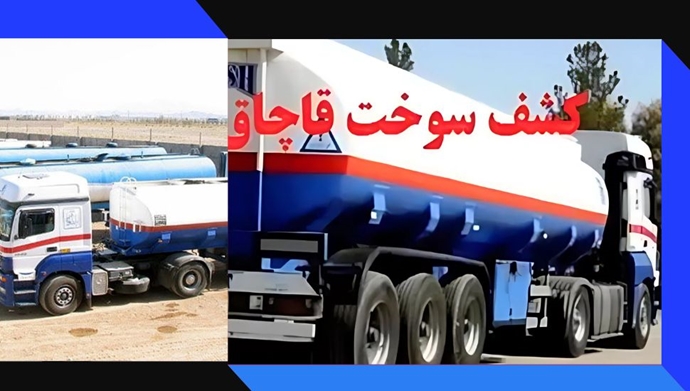

In the days leading up to the impeachment of Iranian regime oil minister Abdolnasser Hemmati, regime supreme leader Ali Khamenei inadvertently revealed a clue regarding the dispute over the smuggling of millions of liters of fuel. He brought up the issue of fuel smuggling at every opportunity, with or without introduction, saying, “Twenty million liters of diesel are smuggled daily. Now, the question is, who is taking this huge volume of reserves out of the country? It’s not like someone can carry diesel across the border by hand or in small barrels. This volume of smuggling requires an extensive network, so it needs to be determined who is involved in this cycle.”
The Iranian regime president, Masoud Pezeshkian, in an attempt to increase the stakes in the impeachment battle, pointed out that “Diesel is not a commodity that can be easily collected from the market and smuggled. This volume of transfer requires an extensive transportation chain that must be stopped…” (Jamaran news website, February 26, 2025).
On the same day, speaking to a gathering of government officials, he alluded to those who openly “buy diesel for 3,000 rials and pocket huge sums by selling it for 600,000-700,000 rials,” saying: “Some people do nothing. Who are these smugglers? Diesel is not a separate well. They buy diesel, then empty it, then come back, refill, empty it again, and then smuggle 20 million, 10 million, 30 million liters. Why does this have to happen every day?”
The next day, while mentioning that the “smuggling brothers” had plundered the oil in the government’s silence, he said, “We must manage this. This is something we must help each other with, not that everyone can plunder from one corner and we just watch and remain silent” (state-run TV, February 27, 2025).
On the same day, a state-run newspaper, in an article titled “Mr. Pezeshkian! Do not interfere in our work,” wrote: “According to your own statistics, about 4 billion liters of diesel have been smuggled in the 200 days that you have been president. For your information, the price of each liter of diesel in Pakistan is close to one dollar, and in Turkey it is about 1.3 dollars (about 1.2 million rials per liter). With this calculation, in just these 200 days, the same smugglers you ask who they are have cost the country over 4 billion dollars just in diesel smuggling. Of course, they naturally sold it for less than that (it’s not their father’s property), but the value of the diesel they smuggled is in this range. Not to mention the smuggling of gasoline, which is a similar story.”
Hemmati himself, in his remarks to the regime’s parliament before his removal, attacked the “smuggling brothers” who had violated the rules of the game, saying: “Smuggling is not in the hands of customs. We have over 30 billion dollars in smuggling in this country. It’s very bad, I swear to God. We talk about this issue every day. They say, ‘Minister of Economy!’ What should the Minister of Economy do about smuggling? When 20 million liters of diesel go out every day, what should the Minister of Economy do?… Should I go and stop the smuggling? It’s really alright if Hemmati has to stop the smuggling, see whose hands these docks are in? Who is doing this smuggling? I have absolutely no idea.”
Hemmati then fired his final shot by raising the issue of “rent-seekers” and added, “Our nation is caught in the clutches of smugglers who profit from sanctions and rent-seekers. Whether you want it or not, eighty percent of our people are being crushed because of the costs that these people impose on the nation.”
The efforts of Hemmati and Pezeshkian to bargain and maintain the “rent-seeking unity” came to nothing, and Hemmati was removed on Sunday, March 2. But in this affair, it became clear that the gentlemen were aware of the large-scale corruption of the Islamic Revolutionary Guard Corps (IRGC) and those profiting from sanctions within Khamenei’s inner circle from day one but did not speak up, until the power struggle and plunder partially lifted the veil from this aspect of government corruption—of course, to a limited extent and with consideration for the interests of the regime.