

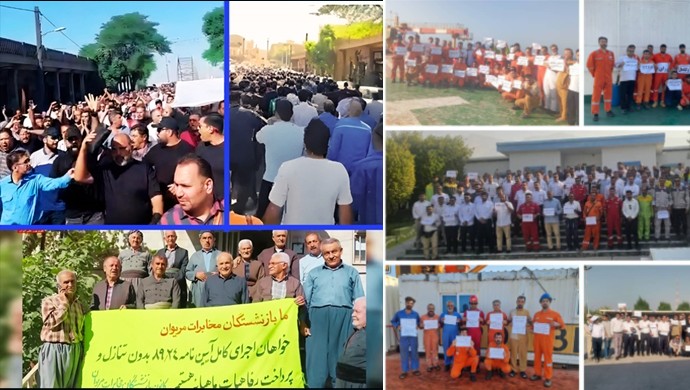

On September 28 and 29, 2025, the streets of Iran once again erupted with the roar of a nation pushed to its breaking point. A tidal wave of protests, from steelworkers in Ahvaz and retirees in dozens of cities to students in Tehran, swept across the country, exposing the clerical regime’s profound incompetence. Yet, while the courage of the Iranian people was on full display, the most damning evidence of the regime’s fragility came from within its own ranks. Haunted by the specter of another nationwide uprising, its state-controlled media, internal officials, and judiciary are now openly broadcasting their terror of “protest riots” and the “emergence of a revolution.” This fear, however, is leading not to reform but to intensified repression, creating a vicious cycle that is accelerating its path toward collapse.
The writing on the wall: the regime admits its own instability
The regime’s fear is no longer a secret; it is a matter of public record, discussed openly by its own affiliates. On September 29, the IRGC-affiliated Javan newspaper bluntly warned that “if inflation is not contained, it will become a factor for the spread of dissatisfaction.”
This sentiment was echoed by a figure from the so-called reformist faction, Ahmad Zeidabadi, who cautioned on September 28 that destabilizing forces have “internal support” in Iran from those who believe change can only be achieved through “overthrow.” Most starkly, a government expert, writing for the state-affiliated Jamaran website on September 29, laid out the exact scenario the regime fears: as the government fails to provide basic services like medicine, water, and electricity, its authority will weaken, leading to “protest riots” until “society will witness the emergence of a revolution.”
A symphony of dissent: why the regime is terrified
More footage of INSIG workers in Ahvaz. Protesters chant:
"Workers will die but won't accept humiliation"#IranProtests pic.twitter.com/UrypKYcsNr— People's Mojahedin Organization of Iran (PMOI/MEK) (@Mojahedineng) September 29, 2025
The regime’s terror is a direct response to the unprecedented scope and political clarity of the recent protests. This is no longer just a series of economic grievances but a nationwide rejection of the entire corrupt theocracy.
In a coordinated movement across dozens of cities, telecommunications retirees directed their anger at the financial empires controlled by the regime’s elite, explicitly chanting against the Supreme Leader’s “Executive Headquarters of Imam’s Directive” (Setad Ejraiye Farman Imam) and the IRGC Cooperative Foundation. Slogans like “Neither parliament, nor the government, cares for the nation!” and “The state broadcaster is a disgrace!” echoed from Isfahan to Shush, demonstrating a complete loss of faith in all state institutions.
In Ahvaz, steelworkers marched with chants of “Hussein, Hussein, is their slogan; lies and theft, their work!”—a direct indictment of a leadership that cloaks its plunder in religious piety. It is this unity of purpose and the evolution of slogans into direct political condemnations that terrifies the regime.
September 29—Kermanshah, western Iran
Retirees of Telecommunications Company of Iran (TCI) protest injustice and mismanagement by regime-linked institutions blocking their benefits.
Chants: “The Execution of Imam’s Order HQ has hijacked TCI & stolen our rights!”#IranProtests pic.twitter.com/jIKal4G687— People's Mojahedin Organization of Iran (PMOI/MEK) (@Mojahedineng) September 29, 2025
Lashing out in panic: repression as the only response
Trapped in a “complete deadlock” and unable to solve the nation’s profound crises, the regime has resorted to its only tool: brute force and intimidation. Its panic was palpable on September 28, when the parliament held a secret, closed-door session just hours after the UN snapback mechanism was triggered, to discuss what its speaker called “serious challenges” to the people’s livelihood. The regime’s judiciary immediately followed with threats, announcing on September 28 that it would create legal cases for anyone disturbing “the psychological security of society” and vowing to “deal with” them. This repressive instinct is not just theoretical. In Hamedan, security forces used pepper spray on residents, including women and children, who were peacefully protesting the non-transparent installation of a telecommunications tower. It is a clear sign of a system that views its citizens not as a populace to be governed, but as an enemy to be subdued.
A self-fulfilling prophecy of collapse
The Iranian regime is caught in a fatal feedback loop. Its systemic corruption creates the conditions for protest, and its profound fear of that protest leads it to double down on the very repression that fuels public anger and further delegitimizes its rule. The open admissions of fear from within the system, combined with the growing bravery and unity of the Iranian people, paint a clear picture of a theocracy on its last legs. The current “symphony of dissent” is not just a series of isolated demonstrations; it is the prelude to the “emergence of a revolution” that the regime’s own experts now foresee. The more the regime tightens its grip in fear, the more it confirms its illegitimacy and hastens its own demise.