

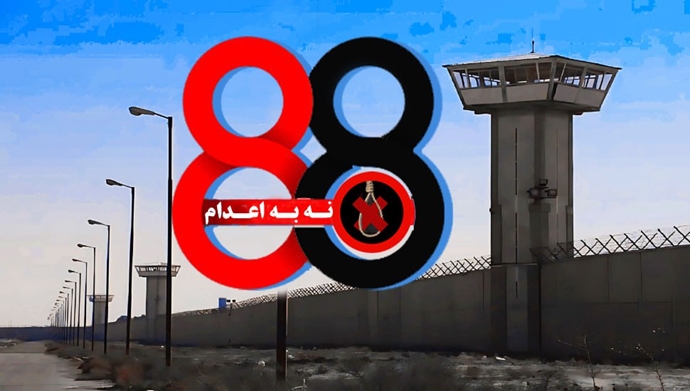

On September 30, 2025, Iran’s “No to Executions Tuesdays” campaign marked its 88th consecutive week with a large-scale hunger strike across 52 prisons, coordinated with public protests in cities nationwide. This wave of defiance comes in response to an unprecedented surge in state executions, with 190 people executed in the Persian month of Shahrivar (August 23—September 22) alone—a figure described as unparalleled in the last 35 years. Reports indicate 871 executions were carried out in the first six months of 2025.
The campaign, which began in January 2024, has become a powerful symbol of resistance against the regime’s use of capital punishment as a tool of political suppression.
A defiant message from behind bars
In their 88th weekly statement, prisoners participating in the hunger strike mourned the recent death of political prisoner Somayeh Rashidi due to the denial of medical care, condemning what they called the regime’s deliberate policy of “killing prisoners by attrition.” They described her death as “a bitter warning about the situation of sick prisoners… who are deprived of the most basic human rights.”
The statement highlighted a series of recent judicial actions as proof of the escalating crackdown: the execution of Bahman Choubi Asl on September 29, new death sentences issued to political prisoners Hamed Validi and Nima Shahi, and the Supreme Court’s decision to uphold the death sentence for Peyman Farahavar. The prisoners’ statement decried these actions, declaring: “These unjust sentences are a clear violation of human rights and a tool for suppression that must be stopped immediately.”
The hunger strike spanned dozens of facilities across the country, including the notorious Evin and Ghezel Hesar prisons, as well as jails in Karaj, Ahvaz, Shiraz, Mashhad, Tabriz, Urmia, and Sanandaj.
Solidarity on the streets
The prisoners’ calls for action were answered by citizens who took to the streets in numerous cities, including Tehran, Karaj, Sanandaj, Shiraz, Mashhad, Ahvaz, and Isfahan (Najafabad). Despite heavy security pressure and threats, protesters turned public spaces into platforms for dissent against the death penalty.
Chanting slogans that directly challenged the authorities, they made their demands clear. Cries of “This is the final message: if you execute, there will be an uprising!” and “Our cries are louder than your hangman’s ropes” echoed through the demonstrations. Protesters held images of prisoners on death row and chanted, “We support the ‘No to Executions Tuesdays'” and “Free political prisoners.”
September 30—Iran
Family of political prisoner Pouya Ghobadi protested his death sentence, joining the 88th “No to Executions Tuesdays” campaign. Their call: No to executions.#IranProtests pic.twitter.com/ckZvfKr02p— People's Mojahedin Organization of Iran (PMOI/MEK) (@Mojahedineng) September 30, 2025
The families of political prisoners played a central role in these gatherings, transforming the protests into a deeply personal and emotional national appeal. Their presence has been a driving force since the campaign’s inception, underscoring the human cost of the regime’s policies.
A movement of growing resistance
The 88th week of the campaign highlights a deepening synergy between the organized resistance inside prisons and the growing public outrage on the streets. As the regime accelerates its use of capital punishment, the “No to Executions Tuesdays” movement has evolved from a prison-led protest into a symbol of sustained national defiance.
In their statement, the prisoners reaffirmed their belief that “the execution machine can be stopped with solidarity and unity,” a sentiment now visibly shared by a growing number of Iranians. The coordinated actions demonstrate that attempts to rule by fear are instead fueling a more determined and unified opposition.