


More than a year since the conflict in Gaza began, the Iranian regime’s strategic downfall and disgrace have become glaringly apparent to the world. Every impartial observer witnesses the collapse of the decades-long claims of this malevolent regime.
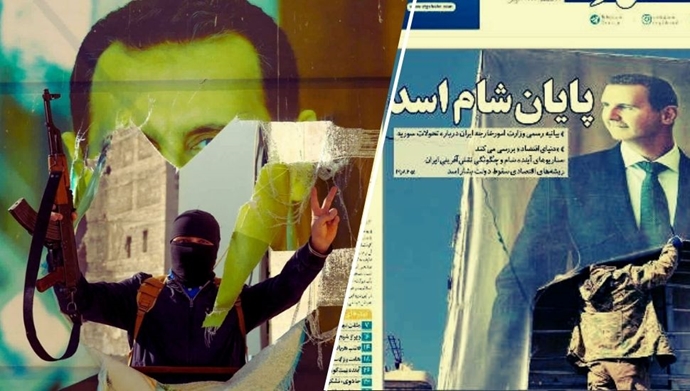
On December 14, Sky News Arabia quoted commentators, analysts, and Arabic media, who are deeply involved and closely following the fall of the Assad regime in Syria and its consequences, discuss the collapse of the Iranian regime’s deceptions such as the “Axis of Resistance,” “Shia Crescent,” and “Strategic Depth.”
Sky News Arabia reported, “Although some Iranian regime officials even recently pretended that Iran controlled four Arab capitals, in recent months, its position in the Middle East has regressed, with profound geopolitical and military changes taking place in the region. The results of this regression suggest that Iran’s spring, summer, and even autumn in the region have been lost, and it seems to be on the verge of a harsh political winter. One by one, the Iranian regime’s cards burned after the October 7 attack.”
“The Moral Defeat” of the regime
In addition to its strategic defeat, the Iranian regime has suffered a moral defeat by unconditionally supporting Bashar al-Assad’s oppressive regime in Syria and disregarding the Syrian people’s aspirations for freedom and liberation from tyranny. It has lost all credibility among Arab nations. Many Arabs now view the Iranian regime as complicit in tyranny and responsible for prolonging the suffering of the Syrian people.
On December 22, Al Jazeera reported: “The Islamic Republic has suffered moral damage as well, due to its endless support for the Syrian regime and its neglect of the Syrian people’s aspirations for liberation from tyranny. This is while it forgot or ignored what Iranians themselves did in their struggle against the tyranny of the Pahlavi monarchy… It seems Iran’s declining influence is the result of strategies lacking alternative options and a deep understanding of the rapid transformations in the Middle East. This decline began with moral damage, as there was no coherence in understanding the concept of ‘defending the oppressed and disadvantaged,’ because the domination of tyrants is no different from the domination of occupiers.”
It is evident that this type of defeat has immediate and increasing impacts on developments on the ground and the regime’s subsequent challenges:
“This decline in influence in Syria and Lebanon is just the beginning. It also signifies the collapse of one of the main pillars of Iran’s national security theory post-Iran-Iraq war. This theory was based on maintaining a presence outside its borders to counter potential threats rather than waiting for them to approach its borders. According to available data, Iraq seems to be the next destination where Iran’s influence will face challenges and possibly tough tests” (Ibid).
This moral defeat is most strongly felt by Palestinians, who have been the primary victims of the regime’s opportunistic policies cloaked in deception under the banner of their cause.
On December 21, Al-Arab London quoted Palestinian writer Hamid Qarman, as saying, “The Iranian regime’s interference through elements affiliated with the Islamic Jihad Movement in the West Bank areas not only provides no benefit to Palestinians but is, in fact, detrimental… The Palestinian people, now voicing their opposition to armed interventions, understand such actions, affiliated with regional forces indifferent to the sanctity of Palestinian lives and their destiny, only bring new disasters. They have realized that the timing of activities by Iran-affiliated cells has catastrophic consequences, disasters that again fall upon the Palestinian people and impose heavy costs on them.”
Baghdad, the Last Stronghold of Iran’s Regime
Following a significant statement by Ibrahim al-Sumaydi, political advisor to Iraq’s Prime Minister, who said, “If we don’t act to dissolve the armed groups ourselves, others will do it by force. Iraq cannot remain as the sword of the Axis of Resistance (Khamenei) after the fall of the Assad regime and the weakening of Hezbollah in Lebanon.” The question arose whether these remarks were merely his personal views or if there was a “will” or movement behind them. The Asharq Al-Awsat newspaper answered this question on December 18:
“Some sources close to the Shia ‘Coordination Framework’ forces speculate that Prime Minister al-Sudani may have authorized al-Sumaydi to express the government’s view on armed groups… Within Iraq, there are extensive discussions about this issue, suggesting an ‘international will’ determined to end the dual connection (between the state and armed groups). This issue is reinforced by regional political and security developments, including the Gaza events in October last year, the weakening of Hezbollah in Lebanon, and the fall of the Baath regime in Damascus. These developments have led to the collapse of what is known as the ‘Axis of Resistance’ led by Iran.”
Interestingly, other Arab commentators and writers take this further, referring to Baghdad as the “last stronghold” of the mullahs’ regime.
On December 15, Al-Arab London reported, “Baghdad is the last gate behind which the ‘Supreme Leader system’ has entrenched itself. Through a gradual process with precise timing, Iran’s ‘Supreme Leader system’ is being led into a prison from which it will remain confined forever. This process began with the ‘Al-Aqsa Storm’ and the temptations of the ‘Operation True Promise’ corridors. It passed through Beirut, crossed borders, reached the depths of Damascus, and from atop Mount Qasioun gazed at Baghdad, to map out a route towards Tehran in its flat plains.”