

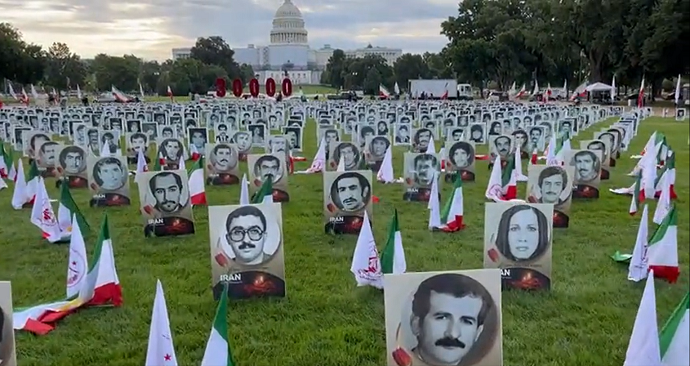

The widespread reaction and protest by parliamentarians, political parties, and prominent political figures to the condolence messages from the President of the European Council and the U.S. Secretary of State over the death of Iranian regime president Ebrahim Raisi is an exceptional case in contemporary diplomacy.
The intensity and tone of condemnation from the public and representatives in Europe and America are such that it can be described as a protest rebellion against a moral and human disgrace under the pretext of diplomatic protocols and formalities.
This protest and rebellion did not happen overnight but is the result of awareness, knowledge, and a political and historical background. It is the voice of the 30,000 executed in 1988 and the martyrs of the blood-soaked uprisings of the Iranian people echoing in European parliaments, the U.S. Congress, and the corridors of the United Nations, disrupting the tranquility of the press conferences and formal gatherings of appeasing politicians.
Several members of Congress condemned the State Department’s condolence statement following the death of the executioner Raisi by introducing Resolution H. RES. 1246 to the House Foreign Affairs Committee. This resolution, presented by ten representatives, states: “Whereas Iranian President Ebrahim Raisi was notably referred to as the ‘Butcher of Tehran’ and helped oversee the mass executions of thousands of political prisoners in 1988 after the Iran-Iraq war; Whereas, in 2019, the Department of the Treasury sanctioned President Raisi for his participation ‘in a so-called ‘death commission’ that ordered the extrajudicial executions of thousands of political prisoners’… the House of Representatives condemns the Department of State’s statement expressing condolences for the death of Iranian President Ebrahim Raisi, Foreign Minister Amir-Abdollahian, and other members of their delegation.”
Additionally, many members of the Senate and Congress protested this action on their X (formerly Twitter) accounts, condemning the condolence and mourning over the death of the executioner of thousands of political prisoners in 1988 and the suppressor of uprisings in Iran.
On May 22, during a hearing with the Deputy Secretary of State in the Middle East Subcommittee of the House Foreign Affairs Committee, senior committee member Brad Sherman (D) spoke about Raisi’s death: “Unfortunately, the Security Council decided for a moment of silence in mourning his death… Few have murdered as many thousands of people… I hope you suggest to Linda Thomas-Greenfield (U.S. Ambassador to the United Nations) that at an appropriate time, in the Security Council, there be a moment of silence for the families of those whom Ebrahim Raisi sentenced to death, 30,000 of them in 1988, the 1,500 in 2019, the Bloody November, and the many others who are victims of his bloodstained hands.”
In the French Senate, First Vice President Roger Karoutchi, in protest the condolence over Raisi’s death, addressed Deputy Foreign Minister Jean-Noel Barrot: “the Secretary General (of the UN) called for a minute of silence for the butcher of Tehran. The French ambassador participated willingly, visibly […] What do Iranian women think of it? What does the Iranian democratic opposition think? What do all these young Iranians think of what you are doing?”
On May 24, in an article on Fox News, former U.S. Secretary of State Mike Pompeo wrote, “In remembering Raisi, we should not honor the man, who earned the title ‘Butcher of Tehran’ for his role as chief executioner during the mass murder of tens of thousands of innocent Iranians in 1988… Further, the Biden administration and the world should do more to support the organized opposition movement inside Iran. The mullahs constantly say that there is no alternative to their regime, yet they spend billions of dollars to demonize this very alternative.”
This wave of protest, which targets diplomatic protocols tainted with disgrace and human rights violations, rises from the sea of blood of the 30,000 executed martyrs of freedom and the movement for justice and will not cease until the overthrow of the ruling regime in Iran.