

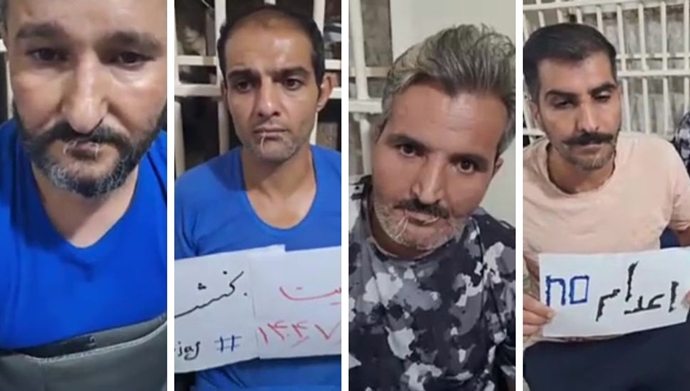

On October 18, a powerful act of defiance entered its sixth day inside the notorious Ghezel Hesar prison, as over 1,500 death row inmates in Unit 2 continued their mass hunger strike against the Iranian regime’s escalating campaign of executions. In a harrowing display of their resolve, some prisoners have sewn their lips shut. Smuggled video footage reveals their gaunt bodies and hand-written placards bearing a simple, urgent message: “No to execution.”
This life-or-death protest is not a plea for mercy but a firm demand for justice. The prisoners have vowed to continue their strike until their death sentences are overturned or commuted to imprisonment. Their courageous stand from within one of the regime’s main killing centers exposes the brutal reality of the clerical dictatorship and serves as a rallying cry for all who stand for human rights.
A ‘bloody October’ fueled by fear
The hunger strike was ignited after authorities transferred at least 16 prisoners to solitary confinement in preparation for their imminent executions. This move was the final straw in what has become a month of unprecedented bloodshed. In a statement of support, political prisoners in Ghezel Hesar declared Mehr 1404 (September 23–October 22) the “bloodiest month” for death row inmates, with the regime having already carried out approximately 200 executions.
October 18—Ghezel Hesar prison, Karaj, Iran
Sixth day of hunger strike by death-row prisoners, protesting the growing wave of executions in Iran. Despite deteriorating health conditions, prisoners continue their protest movement.#IranProtests pic.twitter.com/MEvWYYUwoi— People's Mojahedin Organization of Iran (PMOI/MEK) (@Mojahedineng) October 18, 2025
This shocking figure is part of a deliberate policy of terror. The first half of the Persian year 1404 (March 2025-September 2025) has seen a staggering 250% increase in executions compared to the previous period. For the ruling theocracy, the gallows are not an instrument of justice but a political tool to suppress a restive society and project strength amid deepening internal crises. This state-sanctioned murder campaign is a chilling echo of the regime’s darkest chapters, particularly the 1988 massacre of political prisoners, when death became the unwritten law of the land.
The regime’s response: threats and a wall of silence
Faced with this organized resistance, the regime has responded with predictable brutality. Prison guards have threatened, beaten, and attempted to isolate the striking inmates. In a chilling escalation, officials told the prisoners that their case was no longer being handled by the Prisons Organization but has been transferred to the Judiciary. The threat was explicit: “The prisoners who have been taken to solitary confinement will be executed, and starting tomorrow, the execution of the rest will begin.”
October 18—Ghezel Hesar prison, Karaj, Iran
Death-row prisoners continue their hunger strike for the sixth day, hanging signs that read for an end to executions.#IranProtests #StopExecutionsInIran pic.twitter.com/rgjQdtHJnn— People's Mojahedin Organization of Iran (PMOI/MEK) (@Mojahedineng) October 19, 2025
Desperate to prevent the prisoners’ message from reaching the outside world, authorities have weakened the internet in the area surrounding Ghezel Hesar and installed jammers to block mobile phone signals. Yet, this wall of silence has not broken the inmates’ spirits. In a remarkable act of solidarity, when guards tried to remove the prisoners who had sewn their lips shut, their fellow strikers stood together and prevented their separation. They have declared they will “stand firm until death” and continue their protest with strength.
A call to the world from the shadow of the noose
As the physical condition of many prisoners deteriorates, their voices are growing more urgent. A statement from political prisoners supporting the strike powerfully captured their sentiment: “They watched daily as groups of their friends were taken to the slaughterhouse… Now, they protest this waiting for death and call on the world to accompany them.”
The strikers themselves have directly appealed to the Iranian people and their families, pleading with them to protest the regime’s “savage executions.” Their message is clear: they are fighting not just for their own lives, but for the soul of a nation held hostage by a ruthless dictatorship.
October 18—Ghezel Hesar prison, Karaj, Iran
On the sixth day of their hunger strike, death-row prisoners plead with the people to help send their message to the world and bring a halt to executions in Iran.#IranProtests #StopExecutionsInIran pic.twitter.com/w2jE2No2Yu— People's Mojahedin Organization of Iran (PMOI/MEK) (@Mojahedineng) October 19, 2025
The hunger strike in Ghezel Hesar has drawn a stark line in the sand. On one side are over 1,500 prisoners, armed with nothing but their principles and their own fragile bodies, demanding the fundamental right to life. On the other is the clerical regime and its horrifying surge in state-sponsored killing.
The international community can no longer afford to be a bystander. Human rights organizations, world governments, and global media outlets must amplify the voices from Ghezel Hesar. They must condemn this execution spree and hold the Iranian regime accountable for its crimes. Silence in the face of such courage and cruelty is complicity. The world must act before the regime silences these brave voices forever.