

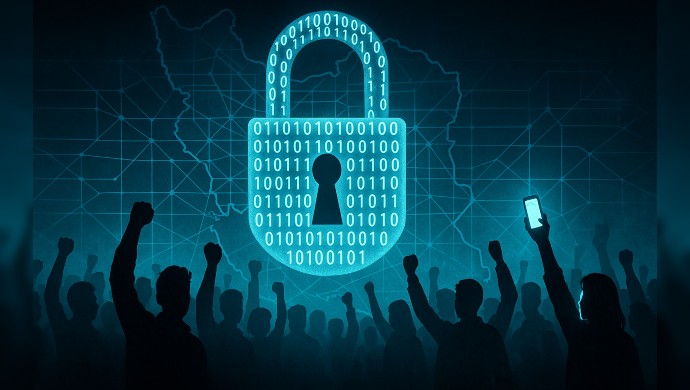

Following a humiliating diplomatic defeat with the snapback of all UN sanctions on September 28, the Iranian regime is revealing its profound weakness and paranoia. Cornered on the world stage after its allies failed to block the move, Tehran’s only recourse has been to intensify its domestic war on the free flow of information. This crackdown is not a sign of strength, but a panicked, self-defeating strategy that is only fueling popular dissent and proving the regime’s illegitimacy. Unable to fight the international community, the regime is turning its fury inward, targeting its greatest perceived threat: a population armed with information and an organized opposition ready to lead it.
The iron fist descends: Official threats and digital sieges
The regime’s reaction was immediate. On September 27, just as the sanctions became a certainty, the regime’s judiciary issued a chilling threat to all media outlets. In a statement, the Tehran Prosecutor’s Office warned them to “be sufficiently and necessarily careful in publishing news” and not allow their output to “become a place for disrupting the psychological security of society,” promising that any violation would be met with an “appropriate response.” The timing of this “sensitive time frame,” as the regime calls it, is no coincidence, aligning with the start of the new academic year, a period when it fears the mobilization of young people in schools and universities.
This clampdown is being enforced through a deliberate digital siege. According to an August 2025 report from Speedtest, Iran now ranks an abysmal 139th in the world for internet speed, a clear indication of a state policy to throttle information and prevent the spread of dissent.
Naming the “enemy”: The regime’s obsession with the PMOI’s influence
The regime’s fear is not abstract; it has a name. Officials across the country are openly admitting their terror of the PMOI’s influence, particularly among the youth. The Friday prayer leader in Shiraz, Lotfollah Dezhkam, recently warned that the “Mojahedin have extensive activity in cyberspace.” This paranoia is echoed by the state-run Hamshahri newspaper, which warned on September 7 that “the young generation has not understood the dangerous nature of the Mojahedin Organization.”
The regime’s own intelligence apparatus has confirmed that it views the opposition’s online presence as a critical threat. In August 2025, the state-run Didban Iran website wrote that “social networks have become the Mojahedin’s invisible net for the young generation,” calling for this “invisible net” to be torn apart.
A self-defeating war: How censorship fuels hatred
But the regime’s strategy is backfiring spectacularly. Far from ensuring stability, the crackdown is creating an explosive backlash. Even the state-run newspaper Ham-Mihan admitted on September 23 that the “filters that have been created for sites and social networks have added to the hatred of the youth.”
The internet is no longer a luxury but a lifeline. Ali Rabiei, an aide to regime president Masoud Pezeshkian, stated in August 2025 that for 50 percent of the population, “the internet is more important than water and electricity.” This highlights how the regime’s restrictions are a direct attack on the daily lives and aspirations of millions. By attempting to cut off information, the regime is severing its last shred of legitimacy with a generation that refuses to be silenced.
The regime’s own officials are confessing their weakness. On September 18, the IRGC’s Deputy Commander, Yadollah Javani, admitted that “the system is in a very sensitive situation” because “the enemy has focused more than 60 percent of its activities on cyberspace and the media.” This is a direct admission that the battle for Iran’s future is being fought online, and the regime knows it is losing.
The international community must recognize that this internal repression is inseparable from the regime’s external threats. The snapback of sanctions was a necessary step, but the final solution lies with the Iranian people. Supporting their right to free access to information is a strategic imperative to empower the forces of change—led by the youth and their organized Resistance—that the mullahs fear most. The world must stand with the people of Iran, not their oppressors.