

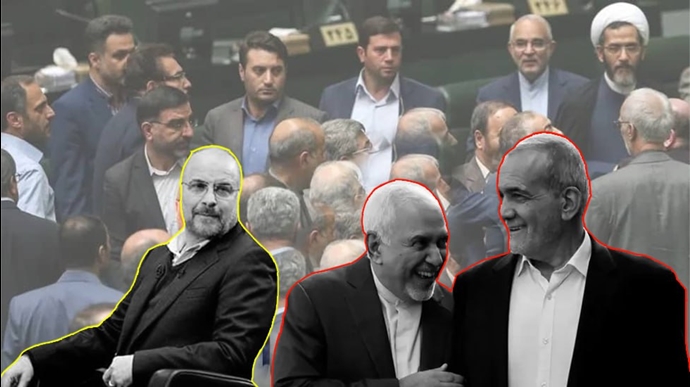

Iranian regime supreme leader Ali Khamenei’s meeting with members of the Majlis (parliament) on July 21 was a desperate attempt to bring order to the chaotic state of the regime. Khamenei’s advice to “hear a unified voice from the country” comes at a time when, with the dust settling from claims of victory in the presidential election, the regime is now facing a new wave of splits and divisions. The process of selecting a so-called steering council to appoint ministers has ignited a new round of power struggle between regime officials and factions. Regime factions are tearing each other apart to gain a larger share of power and wealth.
The tension between the two factions has reached the point where the slogan “[former foreign minister Mohammad Javad] Zarif, get lost” has become popular in Friday prayers.
On July 20, the IRGC-run Javan newspaper wrote: “…All the trust, presence, and assurance of these elections have been entrusted under the title of the Steering Council to someone who once considered an American signature as a guarantee but was not guaranteed, causing concern among the true supporters of the system.”
This newspaper described the composition of this council as “controversial and marginal individuals,” “those promoting blackening, deadlock, and disappointing the people,” “the accused and influential people in the 2009 sedition,” “the main agents and perpetrators of mismanagement and inefficiency in the pro-Western government,” and so on.
On the other hand, the opposing faction has not remained idle and has called the rival faction (attributed to presidential candidate Saeed Jalili) “Jalilism,” using terms like “orthodox authoritarianism,” “self-absolute thinking, self-regime thinking, and self-Islam thinking.”
On July 20, in an interview with the official ILNA news agency, law professor Ali-Akbar Gorji said, “I reflected on the thoughts, principles, and approaches of authoritarian currents and personalities; most of them are self-absolute thinkers, self-regime thinkers, and self-Islam thinkers. With this self-righteousness, they commit a kind of otherness that leads them to a type of systematic abuse. Sometimes, without paying attention, they say things that make their opponents suffer. This political sadism is intertwined with the authoritarian body in all countries of the world. Consider the authoritarianism of Hitler, Mussolini, and Franco; all these authoritarians suffer from political sadism, and this is very painful.”
Furthermore, Masih Mohajeri, the editor-in-chief of the Islamic Republic newspaper criticized the ruling class, calling them “hypocrites” and “power thirsty.” On July 20, addressing incoming president Massoud Pezeshkian, he said, “In our country, since the ninth and tenth governments deceit, trickery, and theft have been institutionalized. These are the roots of corruption, and until they are eradicated, no government can solve the country’s problems.”
The Friday prayer leaders reminding Pezeshkian of his professed loyalty to the “Supreme Leader” and their request for him to follow Raisi’s approach is another aspect of the infighting withing the regime.
Hosseini Bushehri, Friday prayer leader of Qom said, “We pray that he can… choose colleagues who, like Ayatollah Raisi, are committed to the jihadi and value-oriented movement.”
Ahmad Alamolhoda Friday Prayer leader in Mashhad, openly spoke of “having differences with the leadership” and warned that no one should oversee foreign policy who shakes hands with the US Secretary of State, resulting in “centrifuges being loaded like tin onto trucks, taken out, and filled with concrete in the heavy water reactor of Arak!” (Source: Khorasan TV network, July 19)
This chaos is taking place even before Pezeshkian has been “endorsed” or “sworn in” by Khamenei, meaning he is neither fully in power nor out. What is certain is that the effects of the death of Raisi are now clearly felt across the regime.
The regime’s deadlock in solving its crises is reminiscent of the final stage of the Shah regime. The splits and divisions within the regime will eventually create the grounds for another nationwide uprising against the mullahs’ rule.