

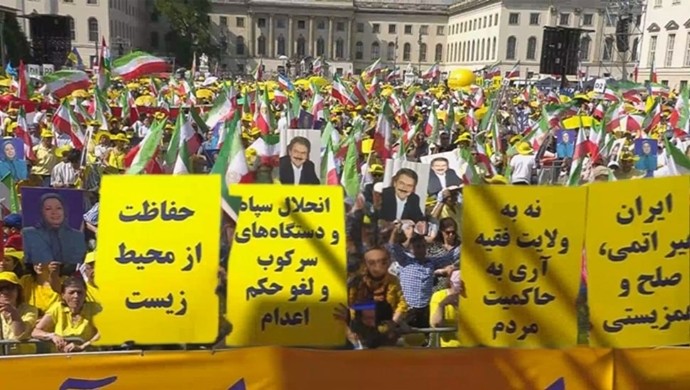

One of the participants in the recent the Free Iran 2024 World Summit was Mr. Francisco Guerreiro, a member of the European Parliament from Portugal. On July 1, in his speech about the “dream of the Iranian people” for freedom, he said, “I define the resistance movement in ‘hope, resilience, and vision.’ Hope, because we must continue to dream of a secular democracy. This dream is not new; it began in the 1950s with Mossadegh. However, in 1953, this dream was shattered by a coup d’état orchestrated by Western forces, primarily the US and British, opposing this vision… We must politically recognize the National Council of Resistance of Iran (NCRI) as the sole entity capable of guiding Iran’s transition to a secular democracy.”
Two days after the grand gathering of the resistance, Mr. Guerreiro wrote on his X account: “Three words define the Iranian Resistance. Hope, Resilience and Vision.”
https://twitter.com/FGuerreiroMEP/status/1807468642642108634
Hope
The difference between fantasizing and having hope is vast. Fantasizing usually results from letting the mind wander in a world of illusions; a directionless world where no price is paid, and no specific action is taken. There is no clear plan or roadmap for reaching a goal, and no collective effort and persistent work are required. It is like letting the imagination roam free in the vast meadows of unfulfilled desires and nothing more.
But hope exists in the hard world of realities. Realities outside the mind that flow in the political and social scene as a constant battle between exploiters and the exploited. In this world, hope is the source of action and effective work, providing a vision. It polishes wills and gives people the power to rise and pave the way. With hope, the first rays of a path to salvation are instilled in the masses of the broken-hearted and the oppressed, creating a belief in change.
But why is “hope” the most prominent characteristic of the Iranian Resistance from the perspective of a politician who has recently become acquainted with this movement, and how has this Resistance been able to instill hope in hearts? What is that ever-burning furnace that has gathered masses of supporters of the Resistance in the Free Iran Summit?
The speakers who participated in the Summit each, in their own words, spoke about what has ignited the flame of hope in their hearts.
Ms. Michèle Alliot-Marie, a minister in several French governments, said, “In every resistance movement, it is crucial to see the positive. There is another path, the one you, Maryam Rajavi, have outlined with your Ten-Point Plan, embodying values essential for peace and prosperity. This hope exists and is recognized internationally, with more official voices denouncing Iran’s actions.”
General James Jones, former National Security Advisor to U.S. President Barrack Obama, emphasized, “The global community must be far, far more in support of the future envisioned by Mrs. Rajavi and the NCRI set forth in the Ten-Point Plan that has been discussed already. The manifesto articulates the irrepressible hopes and aspirations of the Iranian people and all of those who have laid down their lives in protest of that tyranny.”
Ms. Nargis Nehan, former Minister of Mines and Petroleum of Afghanistan, said, “It is the resilience and resistance of the women of Iran and Afghanistan that give me hope and energy to stand here before you.
“I would like to conclude with three recommendations: first, please support Madam Rajavi’s Ten-point action plan if you truly want to secure a better future for Afghanistan. Second, please join our international campaign for the recognition of gender apartheid in Afghanistan and Iran.”
And there are others who consider Mrs. Rajavi herself as a source of inspiration and hope. Long-time supporter of the Iranian resistance, Mrs. Betancourt, is one of them. She said, “It is important to understand why the regime puts so much effort into stopping our support. First, it’s because if we succeed in obtaining official support from governments, it sends a message as powerful as a nuclear bomb. It means game over. Because Maryam Rajavi has given hope to the Iranian people. And hope among leaders in dictatorial regimes is what they fear most.”
This view is also seen in the words of Mr. Abdullah Hoti, former Prime Minister of Kosovo, who told Mrs. Rajavi, “Honorable Madam Rajavi, you have our sympathy and support, as always. And sometimes it might seem that your efforts are not bringing the change that you seek for your people. But remember that you are the only hope for millions of boys and girls who want to live a free and decent life.”
This Resistance movement, which is organized, has a plan, has a network of Resistance Units who are carrying out activities inside Iran every day, and a network of freedom-loving Iranians regularly holding rallies and conferences abroad, is constantly progressing.