

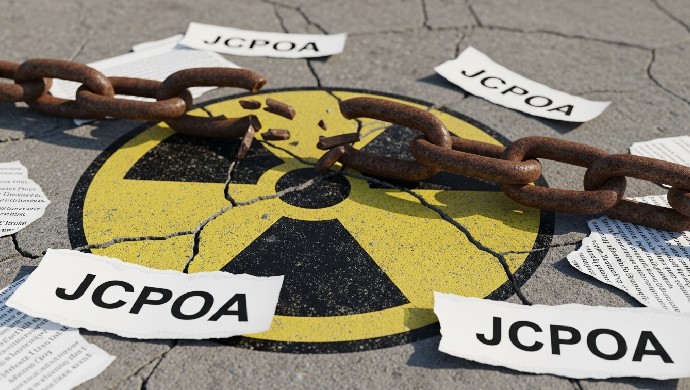

Ten years ago, on July 15, 2015, the Iranian regime celebrated the signing of the Joint Comprehensive Plan of Action (JCPOA), which its then-president Hassan Rouhani hailed as a “great political victory.” Today, that supposed victory lies in tatters. As the deal marks its grim tenth anniversary, European powers are openly warning of activating the snapback mechanism, a move that would reimpose all international sanctions and deliver the final blow to the agreement.
The French Foreign Minister stated on July 15, “France and its partners are … justified in reapplying global embargos on arms, banks and nuclear equipment that were lifted 10 years ago. Without a firm, tangible and verifiable commitment from Iran, we will do so by the end of August at the latest.”
The regime itself understands the gravity of the situation. Its foreign minister, Abbas Araghchi, recently admitted that “the use of the snapback mechanism against Iran has an effect similar to a military attack.” This stark reality exposes the naivety of the appeasement policy, which the West hoped would preserve their interests through partnership with the Iranian regime.
A warning ignored: the Iranian Resistance’s 2015 assessment
While Western powers pursued a flawed deal, the Iranian Resistance offered a clear and accurate analysis of the regime’s intentions. On July 14, 2015, the day before the agreement was finalized, Maryam Rajavi, the President-elect of the National Council of Resistance of Iran (NCRI), warned that the deal was built on a foundation of deceit.
She cautioned that “circumventing the six UN Security Council resolutions, an unsigned agreement will not close the mullahs’ path to deception and access to nuclear bomb.”
Mrs. Rajavi also foretold exactly how the regime would use the financial windfall from sanctions relief. She noted that any money given to the regime must be placed under strict international monitoring. “Otherwise,” she warned, “Khamenei will use these funds to further the regime’s policy of export of terrorism and fundamentalism in Syria, Yemen and Lebanon as well as to fill the coffers of the Islamic Revolutionary Guards Corps.”
Crucially, she highlighted that ignoring the regime’s brutal nature would only make it more aggressive, stating, “Any agreement that disregards and fails to underscore the Iranian people’s human rights will only embolden the regime in its suppression and relentless executions.”
A decade of validation: how the regime proved the Resistance right
The past ten years have proven the Iranian Resistance’s analysis to be tragically correct. Far from abandoning its nuclear ambitions, the regime used the cover of the JCPOA to continue its illicit activities, eventually boasting of enriching uranium to 60% purity, a level with no civilian justification.
The financial relief provided by the deal was not spent on the Iranian people’s needs, such as unpaid salaries for workers and teachers. Instead, as Mrs. Rajavi predicted, it was funneled into the regime’s machinery of war and terror across the Middle East. The regime has spent an estimated $2 trillion of the Iranian people’s plundered wealth on its nuclear program—a project designed not for national advancement, but for the sole purpose of ensuring the survival of a corrupt and illegitimate dictatorship.
The unchanging nature of the mullahs’ regime
The catastrophic failure of the JCPOA is a lesson in the unchangeable nature of the ruling theocracy. As the Iranian Resistance has maintained for over four decades, “A viper never gives birth to a dove.” The regime cannot and will not abandon its core pillars of survival: nuclear weapons projects, terrorism, and the brutal suppression of the Iranian people.
The international community must now abandon the failed policy of appeasement. The only path to regional and global peace is to recognize the truth that the Iranian Resistance articulated a decade ago. The solution lies not in another flawed deal, but in supporting the will of the Iranian people. As Mrs. Rajavi stated in 2015, the time has come to “rise up to overthrow the mullahs’ illegitimate regime and establish a free, democratic and non-nuclear Iran.”