

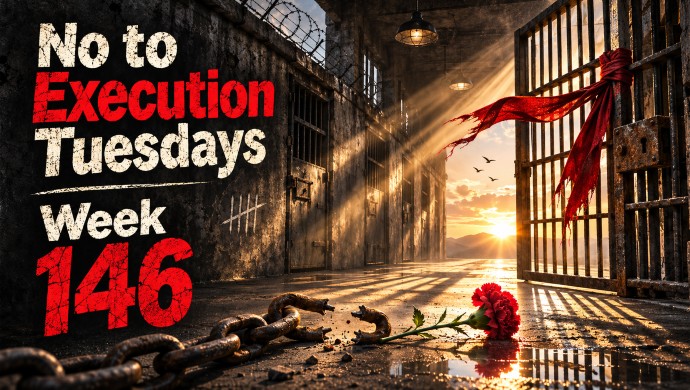

On Tuesday, November 10, 2026, prisoners across 66 different penal facilities in Iran launched a coordinated hunger strike to mark the 146th consecutive week of the “No to Executions Tuesdays” campaign.
The widespread protest comes as political prisoners continue to push back against the regime’s systematic use of the death penalty, demonstrating a highly organized resistance despite severe retaliation. Over the past weeks, participating inmates have faced escalating security pressures, direct threats, strict limitations on their communication with the outside world, and various punitive measures designed to exhaust them and silence their protests.
However, despite the regime’s relentless attempts to break their spirit, the campaign has transformed into a symbol of unwavering defiance over the course of nearly three years. By staging hunger strikes week after week, the prisoners boldly reaffirm their opposition to capital punishment and their defense of the fundamental right to life.
Targeting the Protesting Youth
The clerical regime continues to weaponize its judiciary to eliminate the courageous young generation that recently rose up to demand a free and democratic Iran. Countless young protesters are currently languishing behind bars, facing the imminent threat of execution under heavy, fabricated charges such as Moharebeh (waging war on God) and Efsad-e-Fel-Arz (Corruption on Earth). These charges are frequently wielded against individuals whose only “crime” was taking to the streets to exercise their right to self-determination.
In their week 146 statement, the striking prisoners highlighted this systematic targeting of the youth: “Prisons of Vakilabad, Sheiban, Adelabad, Ghezel Hesar, Evin, Dizelabad, Lakan, Dastgerd of Isfahan, Zahedan Central Prison, Urmia, Karaj, and other prisons of the country, are full of youth who with charges such as ‘Moharebeh’ and ‘Efsad-e-Fel-Arz’, are waiting for the issuance or execution of their death sentences.”
The prisoners emphasized the innocence of these detainees, stating, “These youth are the very same ones who took to the streets for their right to self-determination; a generation demanding freedom, equality, and a dignified life, and who rose up to achieve their fundamental human rights.” The circumstances surrounding their arrests, trials, and convictions raise profound questions regarding the utter lack of due process, the right to defense, freedom of expression, and the right to peaceful protest in Iran.
The Escalating Execution Machine and Extrajudicial Killings
Driven by a deep fear of the people’s uprisings, the Iranian regime is ramping up executions and brutal killings in a desperate bid to spread terror throughout society. The statistics reflect a killing machine operating at full capacity. According to the campaign’s statement, over 40 people were executed in the current Persian month of Aban (which began on October 23). In just one week—since the previous Tuesday—at least 15 prisoners were sent to the gallows, including six political prisoners.
The campaign detailed recent executions that showcase the regime’s ruthless nature. On Tuesday, November 3, two political prisoners detained during the January 2026 uprising, Amirhossein Maleki and Amirhossein Ebrahimi, were executed in Isfahan. On Saturday, November 7, a Baluch compatriot named Mohammad Aref Shahbakhsh was hanged in Karaj. The following day, Sunday, November 8, three more prisoners—Hassan Divband, Hamid Kazemi, and Reza Zanganeh—were executed in Karaj. Tragically, Hassan and Hamid were put to death just days after reports of their torture and mock executions were exposed to the public.
Beyond formal executions, the regime has also resorted to extrajudicial murder. The statement revealed that interrogators recently tortured to death Hedayat Lalarizadeh in a security detention center in Ahvaz, subsequently abandoning his lifeless body in the deserts of Khuzestan.
New Death Sentences Issued in the Shadows
Attempting to preempt public outrage, the regime is quietly fast-tracking death sentences for political prisoners in total media silence. According to the campaign, 15 political prisoners were issued death sentences over the past week alone.
The statement sternly warns that these are merely the cases that have reached the media. It highlights the plight of “unknown prisoners” whose lives hang in the balance unnoticed, citing the case of Mehdi Zanganeh, a 20-year-old youth in Sheiban Prison in Ahvaz. Mehdi has been officially informed of his death sentence, yet his name and critical situation remain entirely obscured by media silence.
Global Echo and International Solidarity
The barbaric surge in state-sanctioned killings and the unyielding bravery of the striking prisoners are drawing substantial international attention, underscoring the necessity for immediate global intervention. The campaign’s statement referenced a recent report by the UN Secretary-General to the General Assembly, which sharply highlighted the alarming spike in executions and the severe deterioration of conditions for inmates in Iran.
Beyond official reports, the “No to Executions Tuesdays” campaign is increasingly resonating with prominent international human rights figures. Renowned defenders of human rights, including Ana Lorena Delgadillo of the UN Working Group on Enforced Disappearances, Andrea Bolaños Vargas, the UN Special Rapporteur on Human Rights Defenders, former UN Special Rapporteur David R. Boyd, and Alexis Anagnostakis, Chair of the Human Rights Committee of the European Criminal Bar Association, have openly voiced their solidarity with the campaign—with several taking part in solidarity hunger strikes themselves to echo the voices of those languishing on Iran’s death rows.