

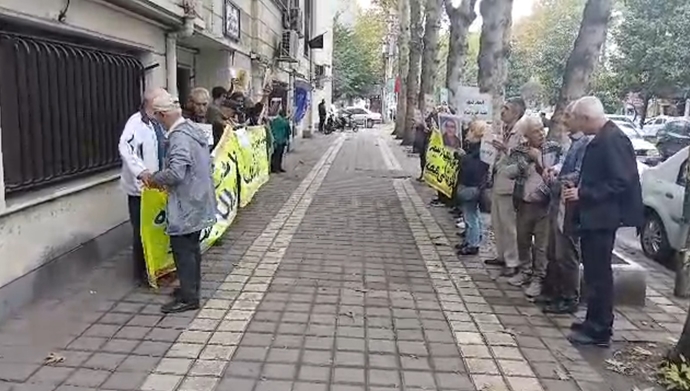

On Sunday, November 8, 2026, several Iranian cities witnessed a wave of protest rallies and labor strikes involving Social Security retirees and retired workers in Ahvaz, Shush, and Haft Tappeh, retirees of Bank Saderat, and municipal bus drivers in Yazd, whose strike entered its ninth consecutive day. The demonstrations and slogans underscored a deepening livelihood crisis that now directly threatens household food and medicine security, alongside a gradual paralysis of public transit and basic utilities driven by runaway inflation and the systemic draining of national resources.
Ahvaz, Shush, and Haft Tappeh: Indicting the Government’s Record in the Streets
In Khuzestan province, Social Security retirees in Ahvaz gathered outside the provincial General Directorate of Social Security to protest deteriorating living conditions and the authorities’ persistent refusal to address their long-standing legal demands. Simultaneously, retired workers from Shush and Haft Tappeh rallied outside the Social Security Organization headquarters to demand their misappropriated rights.
November 8—Ahvaz, southwest Iran
Retirees and pensioners of the Social Security Organization rally to protest poor living conditions and low pensions. pic.twitter.com/J0XVn07kCv— People's Mojahedin Organization of Iran (PMOI/MEK) (@Mojahedineng) November 8, 2026
Protesters in Shush and Haft Tappeh raised slogans that delivered a comprehensive indictment of the executive branch’s record, linking the looting of public wealth directly to the collapse of basic infrastructure and utilities:
“The result of the government’s work is water and power outages!”
“The result of the government’s work is eroding wages, constant lies to the nation, and looting the people’s pockets!”
“How long this poverty and misery? How long this theft from the nation?”
“The government is indifferent, and the market is left unchecked!”
The chants also highlighted the severe humanitarian and healthcare crisis facing senior citizens. Retirees summarized their nutritional and medical plight with the slogans: “The retiree’s refrigerator is emptier than ever” and “With free-market drug prices, medical treatment has become a torment,” while reaffirming their demand for free healthcare coverage: “Proprietary Social Security hospitals are our indisputable right; we will not rest until we reclaim our rights.”
Bank Saderat Retirees: Marching to Preserve the Bare Minimum for Survival
In a parallel demonstration, retirees of Bank Saderat took to the streets once again to protest the rapid erosion of their pensions and the neglect of their occupational entitlements. Participants emphasized that their recurring street protests are no longer aimed at securing prosperity or financial comfort, but have become an existential struggle simply to preserve the bare minimum required for survival as soaring prices wipe out monthly pensions within days.
November 8—Rasht, northern Iran
Retirees and pensioners of the Social Security Organization resume protest rallies, protesting low pensions and poor living conditions. Protesters also called for the release of imprisoned political activists. pic.twitter.com/uc7lCjOGPu— People's Mojahedin Organization of Iran (PMOI/MEK) (@Mojahedineng) November 8, 2026
Yazd: Municipal Bus Strike Enters Day Nine Amid Skyrocketing Maintenance Costs
In central Iran, the strike by municipal bus drivers in Yazd—which began on Saturday, October 31—entered its ninth consecutive day. Despite claims by the Yazd municipality that measures had been taken to maintain operations, field reports and residents confirm significant service reductions, longer waiting times, and the complete cancellation of several transit routes.
Striking drivers stated that operating their buses is no longer financially viable due to an unprecedented surge in the cost of tires, batteries, engine oil, and spare parts over the past year. Detailing the crisis in concrete figures, one driver explained: “A tire that we bought last year for 25 to 30 million tomans now costs around 80 million tomans. Engine oil, which used to cost about one million tomans a month, has multiplied several times over. With these expenses, even if we work a full month, we can barely cover the cost of tires and repairs.”
November 8—Urmia, northwest Iran
Defrauded customers of the state-backed Mahan company rallied in front of the judiciary office of the West Azarbaijan province, demanding the return of their savings after officials were arrested; many lost life savings, home sale proceeds, or… pic.twitter.com/N37a06Q3aN— People's Mojahedin Organization of Iran (PMOI/MEK) (@Mojahedineng) November 8, 2026
These developments stretching from Khuzestan to Yazd demonstrate that Iran’s economic crisis has moved beyond declining purchasing power into the paralysis of vital public services and the inability of citizens to afford basic food, medicine, and equipment maintenance. While retirees face empty refrigerators and cities suffer from water, electricity, and transit disruptions, the ruling establishment under the Velayat-e Faqih system and the financial conglomerates of the Iranian regime’s Revolutionary Guards (IRGC) continue to monopolize national wealth and energy revenues—diverting them toward regional warmongering, foreign terrorist networks, and military projects while leaving workers, drivers, and retirees to pay the price.