

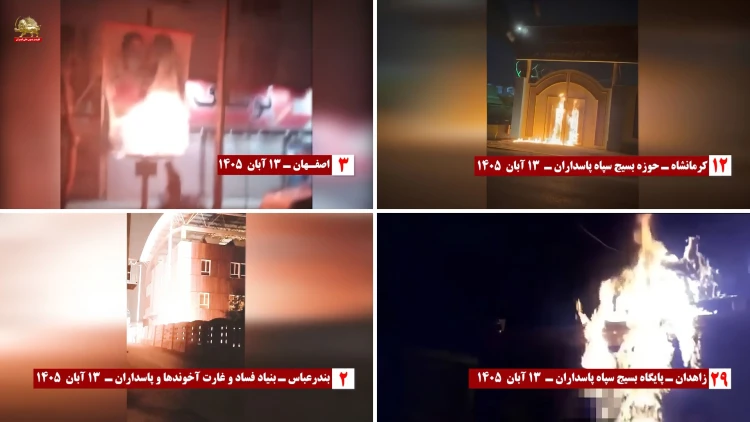

On November 4, 2026, Resistance Units affiliated with the People’s Mojahedin Organization of Iran (PMOI/MEK) carried out 30 operations across Iran in response to the execution of two young political prisoners, Amir Hossein Maleki and Amir Hossein Ebrahimi, who had been arrested during the January 2026 uprising.
The operations targeted institutions affiliated with the regime, bases of the Islamic Revolutionary Guard Corps (IRGC) Basij, and propaganda symbols featuring the regime’s current and former leaders. They took place in numerous cities, including Tehran, Isfahan, Tabriz, Mashhad, Shiraz, Kermanshah, and Zahedan.
November 4—Iran
PMOI/MEK Resistance Units respond to the execution of political prisoners Amir Hossein Maleki and Amir Hossein Ebrahimi, two youth arrested during the January uprising, with 30 daring operations against the regime's centers and symbols of repression and… https://t.co/udVm6K4gW9 pic.twitter.com/plKPxjUcwt— People's Mojahedin Organization of Iran (PMOI/MEK) (@Mojahedineng) November 6, 2026
The campaign came just one day after the regime executed the two 20-year-old protesters at Dastgerd Prison in Isfahan. While the regime is attempting to preserve its rule through executions and intimidation, the Resistance Units’ nationwide response demonstrated that its campaign of repression has not extinguished organized resistance.
Resistance Units target the regime’s centers of repression
Several operations targeted institutions associated with the regime’s security apparatus and its political and economic structures.
In Tehran, Resistance Units set fire to the local headquarters of the Khomeini Foundation, while in Bandar Abbas, they targeted the local headquarters of the regime-run Bonyad Shahid Foundation.
The IRGC Basij, one of the main forces used to suppress protests and enforce the regime’s authority, was another major target. In Kermanshah, Chabahar, Bijar, and Zahedan, Resistance Units set fire to Basij bases.
Isfahan
Resistance Units torch regime propaganda banner featuring eliminated supreme leader Ali Khamenei pic.twitter.com/yQVyaCtjls— People's Mojahedin Organization of Iran (PMOI/MEK) (@Mojahedineng) November 6, 2026
In Mashhad, Resistance Units targeted the signpost of a Basij base tasked with suppressing students. Similar operations targeted Basij signposts in Tabriz and Iranshahr.
In Isfahan, Resistance Units set fire to a billboard promoting a department of the Ministry of Intelligence responsible for spying on citizens.
These operations targeted institutions associated with the regime’s ability to monitor, intimidate, and suppress the population. By carrying out operations against these centers, the Resistance Units challenged the apparatus through which the regime seeks to maintain control over society.
Nationwide operations challenge the regime’s propaganda symbols
Alongside operations against the regime’s institutions, Resistance Units carried out a widespread campaign targeting propaganda displays featuring the regime’s leadership.
In Tabriz, Resistance Units carried out multiple operations against posters featuring the regime’s new supreme leader, Mojtaba Khamenei. They also set fire to a propaganda banner featuring both Mojtaba Khamenei and his predecessor, Ali Khamenei, as well as a large poster of the former supreme leader.
In Isfahan, several regime propaganda banners and posters were set ablaze, including one featuring Ali Khamenei. Similar operations were carried out in Mashhad, Kermanshah, Mahshahr, and Sabzevar.
Tabriz
Resistance Units torch regime propaganda banner featuring Ali Khamenei and the regime's new supreme leader Mojtaba Khamenei pic.twitter.com/yYqn19QeEY— People's Mojahedin Organization of Iran (PMOI/MEK) (@Mojahedineng) November 6, 2026
In Shiraz, Resistance Units targeted a propaganda banner featuring Ali and Mojtaba Khamenei. In Nurabad, they set fire to a poster featuring both leaders alongside regime founder Ruhollah Khomeini.
Additional operations were reported in Marand, Zahedan, and Dezful, where propaganda images of the regime’s leadership and other officials were targeted.
These coordinated activities challenged the regime’s efforts to project political and ideological authority through public displays. Their geographical spread, from major provincial capitals to smaller cities, underscored the continuing presence of organized resistance despite the regime’s escalating repression.
Executions of January uprising protesters trigger nationwide response
The November 4 operations followed the execution of Amir Hossein Maleki and Amir Hossein Ebrahimi on November 3 at Dastgerd Prison in Isfahan.
Both men were 20 years old and had been arrested in connection with the January 2026 uprising. They were among 12 protesters sentenced to death in the Alikhani Square case, which stemmed from clashes between protesters and security forces in Isfahan.
Their executions brought to nine the number of defendants executed in the case since July 2026. Three other young prisoners remain under death sentences.
Marand
Resistance Units torch poster of Mojtaba Khamenei pic.twitter.com/laJ5grJPuz— People's Mojahedin Organization of Iran (PMOI/MEK) (@Mojahedineng) November 6, 2026
The judicial proceedings were marked by serious violations of due-process rights, including the denial of independent legal representation and restrictions on defense attorneys’ access to case files.
The repeated executions, including two public hangings at Alikhani Square on July 28, reflect the regime’s reliance on capital punishment to intimidate society and deter renewed protests.
Executions fail to extinguish the flame of resistance
The regime’s continued executions of young protesters reveal its determination to prevent another nationwide uprising through fear and violence. Yet the response by PMOI Resistance Units shows that repression has not brought an end to resistance.
In her November 3 statement condemning the executions, Maryam Rajavi, the president-elect of the National Council of Resistance of Iran (NCRI), declared: “The regime attempts to prevent the uprising with these executions, but this brutality only strengthens the resolve of the youth in their struggle.”
Kermanshah
Resistance Units set fire to entrance of IRGC Basij base pic.twitter.com/ZPe2FZaBuU— People's Mojahedin Organization of Iran (PMOI/MEK) (@Mojahedineng) November 6, 2026
The November 4 operations gave expression to that defiance. Within a day of the executions, Resistance Units carried out operations across Iran, targeting the regime’s repressive institutions and propaganda symbols.
While the regime attempts to secure its survival through the execution of protesters, the Resistance Units continue to challenge its authority and keep the flame of resistance alive. The nationwide campaign sent a message that the struggle for freedom in Iran continues despite the regime’s violence.