

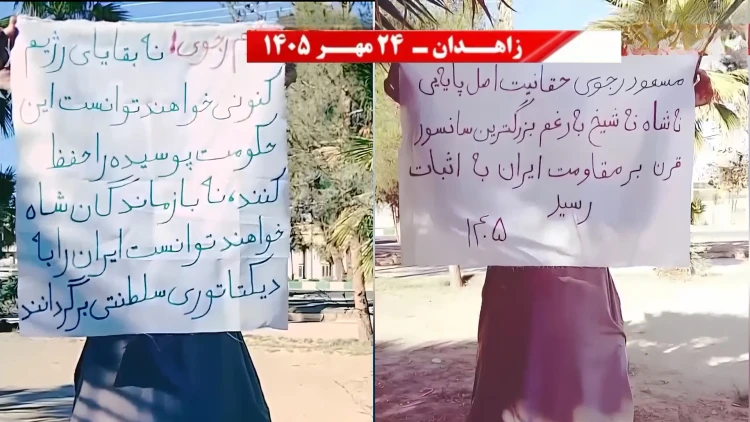

On October 16, 2026, PMOI/MEK Resistance Units resumed their weekly anti-regime activities in Zahedan, southeastern Iran, displaying placards in public places rejecting both the ruling clerical dictatorship and a return to monarchy. Their messages linked opposition to executions and repression with the demand for a democratic republic.
“A dictator is a dictator, whether with a turban or a crown,” read one placard. Another declared: “No to mullahs, no to shah, yes to freedom and democratic republic.”
October 16—Zahedan, southeast Iran
PMOI/MEK Resistance Units resume weekly activities against the regime, spreading messages of resistance and rejecting all forms of dictatorship. pic.twitter.com/yZHcrXKUrm— People's Mojahedin Organization of Iran (PMOI/MEK) (@Mojahedineng) October 17, 2026
A major theme of the campaign was opposition to promoting Reza Pahlavi, son of Iran’s deposed shah, as a representative of the Iranian people. The messages came amid controversy over the Friedrich Naumann Foundation for Freedom’s 2026 Freedom Prize, which was offered to Pahlavi. The decision to give the prize to the representative of the ousted shah dictatorship has caused outrage, including a letter dated October 16, in which 306 Iranian associations and communities protested the arrangement.
One placard rejected “rewarding or legitimizing the remnants of the autocratic, foreign-dependent Shah,” arguing that monarchical dictatorship deserved no more recognition than clerical dictatorship.
Another warned that “every political spectacle staged by the Shah’s heir and his court sycophants ultimately serves no one but the ruling mullahs.” The slogans warned that efforts to rehabilitate the monarchy are a diversion from democratic change.
"Under the flag of 'Neither mullahs nor Shah,' we must raise the cry of freedom and rise in resistance." pic.twitter.com/9dbDbsZrjj
— People's Mojahedin Organization of Iran (PMOI/MEK) (@Mojahedineng) October 17, 2026
Other placards stressed that neither the current ruling establishment nor the remnants of the Pahlavi monarchy could offer Iran a legitimate political future.
“Neither the remnants of the current regime can salvage this decayed tyranny, nor will the survivors of the Shah be able to return Iran to a monarchical dictatorship,” one stated.
The Resistance Units also displayed “No to monarchy, no to the supreme leader, yes to democracy and equality” and “No to shah, no to mullahs, the people demand a democratic republic.”
The Resistance Units stressed that authority must derive from the people, not inherited rule or religious office. They endorsed a “democratic revolutionary alternative and its united front,” emphasizing organized resistance and popular sovereignty.
"The legitimacy of the fundamental principle 'Neither Shah nor mullahs' has been proven, despite the greatest censorship of the century against the Iranian Resistance" pic.twitter.com/DHxO9XnMgl
— People's Mojahedin Organization of Iran (PMOI/MEK) (@Mojahedineng) October 17, 2026
The placards addressed the regime’s use of executions, arrests and torture. The Resistance Units stressed that regime authorities intensify repression to prevent protests and avert their overthrow.
At least 43 prisoners were executed between September 30 and October 13, 2026. Two protesters arrested during the January 2026 uprising were also executed in Isfahan on October 5.
“We pay tribute to the rebels who were executed this year for participating in the uprisings,” another placard declared.
The campaign offered a contrasting objective: “We struggle to establish a society free from executions and torture, for a democratic republic.” The Resistance Units’ continued public activities challenged the regime’s efforts to silence dissent through fear.
"The monster of religious fascism has failed in the face of the people's uprisings and organized resistance and has been unable to stop them." pic.twitter.com/sEforGH7jQ
— People's Mojahedin Organization of Iran (PMOI/MEK) (@Mojahedineng) October 17, 2026
Several messages connected Zahedan’s activities with Iran’s organized resistance. One recalled June 20, 1981, when Revolutionary Guards opened fire on a large PMOI-organized demonstration in Tehran, followed by mass arrests and executions.
A placard described the resolve to oppose both Shah and mullahs as enduring from that date to the present, sustained by Resistance Units and young Iranians.
Other messages declared that the clerical regime was increasingly vulnerable and that political change would come through the Iranian people and organized resistance, not the return of a previous dictatorship.
The campaign concluded with a slogan tying Zahedan to the nationwide struggle: “From Zahedan to Tehran, down with the oppressor, be it the shah or the supreme leader.”