

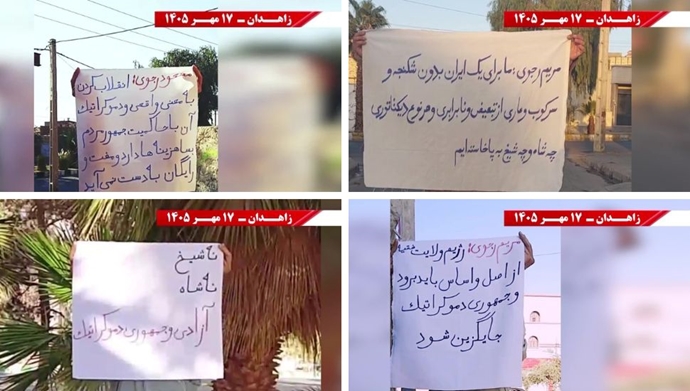

On October 9, 2026, PMOI/MEK Resistance Units resumed their weekly anti-regime activities in Zahedan, southeast Iran, displaying placards in public places despite the regime’s security measures.
Their messages rejected both the ruling religious dictatorship and a return to monarchy, condemned the escalating wave of executions, and emphasized the role of students in the struggle for freedom.
October 9—Zahedan, southeast Iran
PMOI/MEK Resistance Units resume their weekly anti-regime activities, rejecting all forms of dictatorship and reiterating their commitment to overthrowing the religious dictatorship of the mullahs ruling Iran. pic.twitter.com/SPLG8emy9e— People's Mojahedin Organization of Iran (PMOI/MEK) (@Mojahedineng) October 10, 2026
One placard summarized their demands: “We have risen for an Iran without torture and repression, free from discrimination and inequality, and free from any kind of dictatorship—whether Shah or mullahs.”
Neither Shah nor mullahs: Rejecting dictatorship in all its forms
The rejection of both monarchical and religious dictatorship was a central theme of the campaign. Placards declared, “Down with the oppressor, be it the shah or the mullahs,” and “No to mullahs no to shah, yes to freedom and a democratic republic.”
Another proclaimed, “Shah and mullahs are responsible for 100 years of crime.”
These slogans reflect the Resistance Units’ opposition to replacing the current dictatorship with a restored monarchy. Iran’s 1979 revolution ended the Shah’s rule, but the establishment of clerical dictatorship denied the Iranian people the democratic freedoms they had sought.
"Students with boldness and courage have never bowed to humiliation and surrender; now the universities must be reclaimed entirely." pic.twitter.com/YEgAsL2PbE
— People's Mojahedin Organization of Iran (PMOI/MEK) (@Mojahedineng) October 10, 2026
The Resistance Units emphasized that genuine political change requires rejecting dictatorship in all its forms.
Other placards declared, “Baluchestan is awake and despises the bloodthirsty shah and mullahs,” and “From Zahedan to Tehran, down with the oppressor, be it the shah or the supreme leader.”
Executions reveal the regime’s fear of growing resistance
The Resistance Units also condemned the regime’s escalating executions, linking them to its efforts to suppress public dissent.
One placard declared, “The increase in executions has a full correlation with the rise in resistance and public uprisings, demonstrating the regime’s fear of the people and the resistance.”
"True democratic revolution—anchored in the absolute sovereignty of the people—demands immense sacrifice; genuine freedom is never handed over without a price" pic.twitter.com/ZrieeugB2r
— People's Mojahedin Organization of Iran (PMOI/MEK) (@Mojahedineng) October 10, 2026
The campaign followed the executions of several protesters arrested during the January 2026 uprising. On September 30, the regime executed Ali Hemmati, 21, and Majid Nik-Andish, 25 in Mashhad. On October 5, Alireza Sepahi, 24, and Alireza Raisi, 21 were executed in Isfahan.
Meanwhile, on October 6, prisoners in 66 prisons held hunger strikes during the 141st week of the “No to Executions Tuesdays” campaign.
Against this backdrop, with their activities, the Resistance Units exposed the regime’s executions as an instrument of intimidation intended to prevent further uprisings, rather than a sign of regime strength.
Universities and students as a driving force for freedom
The campaign also highlighted the role of students and universities in opposing dictatorship.
“Students with boldness and courage have never bowed to humiliation and surrender; now the universities must be reclaimed entirely,” one placard declared.
Another called for universities to remain the “vanguard and spearhead of the struggle and uprising for freedom,” drawing parallels between student resistance under the Shah and the current clerical regime.
"The ruling regime is on the brink of collapse—shaken to its core, more fragile, and more vulnerable today than at any point in its history" pic.twitter.com/gTqKCsrJ6o
— People's Mojahedin Organization of Iran (PMOI/MEK) (@Mojahedineng) October 10, 2026
These messages came amid renewed student activism. On September 28, students at Allameh Tabataba’i University in Tehran protested rising educational costs and campus restrictions. Universities had also participated in protests during and after the January uprising.
The Resistance Units’ slogans connected student activism with the broader movement for political change.
A democratic republic based on popular sovereignty
Alongside their rejection of dictatorship, the Resistance Units emphasized their vision for Iran’s political future.
One placard stated, “The religious dictatorship of Velayat-e Faqih must be dismantled root and branch and replaced by a secular, democratic republic.”
Another emphasized that a genuine democratic revolution must be based on the absolute sovereignty of the people and requires sacrifice.
"The political rackets of both Shah and mullahs—the twin pillars of despotism and foreign dependency—must be permanently shut down and dismantled root and branch" pic.twitter.com/dDPbLZv4Zl
— People's Mojahedin Organization of Iran (PMOI/MEK) (@Mojahedineng) October 10, 2026
The slogans contrasted the principle of popular sovereignty with systems in which authority derives from either hereditary monarchy or clerical rule.
They also reiterated the Resistance Units’ determination to continue their struggle despite repression, presenting the overthrow of the clerical regime and the establishment of democratic governance as interconnected objectives.
Sustaining resistance despite repression
The October 9 activities demonstrated the Resistance Units’ continued public defiance despite security measures and escalating executions. Their placards conveyed a consistent message: Iran’s future must be determined by its people, free from both monarchical and religious dictatorship.
As one placard prominently displayed: “No to mullahs no to shah, yes to freedom and a democratic republic.”