

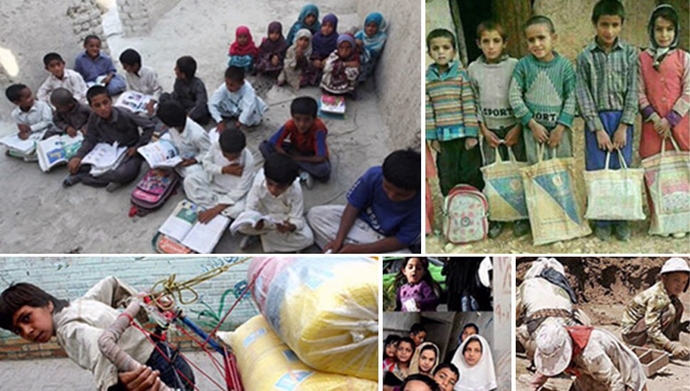

When schools across Iran reopened for the 2026–2027 academic year, around 16.5 million students were expected to return to classrooms. About 1.15 million children were entering first grade. For families, however, the beginning of the school year has become much more than the familiar annual task of buying notebooks, uniforms and backpacks. It has become another test of whether household income can keep pace with the rising cost of education.
Consider two students.
For a student attending a non-government school in Tehran, officially approved tuition can now reach 2.2 billion rials for upper secondary education. The head of Iran’s Organization for Non-Government Schools said in September that approved fees ranged from around 300 million to 2.2 billion rials, depending on the province and level of education. Costs such as uniforms, transport, food and school trips can be charged separately.
At the other end of the economic spectrum is a student attending a public school, where tuition is formally free. Even there, the family must still pay for clothing, shoes, transportation and school supplies. According to estimates, a basic school-supplies package this year ranges from roughly 30 million to 170 million rials. One stationery seller said the price of a quality notebook had risen from 850,000 rials last year to 1.8 million rials this year.
These two experiences are very different, but they point to the same problem: the cost of obtaining an education is becoming an increasingly important dividing line among Iranian families.
The widening gap between free education and its real cost
The economic burden is especially striking because free schooling is not merely an aspiration in Iran. It is written into the regime’s own constitution.
Article 30 states that the government must provide free education for all citizens through secondary school. Yet even Iranian state media have documented the gap between that rule and what some families encounter.
A July 2026 report by the state-run Tasnim news agency on schools in Kashan quoted one father saying that enrollment of his daughter in the first year of secondary school had been conditioned on payment of 50 million rials. Another parent said he had paid 120 million rials the previous year because his child lived outside the school’s designated area. The report described complaints from parents about payments requested under labels such as tuition or parental participation.
And registration is only part of the bill.
A family still has to provide a backpack, stationery, shoes and in many schools a uniform. Transportation can add another recurring expense. Even when public-school tuition is zero on paper, therefore, sending a child to school is not cost-free in practice.
The contrast becomes sharper when compared with private education. In Tehran, the officially announced ceiling for non-government schools is 1.72 billion rials for primary education, 2 billion rials for lower secondary and 2.2 billion rials for upper secondary, including specified extracurricular programs. Uniforms, meals, transportation and trips remain outside those figures.
When poverty turns into educational exclusion
The consequences extend beyond how much families spend. For a significant number of children, the question is whether they enter or remain in school at all.
In early September, the Education Ministry’s “Shahid Mahmoudvand” tracking system had identified 141,837 children between the ages of six and 11 who were out of school. Of these, 78,670 were boys and 63,167 were girls. The ministry also said that 1.154 million children were eligible to enter first grade this year, while the status of part of that population had not yet been determined.
The primary-school figures are only one part of the picture. Official data for the 2023–2024 academic year put the number of children outside education across primary and secondary levels at around 992,000: approximately 192,000 at primary level, 214,000 at lower secondary and 586,000 at upper secondary.
Poverty is one of several factors connected to educational exclusion. Child labor is another manifestation of the same economic pressure. A June 2026 conference in Tehran presented an estimate of approximately two million working children in Iran.
When a household is struggling to cover food, housing and other basic expenses, school supplies and transportation become another competing cost. For some families, an older child can also become a source of income.
That is how an economic crisis can gradually become an educational one: first through cheaper supplies and postponed purchases, then irregular attendance, and in the most vulnerable households, departure from school altogether.
A school system that is also short of teachers
Children who remain in school face another problem: shortages inside the education system itself.
Education Minister Kazemi acknowledged just before the beginning of the academic year that Iran was short by approximately 90,000 teachers. He said the official deficit had declined from about 126,000 the previous year and that the remaining shortage would be covered through around 2.5 million hours of additional teaching, using serving teachers, retirees and contract instructors.
Teachers’ organizations give a higher estimate.
The Islamshahr Teachers’ Association, in a report carried by the Coordination Council of Iranian Teachers’ Trade Associations, estimated the deficit at between 100,000 and 130,000 teachers for the 2026–2027 academic year. The association also warned of overcrowded classrooms, declining educational quality and wider budget problems.
Covering vacancies through overtime and retired or hourly teachers may prevent some classrooms from being left without an instructor, but it does not eliminate the underlying shortage. It also means that the difficulty confronting students is not limited to whether their parents can afford a backpack. The availability of teachers and the quality of the public system are also part of the equation.
This is particularly consequential for lower-income families. Wealthier households have more opportunities to compensate through private schools, tutoring and supplementary classes. Families that depend exclusively on the public system have fewer alternatives when classrooms are crowded or qualified staff are unavailable.
Educational inequality does not end at the school gate
The significance of these economic differences extends beyond the quality of an individual school. They can influence a student’s future access to higher education.
This became the subject of nationwide student protests in June 2026. High-school students demonstrated in numerous cities over changes to university admission rules, including the increased weight given to high-school academic records in determining admission. Protests were reported in Tehran, Mashhad, Shiraz, Isfahan, Tabriz, Kermanshah, Ahvaz, Rasht and other cities.
The dispute is important because students do not compete from equivalent educational environments.
A family able to pay hundreds of millions or even billions of rials for private education, extracurricular programs and specialized preparation has access to resources that a student in an overcrowded public school may not. The June demonstrations highlighted this disparity, arguing that access to private schooling and educational resources has given wealthier students an advantage in the competition for university places.
The broader issue is therefore not only whether students are formally allowed to attend school. Equal access to a classroom does not necessarily amount to equal educational opportunity when the quality of schools, availability of teachers and ability to purchase supplementary education differ sharply according to household income.
This helps explain why changes to entrance-exam rules produced protests far beyond a narrow dispute about testing. For students and families, the rules determine how inequalities accumulated over years of schooling translate into access to university.
Schools are also treated as a political arena
There is another dimension to Iran’s education crisis that cannot be measured in school fees or teacher vacancies.
As the new academic year approached, statements by officials again showed that authorities view schools and universities not only as educational institutions, but as politically sensitive spaces.
Speaking shortly before the reopening of schools, cleric Reza Nouri warned education officials that an “enemy” was seeking to “conquer” the education system and universities. He called for officials, teachers and administrators to “sanitize” the educational environment and urged students to participate in that effort.
The comments came only months after the June student demonstrations. In their aftermath, the regime engaged in escalating disciplinary action against university students. At the time, the state-run Shargh newspaper reported that disciplinary files had been opened against more than 100 students at Iran University of Science and Technology and that 150–200 University of Tehran students were preparing defenses in disciplinary cases. At Sharif University, Shargh reported several expulsion orders and more than 20 suspensions.
These developments provide context for the political language surrounding the reopening of schools. At a time when families are confronting school costs, teacher shortages and the risk that children will leave education, part of the official discussion continues to focus on political control and ideological influence inside educational institutions.
The new school year reflects a much wider crisis
The reopening of Iran’s schools therefore brings together several problems that are often discussed separately. Rising household costs, widespread educational exclusion, a severe teacher shortage, and the growing gap between private and public education are placing increasing pressure on Iranian students and families.
At the same time, authorities continue to approach schools and universities through a political and security lens.
This is what makes the beginning of the school year a revealing measure of conditions in Iran. Behind the familiar images of children returning to classrooms is a convergence of household poverty, unequal opportunity, shortages in public education and continuing political tension around students and educational institutions.
For millions of Iranian families, the central question at the start of another academic year is therefore no longer simply what their children will learn. It is what they must pay to keep them learning, what quality of education they can obtain, and whether the system provides their children with a realistic chance to remain in school and advance.