

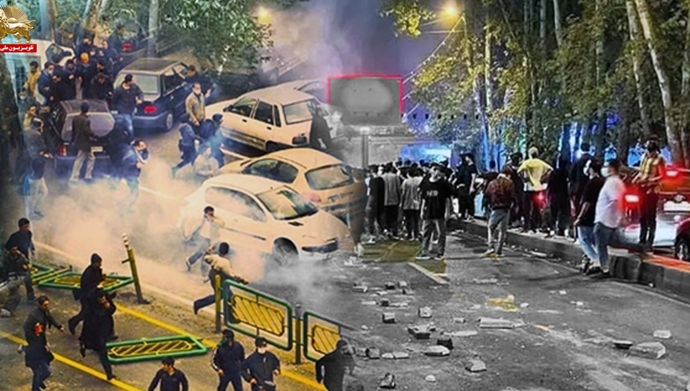

The Iranian regime continues to hold the institutions of state power, but that fact alone does not resolve the deeper question of its domestic stability. Four years after the September 2022 uprising and only months after another nationwide protest wave in January 2026, the authorities continue to treat the prospect of renewed unrest as a serious security concern.
That concern was visible again around the fourth anniversary of the 2022 uprising. On September 15, 2026, amid heightened security measures, PMOI Resistance Units carried out projections, graffiti, poster campaigns, and other public activities in cities including Tehran, Mashhad, Isfahan, Shiraz, Kermanshah, Karaj, Kerman, Hamedan, and Kashan. This is while State Security Forces chief Ahmadreza Radan had spoken of pursuing and arresting PMOI members to create fear in society.
This is a clear indication that while the regime is using violence to suppress protests, the political and social pressures that produced previous uprisings have not disappeared.
The economic foundations of social discontent
The scale of Iran’s economic deterioration helps explain why officials remain sensitive to renewed unrest. In the past months, the rial fell from around one million to more than 2.2 million to the U.S. dollar. In September, official 12-month average inflation stood at 69.9%, unemployment had risen to 9.1%, and an average monthly salary of approximately $125 was far below estimated basic household spending of around $450.
The September 8 gasoline price increase added another politically sensitive pressure point. The price for consumption above the subsidized quotas doubled from 50,000 to 100,000 rials per liter. At the same time, official figures cited in PMOI reporting showed food-price inflation running at approximately 128%. The combination of falling purchasing power, food inflation, fuel costs, and shortages gives the term “explosive conditions” a concrete socioeconomic basis rather than leaving it as a political slogan.
A recurring pattern of nationwide uprisings
Iran’s recent history shows how economic and social grievances can develop into wider political protests. Nationwide protest waves occurred in December 2017–January 2018, November 2019, 2022, and again from late December 2025 into January 2026. Amnesty International has documented a recurring pattern of lethal repression across these protest cycles.
The January 2026 uprising provides the most recent example. Protests had spread to 192 cities by January 10. Amnesty International subsequently described January 8–9 as another large-scale protest massacre and said thousands of protesters were killed during those two days.
The pattern is therefore one of recurring mobilization followed by repression—not the disappearance of the underlying grievances.
The regime’s warnings reveal its priorities
The authorities’ own statements provide another indication of how seriously they regard the domestic situation. On August 27, 2026, the IRGC Intelligence Organization warned that Iran’s adversaries could exploit domestic “weaknesses, shortages and limitations” and turn dissatisfaction into street protests. Regime president Masoud Pezeshkian had raised similar concerns two days earlier, speaking of economic and social dissatisfaction as potential drivers of unrest. Police also expanded surveillance of gasoline stations as debate over higher fuel prices intensified.
These statements are significant because they come from within the governing and security apparatus itself. They show that officials regard the transformation of economic grievances into street mobilization as an active security problem.
The role of Resistance Units between protest waves
It is in this context that the Resistance Units assume significance in the PMOI’s strategy. They are networks affiliated with the PMOI that operate inside Iran and conduct political messaging, public displays, and actions directed at institutions associated with the state and its security apparatus.
During the December 2025–January 2026 uprising alone, PMOI Resistance Units carried out 630 operations against IRGC, Basij, and other regime centers. The Resistance Units have continued their operations against regime targets despite intense security measures by the regime, including a recent wave of 61 daring operations in early September.
The continued activities of Resistance Units helps maintain an organized presence during intervals between nationwide protest waves.
In May, the PMOI published leaked minutes and recordings from Tehran and Alborz security councils covering 2020–2025. According to those materials, officials repeatedly discussed Resistance Unit recruitment, mobility, and reconstruction after arrests. In a December 2023 meeting, a Tehran intelligence official acknowledged that operational teams had been rebuilt following previous arrests and that their activities had subsequently increased.
An unresolved domestic confrontation
Taken together, the economic indicators, successive protest waves, official security warnings, and continued Resistance Unit activity point to a domestic confrontation that repression has not resolved. January 2026 demonstrated that socioeconomic grievances can again develop rapidly into nationwide political protests. The authorities’ subsequent warnings and security deployments show that they continue to prepare for that possibility.
That next uprising will come, and waiting in the wings is the organized Resistance movement, which is the sole solution to regime change and the establishment of democracy and freedom in Iran.