

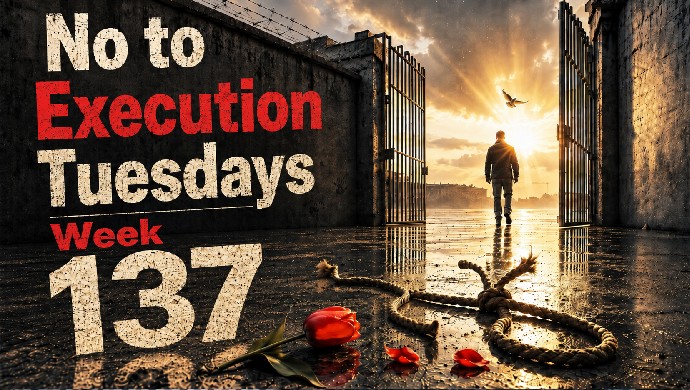

On September 8, 2026, inmates across 62 prisons held the 137th week of the “No to Executions Tuesdays” hunger strike. The campaign, which has become the most sustained organized protest against the death penalty in Iran’s prisons, continues in the face of severe security pressures, threats, punitive measures, and the restriction of inmates’ communications with the outside world.
As the regime grapples with its fragile hold on power following the recent uprisings and the transition of power to Mojtaba Khamenei, authorities are utilizing a surge in executions to preempt further unrest. The country is currently facing a crushing economic crisis, marked by triple-digit inflation and the collapse of the national currency, which has plummeted to 2.3 million rials against the US dollar.
In their weekly statement, the striking prisoners highlighted the direct correlation between the state’s economic failures and its reliance on the gallows. “The intensification of these repressions and executions, both individually and collectively, reflects the regime’s fear of nationwide protests and upcoming uprisings,” the prisoners wrote. “The ever-worsening economic crisis, triple-digit inflation, the dollar jumping to 2.3 million rials, the official start of gasoline price hikes on Tuesday, and the daily shrinking of workers’ and laborers’ tables draw the prospect of a social explosion more than ever.”
The regime’s killing machine is operating at an accelerated pace. According to the campaign’s statement, over 45 prisoners have been executed since late August, with at least 11 individuals hanged in the past week alone. The judiciary is concurrently bypassing its own legal procedures to expedite executions. In Isfahan, for instance, the Supreme Court accepted a retrial for Alireza Sepahi, a prisoner on death row. However, the parallel branch assigned to the case refused to hold a hearing, summarily rejecting the retrial and sending his file directly to the execution branch.
The prisoners also raised the alarm regarding a group case involving 16 defendants facing mass sentences. Ten individuals—Taraneh Rahimi, Navid Elyasi, Abolfazl Dadgostar, Mehdi Mansouri, Ahmadreza Saeedi, Mehrdad Bouyeri, Mohammad Mehdi Asadi, Armin Gholami, Parsa Jafari, and Mehdi Jafari (Khosravi)—have each been sentenced to death and 11 years in prison. Six other co-defendants were handed heavy prison terms: Romina Rahimi and Milad Bouyeri were each sentenced to 36 years, Hamed Mehralian to 26 years, and Setayesh Saedi, Sajjad Abedi, and Ali Bouyeri to 16 years each. The combined prison sentences for these 16 defendants total 256 years.
In their statement, the political prisoners urged the international community not to ignore the systematic slaughter taking place domestically.
“In these critical conditions, the necessity of continuing the ‘No to Executions Tuesdays’ campaign, despite all the dangers and restrictions inside the prison, has doubled,” the striking prisoners declared. “We, the members of this campaign, once again call upon all international institutions, awakened consciences, human rights defenders, and advocates for the abolition of the death penalty worldwide for their companionship and solidarity.”
The prisoners participating in the 137th week of the “No to Executions Tuesdays” hunger strike are located in 62 facilities across Iran.