

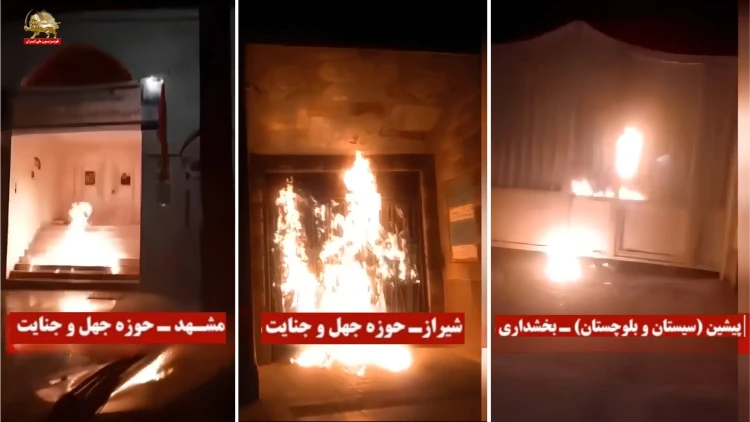

On August 7, 2026, PMOI/MEK Resistance Units across Iran carried out a sweeping wave of 60 daring operations. This coordinated campaign was launched to mark the 38th anniversary of the summer 1988 massacre of political prisoners and to honor the 30,000 individuals who courageously refused to surrender to the Iranian regime. Nearly four decades later, the fight for freedom in Iran is more alive than ever, with the spirit of the 1988 martyrs continuing to drive today’s rebellious youth.
Spanning across major cities and towns—including Tehran, Mashhad, Shiraz, Isfahan, Kermanshah, Khorramabad, and Aligudarz—the Resistance Units systematically targeted the regime’s machinery of suppression and ideological hubs. Brave youths targeted and set fire to the entrances of IRGC Basij bases, which play a central role in suppressing dissidents, as well as various regime buildings. Furthermore, several operations involved setting fire to regime centers for spreading fundamentalism and terrorism.
August 7—Iran
PMOI/MEK Resistance Units across Iran carry out 60 daring operations across Iran to mark the 38th anniversary of the 1988 massacre of political prisoners an in honor of 30,000 political prisoners who refused to surrender to the regime. pic.twitter.com/AR0HY62HJD— People's Mojahedin Organization of Iran (PMOI/MEK) (@Mojahedineng) August 9, 2026
In a direct challenge to the regime’s supreme authority, the Resistance Units also shattered the ruling theocracy’s image of control by torching propaganda banners and posters of top regime figures. These included regime founder Ruhollah Khomeini, the eliminated supreme leader Ali Khamenei, the newly installed supreme leader Mojtaba Khamenei, and eliminated terror mastermind Qasem Soleimani.
These acts of defiance are deeply rooted in the historical epic of the 1988 massacre. During that summer, then-regime supreme leader Ruhollah Khomeini issued a religious fatwa explicitly ordering the purge of all political prisoners who supported the People’s Mojahedin Organization of Iran (PMOI/MEK).
Following sham courts that lasted only minutes and entirely denied prisoners any legal right to a defense or a lawyer, inmates were given a stark choice: disown their pledge to the PMOI and their fight for freedom, or go to the gallows. In an extraordinary epic of defiance, 30,000 political prisoners heroically embraced death rather than surrender to tyranny.
Shiraz
Resistance Units set fire to Khomeini poster pic.twitter.com/m4V2Md5zgt— People's Mojahedin Organization of Iran (PMOI/MEK) (@Mojahedineng) August 9, 2026
The regime went to unprecedented lengths to cover up this monumental crime, marking it highly classified even to minor government officials. Victims were secretly buried in heavily guarded, mass unmarked graves. Families were kept in the dark about the fate of their loved ones, and when finally informed, they were severely intimidated and explicitly instructed not to hold funerals.
Dictators throughout history have repeatedly failed to understand a fundamental truth: the blood of those seeking freedom and justice never dies. It does not simply vanish into the earth; it multiplies, flows, and flourishes. The regime fundamentally miscalculated the resilience of the Iranian resistance, believing that by wiping out a generation of dissidents, they could secure their totalitarian rule indefinitely.
Ardebil
Resistance Units target regime building pic.twitter.com/niu0POHIEX— People's Mojahedin Organization of Iran (PMOI/MEK) (@Mojahedineng) August 9, 2026
For 38 years, the battle between the 1988 martyrs and the regime’s executioners has not stopped for a single day. This confrontation has continuously echoed through the eight major uprisings that have rocked the nation since, including the massive nationwide uprisings in December 2025 and January 2026 that brought the regime to its knees. Today, the martyrs of 1988 remain timeless sparks whose truth lives on in the national collective memory. Their legacy continues to burn brightly in the daring activities of the Resistance Units confronting the regime across Iran.