

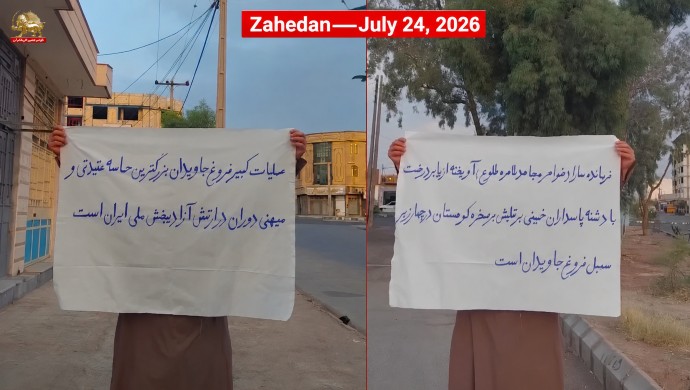

On July 24, PMOI/MEK Resistance Units took to the streets of Zahedan in southeast Iran to mark the anniversaries of Operation Eternal Light and the 1988 massacre of political prisoners. Holding placards in public spaces, these activists sent a defiant message to the clerical regime, proving that decades of executions and repression have failed to silence the Iranian people’s liberation movement.
As one placard boldly declared, “Today, the spirit of Eternal Light lives on through the Resistance Units across Iran.” Another sign reminded the public of the historic sacrifices made by the opposition: “When the monster Khomeini raged and none dared raise their voice against war and stifling repression, our generation of martyrs turned the tide of our nation’s history—rewriting it with our very blood.”
July 24—Zahedan, southeast Iran
In their weekly activities, PMOI/MEK Resistance Units mark the anniversaries of Operation Eternal Light by the National Liberation Army and the massacre of Iranian political prisoners in 1988. pic.twitter.com/xDuJYXmACa— People's Mojahedin Organization of Iran (PMOI/MEK) (@Mojahedineng) July 25, 2026
The continuous influx of Iranian youth into the ranks of the Resistance Units—a network of activists spread across all corners of Iran—proves that the regime’s efforts to eradicate the PMOI have completely failed. In fact, regime officials and analysts are increasingly warning that the PMOI has become the establishment’s main problem.
The Resistance Units’ street campaign honors a military offensive that struck at the core of the regime and exposed its fundamental weakness. On July 25, 1988, the PMOI forces within the National Liberation Army of Iran (NLA) launched Operation Eternal Light from Camp Ashraf near the border.
Committing their full strength to the liberation of the homeland, the NLA pushed deep into Iranian territory, reaching the gates of Kermanshah in less than 12 hours and bringing the clerical establishment to the brink of collapse.
"Operation Eternal Light remains an unforgettable epic in the history of the Iranian people's liberation movement—a living testament to the independent, democratic alternative forged through the sacrifices of its immortal martyrs and courageous defenders." pic.twitter.com/iXoNaf9m11
— People's Mojahedin Organization of Iran (PMOI/MEK) (@Mojahedineng) July 25, 2026
The offensive was a masterful counter-move designed to disrupt the regime’s intent to use the ensuing peace of a UN ceasefire to annihilate the opposition. The PMOI paid a heavy price in the week-long combat, losing 1,304 officers and soldiers. Among them was Commander Sara (Tahereh Toloo), who became an immortal symbol of the operation after Khomeini’s forces plunged a dagger into her heart and hanged her upside down from a tree in the mountain cliffs of Chahar Zabar.
In return, the NLA inflicted massive losses on Khomeini’s forces, who suffered roughly 17,000 killed and 35,000 wounded, with total regime casualties reaching 55,000. Through these operations, the Mojahedin poured the poison chalice of a ceasefire down Khomeini’s throat.
"When the monster Khomeini raged and none dared raise their voice against war and stifling repression, our generation of martyrs turned the tide of our nation’s history—rewriting it with our very blood." pic.twitter.com/zgJlHIqt9y
— People's Mojahedin Organization of Iran (PMOI/MEK) (@Mojahedineng) July 25, 2026
At the same time, terrified by the PMOI’s steadfastness and their push for freedom, Khomeini resorted to unprecedented brutality. On July 19, 1988—just one day after accepting UN Resolution 598 and the ceasefire—Khomeini issued a fatwa declaring PMOI members “apostates” and ordering the massacre of all steadfast PMOI political prisoners.
The regime established Death Commissions that orchestrated the mass killings of more than 30,000 political prisoners throughout August and until mid-September 1988. In utter secrecy—so strict that prison guards were barred from leaving to prevent news from spreading—prisoners were tried in five-minute trials and sent to the gallows simply for refusing to abandon their support for the PMOI.
"On July 19, 1988—just one day after accepting UN Resolution 598 and a ceasefire—Khomeini issued a fatwa ordering the massacre of all steadfast PMOI political prisoners." pic.twitter.com/IExpUxRizS
— People's Mojahedin Organization of Iran (PMOI/MEK) (@Mojahedineng) July 25, 2026
Khomeini’s judiciary chief, Mousavi Ardebili, declared during a Friday sermon on August 5, 1988: “A PMOI prisoner needs no trial; their sentence is predetermined, and they must all be executed without exception.” Survivors recalled prison guards kicking and punching prisoners as they were in the throes of death. The victims were then secretly buried in mass graves, with the regime later building roads and structures over some locations to destroy all evidence of their crimes.
The regime did not halt its efforts to destroy the PMOI after 1988. It has continued with arrests, executions of supporters, terrorist attacks abroad, and vast demonization campaigns. Yet, it has utterly failed to extinguish the flame of resistance. The PMOI’s 61 years of unyielding sacrifice and the roaring torrent of martyrs’ blood stand as an unbreakable commitment to peace and freedom.
"On July 25, 1988, the PMOI forces within the National Liberation Army of Iran launched the momentous Operation Eternal Light from Camp Ashraf near the border, committing their full strength to the liberation of the homeland." pic.twitter.com/Ll7rKAZNbL
— People's Mojahedin Organization of Iran (PMOI/MEK) (@Mojahedineng) July 25, 2026
As the placards in Zahedan highlighted, the regime sustains itself solely through the slaughter of its discontented citizens and by opening the door to foreign war, but this status quo cannot endure. Peace remains a noose around the regime’s neck. “An awakened society will never back down, even as the criminal IRGC spills the blood of its youth,” one activist’s sign read. Today, the legacy of the 1988 martyrs is the bedrock of the ongoing uprising, proving that the only forward-looking solution for Iran lies in the establishment of a democratic republic.