

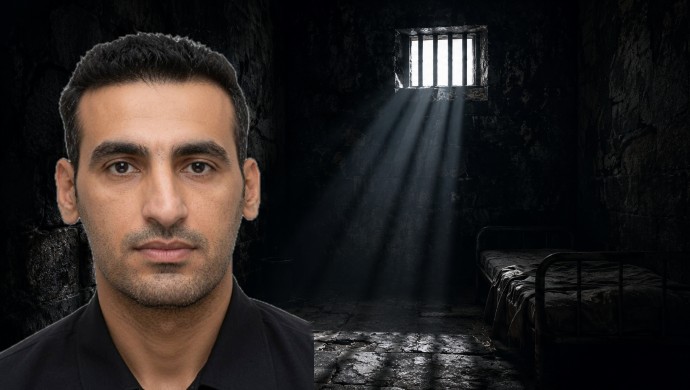

The clerical regime in Iran has sentenced political prisoner Isa Chari, an oppressed 37-year-old laborer, to death, marking the latest atrocity in its escalating crackdown on dissidents. A father of two young children and of Baluch origin, Chari worked at a poultry farm in Varamin to earn a living.
The criminal death sentence was issued by Judge Mohammad Mehdi Shahmirzadi in Branch 23 of Tehran’s Revolutionary Court on fabricated charges of membership in the People’s Mojahedin Organization of Iran (PMOI/MEK) and “committing anti-security measures.”
Arrested in Varamin on December 7, 2025, Chari has been held in solitary confinement in Ward 35 of Ghezel Hesar Prison. For seven months, the regime completely bypassed its own customary judicial and legal procedures, leaving his family entirely in the dark until his sudden transfer.
On December 23, 2025, the Ministry of Intelligence-affiliated Mehr News Agency reported his arrest without naming him, dubiously labeling him an “insecurity-causing element affiliated with expatriate currents” caught by IRGC intelligence forces.
A wider campaign of retaliation and heavy sentences
Chari’s case is not an isolated incident; it is part of a broader, retaliatory campaign targeting PMOI supporters and their relatives. In Evin Prison, 22-year-old accounting student Amir Hassan Akbari-Monfared was recently sentenced to death for “rebellion” by the notorious executioner Judge Abolghasem Salavati in Branch 15 of Tehran’s Revolutionary Court.
His persecution is based solely on his family connection to a martyred PMOI member and alleged contact with the organization. Tragically, four members of the Akbari-Monfared family were already martyred by Khomeini’s executioners during the 1980s.
Simultaneously, five political prisoners in Hall 37 of Ghezel Hesar Prison face imminent death threats and heavy sentences over PMOI membership charges. Abolfazl Rahbar, 23, and his cousin Omid Rahbar, 24, who were arrested in January 2026, were recently verbally notified of 20- and 26-year prison sentences, respectively.
Vahid Azizi, 42, a PhD holder in civil engineering arrested during the January 2026 nationwide uprising, and Mostafa Imani, 39, a writer and artist, both face active execution threats. Farshid Dolatyari, 41, has also been held in limbo and endured intense pressure since his November 2025 arrest over fabricated weapon-stockpiling accusations.
Executions as a tool of a desperate dictatorship
These death sentences reflect the violent desperation of a weakened regime that is profoundly terrified of Iranian youth gravitating toward PMOI Resistance Units. Following the massive nationwide uprisings in December 2025 and January 2026, which brought the dictatorship to its knees and were only contained through massacres, Tehran is desperately weaponizing executions to maintain its fragile grip on power.
On July 22, 2026, the regime executed 26-year-old law graduate and PMOI member Mehdi Khanaki in Karaj after a sham trial. Subjected to months of severe physical and psychological torture after his February 2026 arrest, he is one of eleven PMOI members—and among an estimated 2,400 individuals—executed over the past year.
Operating under the distraction of the fog of war and regional conflicts, the regime is systematically accelerating its political executions to prevent a resurgence of protests. Cruelly adding to the psychological torment, authorities continue to refuse to return the bodies of executed dissidents to their grieving loved ones.
The imperative for international action
The international community must not remain silent as the clerical dictatorship lays the groundwork for another massive purge of political prisoners, a chilling repeat of the 1988 massacre. These killings are a clear sign of the persistent uprising of the Iranian people” and demonstrate the regime’s terror of the inevitable explosion of public anger.
The Iranian Resistance urgently calls on the UN Special Rapporteur, the UN High Commissioner for Human Rights, and all international human rights bodies to take immediate, effective action to save the lives of Isa Chari, Amir Hassan Akbari-Monfared, and all political prisoners facing execution. An international fact-finding mission must urgently visit Iran’s prisons to investigate these conditions and halt the regime’s deadly machinery.