

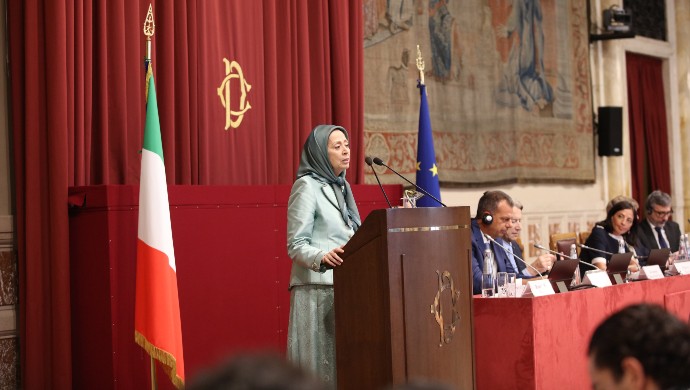

On July 16, 2026, the Italian Chamber of Deputies in Rome hosted a landmark conference titled “Iran’s Crisis: The Democratic Path Forward.” Taking place in Regina Hall, the gathering brought together prominent Italian lawmakers, former international officials, and the Iranian democratic opposition during a highly volatile geopolitical climate.
The year 2026 has been a watershed moment for Iran. A massive nationwide uprising spanning from December 2025 to January 2026 shook the clerical establishment to its core. Despite the deaths of thousands of protesters and a shifting political landscape following the February military strikes that eliminated Ali Khamenei and elevated Mojtaba Khamenei to Supreme Leader, the regime continues its brutal survival tactics.
The Italian conference highlighted a crucial, undeniable reality: foreign aerial bombardments and external military strikes will not overthrow the ruling theocracy. Regime change remains the exclusive prerogative of the Iranian people and their organized Resistance.
A Blueprint for a Free Iran: Mrs. Rajavi’s Address
Delivering the keynote address at the Chamber of Deputies, Mrs. Maryam Rajavi, President-elect of the National Council of Resistance of Iran (NCRI), presented a clear-eyed assessment of the ruling theocracy’s desperate state and the path to a free Iran. She stressed that the regime, heavily fractured after the January uprising and recent geopolitical shocks, survives solely through domestic suppression, nuclear ambition, and regional warmongering.
Addressing the recent ceasefire and nuclear negotiations, Mrs. Rajavi highlighted the fatal paradox facing the new Supreme Leader: “Peace is the noose around the regime’s neck, and that if forced to choose, it would prefer war a hundred times over peace.”
Over the past four decades, the dominant policy in the West was the attempt to change the regime's behavior. However, this produced the exact opposite results, as it ultimately paved the way for war.
As long as this regime remains in power, the region will never see peace and… pic.twitter.com/5sl2yveMS3
— Maryam Rajavi (@Maryam_Rajavi) July 16, 2026
Mrs. Rajavi underscored that foreign military engagements cannot substitute the will of the Iranian populace. “Freedom is fully attainable by the hands of the people themselves,” she declared, pointing to the organized Resistance Units preparing for future uprisings. She warned Western powers that providing financial resources or chasing grand bargains will never pacify Tehran. “It is a profound mistake to believe that a day will ever come when this regime abandons its hostility toward Iranian society and the international community to embrace peace,” she stated.
Outlining the NCRI’s Ten-Point Plan, Mrs. Rajavi offered a blueprint for a future free of both the ruling clerics and the deposed monarchy. “We seek a democratic republic based on the separation of religion and state, gender equality, and the abolition of the death penalty; a non-nuclear Iran… founded upon peace, coexistence, and international and regional cooperation.”
A Desperate Theocracy: Executions as a Tool of Survival
In the aftermath of the December 2025–January 2026 nationwide uprising, the Iranian regime has found itself in a state of unprecedented fragility. The national economy is in free fall, characterized by rampant inflation, unemployment, and poverty. Following the death of Ali Khamenei, the rapid succession of his son, Mojtaba Khamenei, has laid bare crippling internal divisions. Lacking the traditional influence of his father, Mojtaba has struggled to contain the factional infighting over how to navigate the recent ceasefire and international nuclear negotiations.
To mask this inherent weakness and project a facade of control, the state has drastically escalated its domestic repression. The statistics presented at the Chamber of Deputies illustrate a grim reality: since the beginning of 2026, Tehran has executed nearly 1,000 individuals.
This sweeping campaign of state-sponsored violence has heavily targeted political prisoners, members of the PMOI, and protesters detained during the January uprisings. Furthermore, state crackdowns have aggressively expanded to target religious minorities, with dozens of churches shuttered and congregants arrested. Just prior to the conference, UN experts publicly condemned the confiscation of St. Peter’s Anglican Church in Tehran and the forced displacement of Armenian and Assyrian Christians who resided on the premises.
Addressing this brutal reality, former US Representative Patrick Kennedy identified the crisis in Iran as the premier human rights imperative of the modern era, pointing out that the regime operates as the world’s leading state sponsor of terrorism while simultaneously being the top executioner of its own citizens. Fabio Rampelli, a Member of the Italian Parliament, reinforced this assessment, noting that the UN Human Rights Council is actively investigating the regime’s mass arrests and executions, which Tehran employs as a grim mechanism of political deterrence to prevent the next wave of popular revolts.
The Democratic Solution: Regime Change from Within
A prevailing theme throughout the conference was the fundamental mechanics of political change in Iran. While foreign aerial bombardments and external military conflicts have heavily targeted the regime’s infrastructure over the past year, the speakers were unified in articulating a definitive reality: a foreign war will not overthrow the Iranian regime. The collapse of the theocracy will only materialize through the sustained efforts of the Iranian people and their Resistance Units.
The January 2026 uprisings demonstrated the emergence of a highly organized, younger generation of Iranians who, alongside established Resistance Units, successfully confronted the suppressive forces of the IRGC and the Basij. This internal momentum is widely recognized by international observers as the only legitimate and capable vehicle for regime change.
https://twitter.com/JavadDabiran/status/2077765581801992679
Naike Gruppioni, Member of the Foreign Affairs Committee of the Chamber of Deputies and organizer of the conference, emphasized this internal dynamic. She stated that Mrs. Rajavi’s roadmap “is a vision that looks to the future and continues to inspire those who believe that change can be born from the strength of ideas and the will of the people.”
Gruppioni added, “With courage, determination, and extraordinary consistency, she has continued for years to carry forward a battle founded on the universal values of freedom, democracy, the rule of law.” Highlighting the Ten-Point Plan, she noted that it constitutes a clear and credible political proposal for a free, pluralistic Iran.
Senator Marco Scurria drew historical parallels between the current situation in Iran and the fall of the Iron Curtain, reinforcing that systemic change relies on the citizens on the ground. Directing his message to the Resistance Units operating inside Iran, Senator Scurria declared, “Tell them that there is no prison that can stop the wind of freedom.” He continued, “Tell them that there is no fear that can subdue millions of citizens, and that there is a struggle worth fighting so that a people can have a free and democratic future.”
Rejecting the Shadows of the Past: The Illusion of Monarchy
As the clerical regime’s grip weakens, discussions regarding Iran’s future have also necessitated a firm rejection of any regression to past dictatorships. The Italian conference served as a platform to critically dismiss the opportunistic campaigns organized by the son of the deposed Shah, whose recent media efforts seek to capitalize on the country’s instability to promote a return to monarchist rule.
https://twitter.com/en_simayazadi/status/2077791729504207273
Former New York City Mayor and US Federal Prosecutor Rudy Giuliani delivered a scathing critique of these attempts. Giuliani starkly contrasted the decades of immense sacrifice and organizational rigor of the PMOI/MEK with the sudden reappearance of the monarchist faction.
Labeling the Shah’s son a “nepo baby” surrounded by remnants of the notorious SAVAK secret police, Giuliani issued a direct challenge to proponents of the monarchy: “When they give you the Shah, bring him to me. And tell him, when he returns the money that he stole and the food that he took out of the mouths of his people, maybe we can give him a job in the post office.”
Giulio Terzi, President of the EU Policies Committee of the Italian Senate and former Foreign Minister, echoed this sentiment, criticizing the monarchist faction for deliberately deflecting questions about the dictatorial legacy of the Shah’s era. “This is a bit the mental attitude of a monarch who would like to propose himself with self-painted noble titles and who is certainly not up to representing that charge of freedom, of strength, and of will to go forward of the Iranian people which is that of Maryam Rajavi,” Terzi stated. He emphasized that European policy must firmly recognize the organized opposition that truly represents the democratic aspirations of the Iranian populace.
Ending Appeasement: A Call to the International Community
For decades, Western foreign policy toward Iran was anchored in the hopes of modifying the regime’s behavior through economic incentives, negotiations, and grand bargains. The speakers in Rome methodically dismantled this approach, pointing out that diplomatic appeasement has only emboldened Tehran’s domestic crackdowns and transnational terrorism. The recent move by the United Kingdom to designate the IRGC as a terrorist organization was highlighted as a crucial step that the broader European Union must immediately emulate.
Senator Terzi argued against maintaining dialogue with Tehran, noting that such engagements merely afford the regime the time and resources to arm itself and massacre dissidents. Comparing the regime’s atrocities to the worst totalitarian plagues of the 20th century, he rejected the premise that the regime will ever moderate its behavior.
MP Fabio Rampelli outlined the catastrophic global consequences of the regime’s unchecked belligerence, pointing to its direct involvement in international conflicts. “The military aid provided to the Russian Federation in the war of aggression against Ukraine with the transfer of drones and ballistic missiles, the support to non-state armed groups in the Middle East and the Red Sea area, the Houthis, so to speak, and the actions that have hindered free navigation in the Strait of Hormuz have contributed to a crisis involving essential energy and commercial routes,” Rampelli noted.
Mayor Giuliani emphasized the futility of appeasement, insisting that the theocracy cannot be defeated with words or economic concessions. Highlighting the extensive track record of the Iranian Resistance, Giuliani stated, “We know what we’re getting in Madame Rajavi and we know what we’re getting in the MEK and the NCRI and the various groups that have been working not for a day, not for a week, not for a month, for 47 years and before that against the Shah.”
Giuliani stressed that Western governments must firmly back this alternative, adding, “The only way we can do that… is my people in all these governments, all over Europe, all over the United States, and every place else we have to go, standing up and saying, we got an answer, MEK is the answer.”
Mrs. Rajavi further underscored this point, warning that Europe deprives itself of its most effective leverage by ignoring the Iranian Resistance. She stated, “Let me make it clear that Europe will regain its credibility in the Middle East only when it plays an effective and active role at the very epicenter of the region’s crisis, namely, in Iran.”