

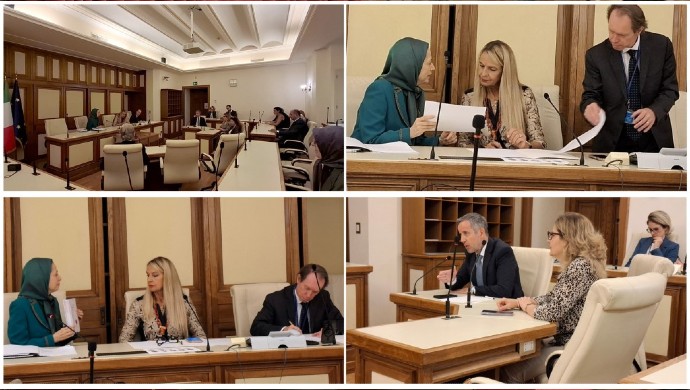

On July 16, 2026, the Human Rights Commission of the Italian Senate convened an official hearing with Mrs. Maryam Rajavi, President-elect of the National Council of Resistance of Iran (NCRI). The formal session aimed to address the escalating human rights crisis inside Iran.
The hearing took place at a critical juncture, as the newly consolidated regime under Mojtaba Khamenei accelerates its use of political executions to suppress dissent and mask its fundamental vulnerability following the massive nationwide uprisings of December 2025 and January 2026.
While recent months have seen foreign military strikes that killed former Supreme Leader Ali Khamenei and altered the geopolitical landscape, the proceedings in Rome focused on a clear, unified message: foreign wars and aerial bombardments will not bring down the religious dictatorship.
Instead, both Mrs. Rajavi and Italian lawmakers emphasized that true, democratic regime change can only be achieved from within, driven by the Iranian people and their organized Resistance. Opened by Senator Stefania Pucciarelli, President of the Commission, the hearing served as a major European platform to expose the clerical establishment’s domestic atrocities and to outline a decisive, human rights-driven foreign policy roadmap for Italy and the wider European Union.
Mrs. Rajavi’s Vision: A Democratic Republic Forged in Resistance
During her address to the Italian Senate, Mrs. Maryam Rajavi delivered a sobering account of the Iranian regime’s escalating brutality, detailing how the ruling dictatorship has exploited the fog of recent regional conflicts to launch a sweeping campaign of mass arrests and political executions.
Noting that approximately 2,400 individuals have been executed since last July, Mrs. Rajavi emphasized that the regime’s violence is wholly politically motivated—a desperate attempt to breed a climate of terror and prevent a resurgence of the sweeping January uprisings.
Today, Thursday, at a hearing of the #HumanRights Commission of the Italian Senate, I expounded on the critical human rights situation in Iran and reminded the responsibility of European countries, including Italy, in this regard.
Senators strongly condemned the regime’s… pic.twitter.com/Vwds6eOod1— Maryam Rajavi (@Maryam_Rajavi) July 16, 2026
Mrs. Rajavi highlighted the specific cruelty inflicted upon political dissidents, pointing out that ten members of the PMOI/MEK were recently hanged for participating in the protests, with authorities cruelly withholding their bodies from mourning families.
She presented the harrowing case of Arghavan Fallahi, a 25-year-old woman enduring severe torture and solitary confinement, illustrating a broader systemic crisis where citizens are entirely stripped of their right to a fair trial.
Yet, amid this darkness, Mrs. Rajavi highlighted the unbroken spirit of the Iranian people. Recounting the final words of executed PMOI members like Pouya Ghobadi, who wrote, “If the freedom of these people requires the blood of someone like me, I offer my life with all my heart for the liberation of my nation,” she underscored that state-sanctioned killings have failed to extinguish the Resistance.
Presenting the NCRI’s platform for a future free Iran, Mrs. Rajavi called for a secular republic, the absolute abolition of the death penalty, and complete gender equality. She concluded by urging the international community to condition all diplomatic relations with Tehran on an immediate halt to executions.
The Escalating Execution Crisis and Systematic Repression
The statistics and testimonies presented at the Senate hearing laid bare the sheer scale of the regime’s reliance on capital punishment as a tool for political survival. Following the intense nationwide protests earlier this year, the clerical establishment responded not with reform, but with the gallows.
Senator Giulio Terzi provided startling figures to the commission, noting that over 818 arbitrary executions have been officially recorded in the current year alone. This surge in state-sanctioned killings is occurring alongside an institutional acceleration of the death penalty. Senator Bartolomeo Amidei formally requested the archiving of reports indicating that Tehran Prosecutor Ali Salehi has established specialized judicial sections designed exclusively to expedite the death sentences of protesters detained during the uprisings.
#Iran. Terzi (FdI) : un onore ascoltare in Senato Maryam Rajavi, presidente eletta del Consiglio Nazionale della Resistenza Iranianahttps://t.co/d4FJLO538e
“Oggi l’Iran vive sempre più sprofondato nel baratro delle terribili violazioni di diritti umani e delle atrocità che il… pic.twitter.com/kmAnHwRiZn— Giulio Terzi (@GiulioTerzi) July 16, 2026
Beyond the executions, the regime has weaponized information and basic civil rights. As Mrs. Rajavi noted, authorities instituted a sweeping, 4-month and 18-day nationwide internet blackout to enforce absolute censorship during the height of the uprisings and subsequent crackdowns. The legal system itself has been systematically dismantled; citing a recent report by the International Bar Association, Mrs. Rajavi demonstrated how restrictive laws, security apparatus interference, and the state takeover of bar associations have completely hollowed out the right to a legal defense.
Senator Stefania Pucciarelli voiced the commission’s profound solidarity with the victims of these abuses, setting the tone for the hearing. “Respect for human rights in Iran is among the priorities of this commission,” Senator Pucciarelli stated. “We express our profound solidarity with the Iranian people and particularly with Iranian women, who are suffering due to a regime and have been suffering for too long.”
The Democratic Solution: The People and Their Resistance
A recurring theme throughout the Senate hearing was the acknowledgment that the responsibility for overthrowing the religious dictatorship rests entirely with the Iranian people. The premise that a regime can be toppled through foreign military intervention or aerial bombardments has proven fundamentally flawed. The recent military strikes may have altered the regime’s leadership structure, but they did not dismantle the deeply entrenched apparatus of state terror on the ground.
Recognizing this reality, Senator Gisella Naturale noted the limitations of foreign nations to intervene directly in a struggle that must be resolved internally. The true engine for change remains the grassroots movement and the Resistance Units operating across Iranian cities. Despite enduring heavy casualties, including the ongoing executions of its members, this movement continues to grow in defiance.
The political maturity of the Iranian Resistance was openly acknowledged by European lawmakers, who recognize it as a force striving for a modern, democratic republic rather than a return to past dictatorships. Senator Terzi explicitly addressed this, stating, “[The NCRI represents] a very broad, vast, and deep-rooted resistance; a resistance that does not want to restore an oppressive monarchy, but to realize a new Iran of democracy and certainty, not only of hope. This movement is gaining, on a rising wave, consensus and success.”
Furthermore, Senator Terzi praised the resilience of political prisoners currently locked inside the regime’s dungeons. He drew special attention to the ongoing hunger strikes carried out every Tuesday by political prisoners across more than 25 Iranian prisons, describing their 45-week struggle as an inspiring battle for civilization and freedom. Senator Amidei echoed this sentiment, noting the heavy toll paid by the PMOI/MEK since 1988 and urging all resistance factions to unite under the common goal of overthrowing the regime.
The Role and Responsibility of the International Community
For decades, the international community’s approach to Iran has been marred by a failure to hold the regime accountable for its crimes against humanity, granting its leaders systematic impunity. Mrs. Rajavi reminded the panel that the 1988 massacre of 30,000 political prisoners remains a foundational crime that set the precedent for the mass killings happening today.
During the hearing, Italian senators urged a fundamental shift in European foreign policy—away from short-term economic or security appeasement, and toward a strict adherence to human rights principles. Senator Amidei challenged the prevailing international narrative, stating, “I believe that at a time when world public opinion, and also Italian public opinion, is more focused on the oil tankers passing through the Strait of Hormuz, turning the spotlight on what is happening in terms of repression, of the lives and deaths of those who protested against the regime, is fundamental.”
In Commissione #DirittiUmani, incontro con @Maryam_Rajavi @iran_policy. Diretta → https://t.co/aoJ2dxiixH pic.twitter.com/WIArtphSdK
— Senato Repubblica (@SenatoStampa) July 16, 2026
Mrs. Rajavi laid out clear, actionable steps for Italy and the European Union to lead this policy shift. She called for all diplomatic and trade relations with the regime to be strictly conditioned on a halt to executions. Additionally, she urged the international community to prosecute the ruling perpetrators of these atrocities under the principle of universal jurisdiction and to refer Iran’s human rights violations to the UN Security Council.
Lawmakers also highlighted immediate actions that European governments can take to support the Iranian diaspora. Senator Naturale insisted that Italy has a moral obligation to protect diaspora members suffering from severe existential distress over the safety of their families back home.
The proceedings at the Human Rights Commission of the Italian Senate illuminate a critical truth about the future of Iran. The newly formed leadership under Mojtaba Khamenei is highly vulnerable, relying exclusively on the gallows and mass repression to maintain its grip on a restive population following the January uprisings.
Concurrently, the events of the past year have definitively shown that foreign wars will not deliver freedom to the Iranian people. True, lasting regime change is a process that can only be realized by the millions of Iranians who have marched in the streets and the dedicated Resistance Units operating inside the country. As the international community navigates the complexities of a volatile Middle East, it must recognize that acknowledging the Iranian people’s right to establish a secular, democratic republic is the only viable path to lasting peace.