

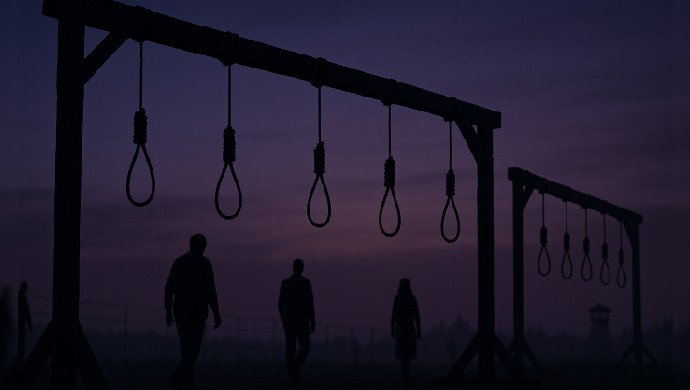

Fearing the eruption of another nationwide uprising, Iran’s ruling religious dictatorship has drastically accelerated its machinery of execution and death. Rather than a display of power, this relentless wave of state-sanctioned killings exposes a fractured regime deeply terrified of the people, particularly a rebellious generation determined to overthrow it. The daily acceleration of these killings is a desperate attempt to prevent the explosion of public anger.
The sheer volume of recent hangings reveals the regime’s desperation. In the Iranian month of Khordad (May 22 – June 21, 2026), the regime executed at least 134 prisoners. The killing spree reached horrific peaks: over a four-day span from Saturday, June 13 to Tuesday, June 16, at least 31 prisoners were sent to the gallows, averaging one execution every three hours. Among those executed during this four-day period were several compatriots from the Baluch people, who are suffering extra suppression and violence from the regime.
The state’s killing machine did not stop there. Over just two days—Wednesday, June 17, and Sunday, June 21—another 20 prisoners were hanged by the regime’s henchmen. These executions were systematically carried out in prisons across the country in cities such as Zahedan, Shiraz, Zabol, Yazd, Shirvan, Maragheh, Borujerd, Gorgan, Hamedan, Sanandaj, Isfahan, Tabriz, Amol, Kashan, Ahvaz, Sari, Birjand, and the notorious Qezelhessar prison.
Targeting political dissidents and protesters
While the regime attempts to mask its atrocities under various pretexts, a primary focus of this lethal campaign is the outright elimination of political opposition and protesters and to intimidate an outraged population only months after a nationwide uprising that brought the regime to its knees.
Since March 19, the ruling clerics have executed dozens of political prisoners. This includes eight members of the PMOI and more than 20 protesters who were detained during the January 2026 uprising. The victims come from all social backgrounds, ranging from 18-year-old youths to men in their sixties.
These victims are systematically deprived of all their basic rights. They are subjected to severe torture and sentenced to death in unjust courts that completely disregard minimum judicial standards. The regime’s cruelty extends beyond the victims to their families, who face arrests, threats, and abuse. They are denied the right to mourn, and the bodies of their loved ones are brutally withheld from them.
Validating the political nature of this violence, the head of the regime’s repressive judiciary recently insisted on speeding up death sentences, openly admitting that in dealing with the Iranian people, “the judiciary has adopted a fully wartime position.”
The regime’s deep-seated fear of uprisings
The ruling clerics are profoundly concerned about the looming threat of future uprisings. Through these brutal public executions, the regime desperately seeks to terrorize the rebellious youth and deter them from joining the resistance against the regime, including the ranks of the Resistance Units, which have played a decisive role in organizing and expanding the nationwide protests.
However, this strategy of terror is ultimately failing. The regime is facing a courageous new generation that has firmly found its path in resistance and is no longer willing to tolerate the clerics’ repression and dictatorship.