

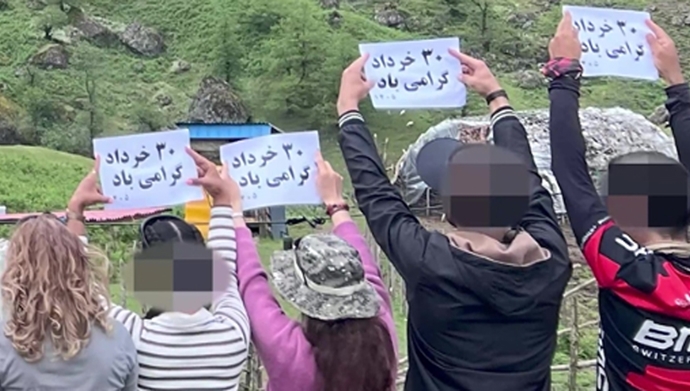

As the 45th anniversary of the June 20, 1981, uprising arrives, the world is once again witnessing the renewed vows of a new generation of Iranian fighters. June 20, recognized as the Day of Martyrs and Political Prisoners, also marks the anniversary of the founding of the National Liberation Army (NLA) of Iran in 198.
This historic date has sparked a nationwide surge across dozens of Iranian cities, proving that the flames of organized resistance against the ruling system are burning brighter and more defiantly than ever. While the bankrupt regime of the mullahs attempts to prevent a popular uprising by executing political prisoners, PMOI Resistance Units have turned cities across Iran into theaters of defiance against the regime.
A nationwide display of defiance
Coordinated, symbolic, and promotional operations swept the country, starting from major metropolises like Tehran, Mashhad, Isfahan, Tabriz, and Shiraz, and extending to deprived border cities such as Saravan, Zahak, Baneh, and Sardasht.
Sanandaj
"June 20th marks the most glorious chapter of resistance in Iranian history against the religious dictatorship." pic.twitter.com/x1jv5rrdDB— People's Mojahedin Organization of Iran (PMOI/MEK) (@Mojahedineng) June 15, 2026
Braving immense security risks, the heroic Resistance Units took to the streets to install large banners on highways, lay flowers in thoroughfares, organize photocalls, and hold up revealing placards. In Astara, a large placard draped over a bridge highlighted the national solidarity of the resistance.
Meanwhile, in the capital, massive banners bearing messages about the beginning of Iran’s most glorious historical resistance adorned the streets. This vast geographical spread demonstrates that the message of the resistance and the Liberation Army has transcended ethnic and regional boundaries, evolving into a nationwide demand.
Widespread image projections across Iran
Simultaneously, a coordinated series of image projection operations overtook the country’s streets with messages of resistance. In Tehran, freedom fighters projected slogans such as “Salute to Rajavi” on Shaghayegh Street and “Death to the oppressor, be it the Shah or the Leader” on Qazvin Street.
Tehran (Qazvin Street)
"Down with the oppressor, be it the shah or the supreme leader" pic.twitter.com/DLMxqVKOY8— People's Mojahedin Organization of Iran (PMOI/MEK) (@Mojahedineng) June 18, 2026
They also paid tribute to PMOI members executed by the regime with placards that read “teachers of sincerity and steadfast Mojahedin, Babak, Pouya, Mohammad, and Akbar” in Goldad Park. Similar operations echoed across other major cities.
In Mashhad (Izadi Park and Ferdowsi Market) and Shahrekord (Saadi Street), walls were illuminated with the slogan, “On June 20, we raised the flag of our people’s honor.”
In Isfahan, Karaj, Hamedan, Ilam, and Bandar Abbas, the core message that “the Liberation Army is the enduring guarantor of peace, freedom, and independence of Iran” was widely projected.
Furthermore, the rejection of the regime’s entirety was emphasized with the phrase “National Liberation Army” in Sari, Kermanshah, and Boukan, and the slogan “The only answer to the mullahs is fire” in Bandar Abbas. In Ilam, a projection on Azadi Street reminded the public of June 20 as the red line between surrender and resistance.
Rejecting dictatorship and projecting the alternative
The handwritten slogans, projections, and placards reveal the deep strategic direction of the Iranian Resistance.
One of the most prominent slogans repeated in cities like Tehran, Mashhad, Yazd, and Sardasht was “Death to the oppressor, be it the Shah or the Leader.” This reflects Iran’s youth’s profound awareness in rejecting any form of individual dictatorship, whether the former monarchy or the current clerical rule.
June 16—Iran
PMOI/MEK Resistance Units continue their activities in commemoration of the 45th anniversary of the June 20, 1981, uprising and in solidarity and support for the upcoming rally of the Iranian Resistance.#100kFreeIranRally pic.twitter.com/zUFdme7XQP— People's Mojahedin Organization of Iran (PMOI/MEK) (@Mojahedineng) June 17, 2026
Emphasizing the National Liberation Army as the “only path to liberation and overthrow” and the “enduring guarantor of peace, freedom, and independence” showcases society’s complete move beyond reformist illusions, relying entirely on the strategy of a mass uprising. The nationwide dissemination of messages from Resistance leaders Massoud and Maryam Rajavi was another pivotal part of this campaign.
Renewed oaths and readiness for the final battle
A striking feature of this field campaign was the formal declarations of readiness by the PMOI network. In cities like Ahvaz, Yazd, and Gachsaran, Resistance Units pledged their commitment to the martyrs’ path and their readiness for the final battle with the regime to achieve popular sovereignty.
In Urmia, the with the slogan, “Freedom comes with ‘we can and we must’,” and in Karaj with a placard reading, “No army or force in the world is stronger than our will.”
Tehran
PMOI Resistance Units march with placards that read "Commemorating June 20th." pic.twitter.com/d8aCELphbu— People's Mojahedin Organization of Iran (PMOI/MEK) (@Mojahedineng) June 17, 2026
These dynamic activities send a firm political message to the regime. They prove that the tradition of selfless resistance founded on June 20, 1981, flows vibrantly in the veins of today’s youth. Relying on this extensive domestic network, the Liberation Army and the uprising remain the clerical regime’s ultimate nightmare, taking solid steps toward the final realization of democracy, equality, and freedom in Iran.