

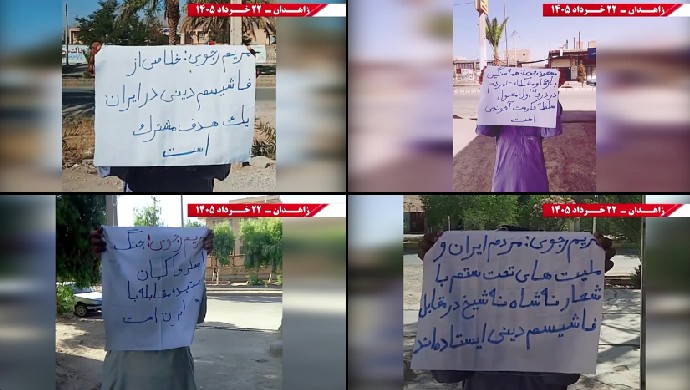

On June 12, PMOI/MEK Resistance Units in the southeastern city of Zahedan continued their weekly anti-regime activities across the city. They reiterated their unwavering commitment to overthrowing the ruling clerical regime and establishing a democratic republic.
Undeterred by the regime’s pervasive security presence, activists boldly displayed placards in public spaces declaring, “Iranian society is moving toward a democratic republic.” They emphasized that the current ruling establishment “neither intends to change its behavior and policy, nor does it have the capacity and nature to do it,” pointing out that “All the heavy burdens and problems of the people are, above all, the direct consequence of the clerical regime’s rule.”
Drawing a red line against all dictatorships
The central theme of the Zahedan activities was the definitive rejection of both monarchical and religious fascism. Protesters held signs with slogans such as “Dictatorship is a dictatorship, be it with a turban or a crown,” “100 years of crimes by the monarchy and the clergy,” and “From Zahedan to Tehran, death to the oppressor, be it the Shah or the Leader.” Placards warned that the “principle of ‘Neither the Shah nor the mullahs’ establishes an absolute red line against all forms of dictatorship and foreign dependence.”
June 12—Zahedan, southeast Iran
In their weekly anti-regime activities, PMOI/MEK Resistance Units reject both the mullahs' and shah dictatorships, reiterating their commitment to overthrow the regime and establishing a democratic republic. pic.twitter.com/DiLoIIweRP— People's Mojahedin Organization of Iran (PMOI/MEK) (@Mojahedineng) June 13, 2026
This message comes at a critical juncture. As a tool to confront the recent uprisings, the clerical regime actively promotes a fabricated opposition alternative centered on the remnants of the former monarchical dictatorship.
Regime theorists acknowledge that these remnants do not pose a threat, but actually help sustain the clerics’ rule. During the nationwide uprisings in 2022 and January 2026, the actions of the Shah’s remnants caused deep divisions among the people, which paved the way for large-scale killings by the regime. While the Shah’s son advocates for a reconstruction of his father’s fascist dictatorship and a return of the notorious SAVAK secret service, the Resistance Units made it clear that Iranian society will neither accept the status quo nor return to the past.
A fragile regime resorts to mass repression
Despite the regime’s attempts to hide its weakness behind the noise of recent external conflicts, it has never been as fragile and vulnerable as it is today. Following the massive nationwide uprising this past January, the regime stands at the brink of overthrow. Its leaders know that their primary threat is not external war, but deep-seated popular outrage and the organized resistance. Fearing the consequences of peace and the eruption of another uprising, they have kept all their forces deployed in the streets.
"The main war of the tyrannical rulers is confronting the people of Iran." pic.twitter.com/O5XxWfH4TS
— People's Mojahedin Organization of Iran (PMOI/MEK) (@Mojahedineng) June 13, 2026
To counter the growing influence of the Resistance Units, the regime has escalated its executions and arrests. Since the start of the recent war, the regime executed 20 young people for participating in the uprising or fighting the Revolutionary Guards, alongside eight PMOI members from the Resistance Units.
Furthermore, the State Security Force announced the arrest of 6,500 individuals, noting that 567 of them were connected to the PMOI. However, repression has failed to halt the momentum. During the January protests, Resistance Units played a vital role, carrying out 630 operations against centers of the Revolutionary Guard, the Basij, and other regime institutions to defend unarmed demonstrators.
The path forward to a democratic alternative
The activists in Zahedan emphasized that by “confronting both the clerical and monarchical dictatorships, the Iranian Resistance offers a viable democratic alternative.” This alternative was formalized on February 28, 2026, when the National Council of Resistance of Iran (NCRI) announced the establishment of a provisional government based on its Ten-Point Plan. This provisional government is tasked with organizing free elections for a Constituent Assembly within a maximum of six months after the regime’s downfall, transferring all power to the people’s representatives.
"Down with Khamenei, cursed be Khomeini, down with the principle of absolute clerical rule. Long live the Liberation Army." pic.twitter.com/9JYmE96OAr
— People's Mojahedin Organization of Iran (PMOI/MEK) (@Mojahedineng) June 13, 2026
As the Resistance Units proudly declared in Zahedan, “There is but one definitive response to the regime’s threats: its overthrow at the hands of the Iranian people and their organized resistance.” Lasting peace and freedom in Iran can only be achieved by ending the religious dictatorship and establishing a democratic republic based on the separation of religion and state, gender equality, and autonomy for oppressed nationalities.