

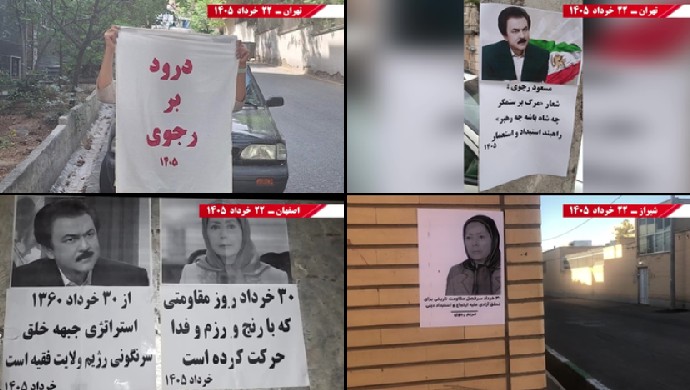

On June 12, 2026, the People’s Mojahedin Organization of Iran (PMOI/MEK) Resistance Units launched a widespread, highly coordinated anti-repression campaign across Iran. Marking the 45th anniversary of the historic June 20, 1981 uprising, these activists took to the streets to express their solidarity with the upcoming rally of the Iranian Resistance.
Operating under an atmosphere of severe domestic suppression, the Resistance Units and rebellious youth successfully executed simultaneous operations in Tehran and 16 other major cities. This nationwide campaign spanned across key provincial capitals and cities, including Karaj, Mashhad, Isfahan, Shiraz, Zahedan, and Qazvin. The actions serve as a stark reminder to the ruling clerics that the resistance movement remains deeply rooted inside the country and possesses the operational capacity to openly challenge the regime’s authority.
The tactics and messages of the Resistance Units
During the June 12 campaign, Resistance Units members utilized a variety of tactics to broadcast their anti-regime messages in public spaces, parks, and highways. Their activities included holding placards, installing posters of Iranian Resistance leader Massoud Rajavi and NCRI president-elect Maryam Rajavi, painting graffiti, and distributing flyers.
June 12—Iran
PMOI/MEK Resistance Units commemorate the 45th anniversary of the June 20, 1981, uprising and express their solidarity and support for the upcoming rally of the Iranian Resistance.#100kFreeIranRally pic.twitter.com/4NQDIJ3Y4d— People's Mojahedin Organization of Iran (PMOI/MEK) (@Mojahedineng) June 14, 2026
In Shiraz, members executed nine consecutive graffiti operations along main streets and thoroughfares, uniformly spray-painting the message, “Salute to Rajavi.” Meanwhile, in Tehran, activists boldly displayed posters and placards featuring photos of Massoud and Maryam Rajavi. The core slogans propagated by these units provide a clear, uncompromising political roadmap for the Iranian people: the absolute overthrow of the current regime and the establishment of a democratic republic.
Key messages displayed by Resistance Units in Tehran and Karaj included, “Down with the principle of absolute clerical rule. Long live the Liberation Army,” and “Our choice is Maryam Rajavi.” Emphasizing the democratic alternative to the regime, members in Karaj held placards reading, “Handing sovereignty back to the Iranian people and establishing a democratic republic through Maryam Rajavi’s Ten-Point Plan.”
Tehran
"June 20th marks the day of a resistance forged in suffering, sustained by relentless struggle, and advanced through ultimate sacrifice." pic.twitter.com/GMgrhu6oNC— People's Mojahedin Organization of Iran (PMOI/MEK) (@Mojahedineng) June 14, 2026
Furthermore, the Resistance Units heavily emphasized the national boundary of the Resistance, rejecting any return to previous dictatorships. Activists in Tehran installed posters that read: “The slogan, ‘Down with the oppressor, be it the Shah or the Supreme Leader,’ stands as an unyielding barrier against despotism and colonialism.”
The historical and current context of June 20
The current bravery of the Resistance Units is deeply intertwined with a decades-long struggle that fundamentally altered Iran’s contemporary history. June 20, 1981, marked the day the despotic clerical regime fully unmasked itself by opening fire on a massive, peaceful demonstration in Tehran. Hundreds were killed in the streets, and thousands more were arrested and swiftly sent to the firing squads.
This watershed moment proved that any compromise with the ruling clerics would only empower them to continue their brutal suppression. Today, the Resistance Units pay direct tribute to this legacy, with members holding placards that declare: “June 20th marks the day of a resistance forged in suffering, sustained by relentless struggle, and advanced through ultimate sacrifice.”
Tehran
"The National Liberation Army is the only way to freedom" pic.twitter.com/2IMQZDW7fx— People's Mojahedin Organization of Iran (PMOI/MEK) (@Mojahedineng) June 14, 2026
The regime’s contemporary response to the PMOI remains rooted in the massacres of the 1980s, driven by an acute terror of being overthrown. Following the massive nationwide uprising in January 2026, which brought the ruling clerics to the brink of collapse, the state has resorted to a horrific surge in executions to prevent another revolt. Exploiting recent wartime conditions, the regime has systematically executed political prisoners, recently hanging eight members of the PMOI alongside over 20 young people involved in the January uprising.
However, the daring activities of the Resistance Units prove that the regime has ultimately failed in its attempt to quell the resistance through brutality.
Tying the Resistance Units to the global movement
The sacrifices and ground-level operations of the Resistance Units inside Iran represent the beating heart of a global movement that is preparing to amplify their voices on the world stage. On June 20, 2026, more than 100,000 supporters of the Iranian Resistance, freedom-loving Iranians, global lawmakers, and human rights advocates are set to gather at Place Vauban in Paris.
https://twitter.com/4FreedominIran/status/2066048624035869093
This monumental gathering—one of the largest Iranian rallies ever held in Europe—perfectly mirrors the physical activities of the Resistance Units in Iran’s streets. Both share the exact same objective: condemning the escalating wave of political executions in Iran and demanding a democratic, secular republic.
As the regime attempts to promote fabricated alternatives centered on the remnants of the monarchical dictatorship, the central slogan of both the massive Paris rally and the street-level Resistance Units remains firmly identical: “No to Shah, No to Mullahs.” The true path to freedom, championed by both the activists in Iran and the demonstrators in France, lies in Mrs. Maryam Rajavi’s “Third Option”—a democratic transformation led by the Iranian people and their organized resistance. Ultimately, the coordinated campaigns inside Iran and the historic turnout expected in Paris prove that the resistance movement born out of the bloodshed of June 20, 1981, is the only legitimate force capable of realizing the dream of a free, democratic, and just Iran.