

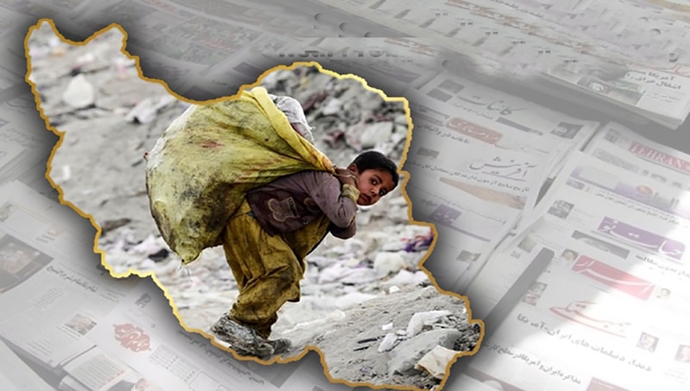

A sick political system inevitably breeds a sick economy. In an absolute dictatorship where freedom is eradicated, a healthy economy cannot exist. Iran’s cancer-stricken economy is the direct product of the regime’s totalitarian and oppressive policies. The economic crisis stems directly from the regime’s prioritization of tyranny over freedom and democracy.
Because of this, the economy has constantly teetered on the edge of a cliff, unable to be salvaged by any administration over the past two decades. Every government that has taken power has merely added another wall to the existing deadlock, making the structural problems more incurable. Today, the economy is trapped in one of its most sensitive and complex historical junctures, paralyzed by a state-controlled, command economy and non-developmental strategies.
The economy is a hostage
In most parts of the world, the economy is the child of politics. However, in mullah-stricken Iran, the economy is the illegitimate offspring of the mullahs’ rule. This disease will never be cured unless the policymakers at the top are entirely removed. This reality has become so undeniable that even state-affiliated experts and media are forced to acknowledge it. On June 10, 2026, the state-run Jahan-e Sanat daily ran a striking headline that read: “Curing Iran’s sick economy by changing the policymaker.”
The half-dead corpse of Iran’s economy has been on the autopsy table for years. The joint conclusion of both state and non-state experts is that the regime prioritizes its own structural survival over the basic living needs of the Iranian people. For four decades, the welfare of the people has been sidelined in favor of “other goals,” namely the security apparatus and the projects of the Revolutionary Guards (IRGC) and the Supreme Leader’s office.
Consequently, the regime’s government—faced with massive budget deficits—resorts to printing money and borrowing from the central bank. This has created a vicious cycle of inflation and widespread rent-seeking, deeply angering a public that watches regime insiders amass astronomical wealth while their own purchasing power vanishes.
Shattered social trust, uprisings, and the cost of warmongering
The regime’s corruption and disastrous economic policies have completely shattered any remaining bond between the state and the society. State media now openly uses coded language to describe this immense rift, particularly pointing to the massive nationwide uprisings of December 2025 and January 2026.
According to Jahan-e Sanat, the January events were a “severe blow to the thin and weak body of social trust.” Furthermore, before the economy could even slightly recover from the uprisings, the regime plunged the country into the March 2026 war. This catastrophic warmongering severely damaged foreign trade, triggered a massive spike in currency exchange rates, and pushed inflation to unprecedented new heights. Today, state experts admit that macro risks have peaked, and the future is “completely dark” for economic activists.
Terrified of total collapse, state-run media desperately beg the regime’s leadership to implement superficial reforms. They plead with the establishment to understand that “restrictive approaches cannot provide a sustainable response to the economic demands of the society.” They naively suggest that respecting citizens’ rights and improving the business environment will bring back the lost social trust. However, these are merely the pathetic pleas of a system trying to hide the fact that the absolute clerical rule is the very epicenter of corruption.
Beyond the repetitive, space-filling illusions published by state-run newspapers, the reality on the ground is entirely different. More than 90 percent of Iranian society knows exactly why they are suffering. The Iranian people have recognized that no reform is possible within this system. Whether in an atmosphere of war or negotiations, the overwhelming majority of the Iranian public has one unwavering priority: the complete and total overthrow of the mullahs’ regime.