

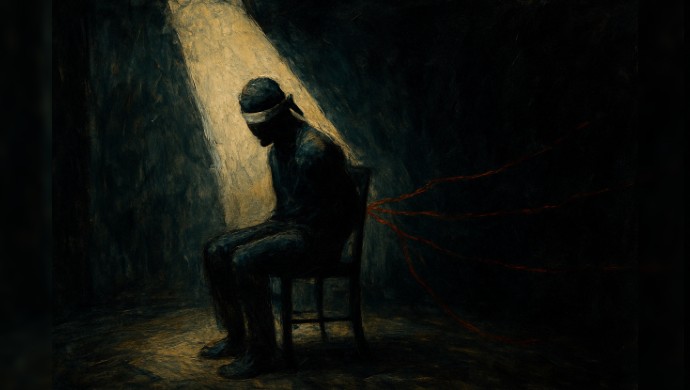

The clerical regime in Iran is once again accelerating its use of the death penalty to instill fear in a restless society. Currently, five political prisoners—Masoud Jamei, Alireza Mardasi, Farshad Etemadifar, Reza Abdali, and Hassan Maslavi—are at imminent risk of execution in Sheiban Prison in Ahvaz. Four of these men have been sentenced to death on charges of “Moharebeh” (enmity against God) and membership in the People’s Mojahedin Organization of Iran (PMOI/MEK).
Masoud Jamei, a 49-year-old oil company employee; Alireza Mardasi, a 53-year-old teacher; and Farshad Etemadifar, 31, from Basht in Kohgiluyeh and Boyer-Ahmad Province, were arrested in the summer of 2023. Etemadifar had previously been arrested in 2018 and imprisoned for 20 months. A fourth prisoner, 36-year-old Reza Abdali, was arrested in February 2025. Jamei, Mardasi, and Abdali are all Arab compatriots, with Abdali belonging to the Daghagheleh tribe in Ahvaz.
In July 2025, Branch 1 of the regime’s Revolutionary Court in Ahvaz, presided over by the notorious judge Adibi-Mehr, sentenced them to death. Abdali was additionally sentenced to 15 years in prison. The regime’s Supreme Court officially upheld these sentences in November 2025. Their plight is compounded by the horrific conditions inside Sheiban Prison, which suffers from severe overcrowding, catastrophic water shortages, and a complete lack of basic sanitary facilities.
Mrs. Maryam Rajavi, the President-elect of the National Council of Resistance of Iran (NCRI), warned of the imminent risk of execution facing these prisoners and called for urgent intervention by the United Nations and all human rights organizations to annul their death sentences and save their lives.
A nationwide campaign of sham trials
The crisis in Ahvaz is part of a broader, systematic crackdown targeting political dissidents, particularly in Rasht’s Lakan Prison. The Iranian judiciary’s proceedings resemble theatrical farces rather than legal trials.
Recently, the Rasht Revolutionary Court sentenced 68-year-old Zahra Tabari, an electrical engineer with a Master’s degree from Sweden, to death for a second time on charges of PMOI membership. Her initial sentence followed a sham ten-minute video conference trial without a lawyer of her choice. In a blatant display of nepotism and judicial corruption, the regime’s Supreme Court referred her retrial from the notorious judge Ahmad Darvish-Goftar directly to his son, Mohammad Ali Darvish-Goftar, who predictably re-issued the death sentence on April 14, 2026.
This same father-son judicial duo presided over the case of 51-year-old Yaghoub Derakhshan, another PMOI supporter facing an imminent death sentence for “Baghi” (armed rebellion) after an online trial lacking legal representation. Similarly, 38-year-old poet and PMOI supporter Amin (Peyman) Farahavar has had his death sentence upheld. Farahavar is being systematically denied vital medical care despite suffering from severe internal bleeding and intense pain following gallbladder surgery.
Mass arrests and executions amid conflict
The mullahs are attempting to hide their fragile grip on power behind the noise of recent war. Since the conflict began, the regime has executed eight PMOI members belonging to the Resistance Units and more than 20 young people who participated in uprisings or fought against the Revolutionary Guards.
The scale of the crackdown is massive. The regime’s own State Security Force chief recently announced that 6,500 people have been arrested since the start of the war, officially acknowledging that 567 of these detainees are connected to the PMOI.
While the regime projects aggression, this wave of executions exposes its fatal weakness and profound fear of collapse. It has no viable answer for an explosive society, especially as PMOI Resistance Units actively organize and fight the Revolutionary Guards in preparation for the next uprising. As Mrs. Rajavi, President-elect of the National Council of Resistance of Iran (NCRI), noted, the regime desperately relies on these criminal executions to create an atmosphere of terror and prevent the eruption of popular anger.
The international community must not remain passive. The Iranian Resistance urgently calls upon the United Nations Human Rights Council, the European Union, and all global human rights bodies to take immediate action. Condemnations are no longer enough; binding diplomatic measures must be taken to annul these sentences, secure the release of political prisoners and save the lives of those who are on death row.