

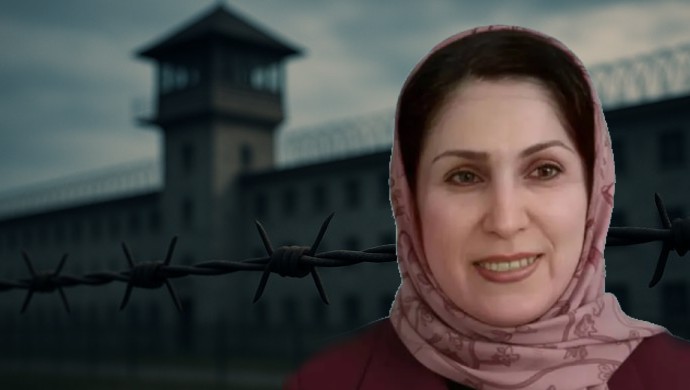

The Iranian regime’s judiciary continues to operate as an apparatus for state-sanctioned murder, systematically targeting political dissidents to maintain its grip on power. The recent re-issuance of a death sentence for Zahra Tabari, a 68-year-old female political prisoner, perfectly encapsulates this mockery of justice.
Tabari, an electrical engineer with a Master’s degree in sustainable energy from the University of Borås in Sweden, was violently arrested in April 2025 when security agents raided her home. She had previously served 18 months in prison following an arrest in June 2022. In November 2025, she was sentenced to death for “armed rebellion” (Baghi) through PMOI membership by the notorious Judge Ahmad Darvish-Goftar at the First Branch of the Rasht Revolutionary Court. The verdict followed a sham 10-minute video trial without a chosen defense lawyer.
Following global protests against the ruling, the regime’s Supreme Court mandated a retrial. In a theatrical and blatantly nepotistic move, the case was assigned to the Second Branch of the Rasht Revolutionary Court, presided over by Mohammad Ali Darvish-Goftar—the son of the original judge. Unsurprisingly, on April 14, 2026, he reinstated the exact same death sentence, which was officially served to her this week.
Rasht’s death machine: A coordinated regional crackdown
Tabari’s sentencing is not an isolated incident; it aligns with a broader pattern of lethal rulings emerging from the Rasht Revolutionary Court, specifically targeting PMOI supporters held in Lakan Prison.
In early May 2026, the Supreme Court officially rejected the retrial request for 38-year-old poet and political prisoner Amin (Peyman) Farahavar, upholding his death sentence for Baghi and Moharebeh (enmity against God). Originally sentenced to death on May 1, 2025, by the same criminal judge, Ahmad Darvish-Goftar, without a lawyer present, Farahavar is now in imminent danger of execution.
Similarly, the death sentence for 36-year-old Manouchehr Fallah, arrested in June 2023, was once again upheld by Ahmad Darvish-Goftar in early May 2026 on charges of PMOI membership, after the Supreme Court referred his case back to the same kangaroo court.
Expanding repression: Torture, medical deprivation, and fabricated charges
Beyond the gallows, the regime utilizes medical deprivation, physical brutality, and fabricated sentences to break the will of political prisoners. Farahavar, for instance, suffers from severe gallbladder surgical complications and internal bleeding from his interrogations, yet he is systematically denied vital medical treatment.
In Tehran, 30-year-old Forough Taghipour, who holds a bachelor’s degree in accounting and is already serving a 15-year sentence, was handed an additional year in prison by criminal Judge Sharifi-Nasab merely for publishing a Student Day message in 2025. Taghipour’s family has a long history of sacrifice; her uncle and two aunts were martyred in the 1980s, and her father and sister currently reside in Ashraf 3.
Physical brutality is also rampant. Forty-year-old Roozbeh Alipour remains in limbo in the secure ward (Ward 35, Unit 3) of Ghezel Hesar Prison. Violently arrested and beaten on January 26, 2026, he suffered severe fractures to his hands and legs, as well as head injuries, under torture in Evin Prison’s Ward 209. Deprived of medical care and family visits, he faces continuous beatings with pipes and sticks. His suffering is compounded by the fact that the regime executed his brother, PMOI member Babak Alipour, alongside Pouya Ghobadi, just weeks prior on March 31, 2026, in the same prison.
A call for immediate international intervention
The nepotism in Tabari’s retrial, the rubber-stamping of death sentences in Rasht, and the vicious torture of prisoners prove that Iran’s judiciary is entirely devoid of due process. The Iranian Resistance urgently calls upon the United Nations, the European Union, and international human rights organizations to strongly condemn these crimes and take immediate action to halt the executions of Tabari, Farahavar, and Fallah. The international community must dispatch a fact-finding mission to inspect Iranian prisons and secure the release of all political dissidents facing the regime’s wrath.