

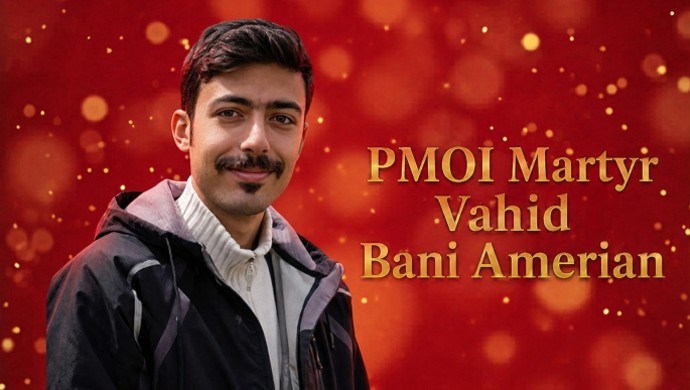

Today marks the 40th day since the martyrdom of Vahid Bani Amerian, a 33-year-old political prisoner and a proud member of the People’s Mojahedin Organization of Iran (PMOI/MEK). Vahid was executed alongside PMOI member Abolhassan Montazer on April 4, 2026.
These executions occurred as the profoundly vulnerable clerical regime desperately tried to maintain its grip on power. Reeling from the massive December 2025–January 2026 nationwide uprisings and acting under the fog of war following the death of Ali Khamenei on February 28, 2026, the mullahs rushed to the gallows to physically eliminate their most capable adversaries.
The regime intended to use Vahid’s execution to terrorize Iran’s rebellious youth. Instead, they immortalized a hero. Vahid’s life, his letters, and his final video testament leave behind an enduring legacy of immense compassion, unyielding bravery, and a conscious determination to sacrifice everything for a free Iran.
The roots of rebellion: A conscience awakened by compassion
Vahid’s revolutionary spirit was rooted in his profound empathy. In a clandestine audio message sent to his mother from Ghezel Hesar prison in September 2025, he traced his path to the gallows back to a childhood awakening. He reminded his mother of a day he asked her to exchange a nice pair of shoes for simpler ones because he felt the “innocent and longing looks” of his impoverished classmates. He would also secretly hide good food in his school bag to bring to them, just to see “the spark in their eyes.”
However, as Vahid grew older, he realized that individual acts of charity could not cure systemic crises like millions of families living below the poverty line, hundreds of thousands of addicted youth, and the brutal suppression of women.
In his final video testament, he vividly recalled the agony of a desperate family outside a Kermanshah hospital. The father asked how he could afford his child’s surgery on a worker’s wage, while the mother cried out in agony, “O God, O justice!” These haunting memories made turning a blind eye and living a so-called “normal life” impossible for him.
A conscious choice: Joining the resistance
Realizing that true justice required systemic political change, Vahid embarked on a quest that led him to the PMOI/MEK. He noted how he first connected with the organization during the suffocating summer of 2014. Despite being under brutal missile attacks and a severe siege in Camp Liberty, Iraq, PMOI members miraculously continued to give the “promise of victory.”
His commitment was further solidified by his historical connection to the movement. In his message to his mother, he described re-reading the story of the 30,000 martyrs of the 1988 massacre buried in the unmarked graves of Khavaran, feeling an unbreakable bond with them and their struggle for freedom.
When regime interrogators later asked him why he did not just pursue an ordinary life and was instead “wasting” his youth, Vahid delivered a powerful response in his final defense: “May that kind of life be forbidden to me if the price of it is stepping on my conscience and closing my eyes to the pain of my people.” He absolutely rejected the idea of living comfortably while the regime continued its massacres, looting, and destruction.
Unbroken by the gallows: Defiance and moral victory
Vahid paid a heavy price for his defiance. Following his arrest in January 2024, he was subjected to months of severe physical and psychological torture in Evin Prison’s notorious Ward 209. The brutality continued until the very end; on the night of March 29, 2026, anti-riot guards violently raided Ward 4 of Ghezel Hesar prison, brutally beating political prisoners before severing all phone lines.
During his retrial on November 16, 2025, notorious criminal judge Iman Afshari in Branch 26 of Tehran’s Revolutionary Court forced through separate, minutes-long hearings, condemning Vahid on fabricated charges of “baghi” (armed rebellion). Yet, Vahid stripped the performance of justice bare. In his final statement, he turned the tables on his judges, asking: “Am I the one who should defend myself—or are you?”
Throughout his imprisonment, Ministry of Intelligence interrogators attempted to weaponize Vahid’s deep love for his mother against him, urging him to abandon his cause for her sake.
Vahid’s response was profound. He explained to his mother that a true PMOI supporter’s emotions “expand to encompass all destitute orphans, all mourning mothers, all suppressed women, and all hardworking laborers.” He absolutely rejected the regime’s demands for televised confessions or disavowing the Resistance. In a January 2025 letter, he wrote directly to his interrogators: “If the price of staying alive is to wash my hands of the name ‘Mojahed-e Khalq’… shame on this life! Let it be yours!”
An eternal roadmap for Iran’s youth
Staring down the gallows, Vahid’s courage remained absolute. In his final letter on March 9, 2026, as the country was engulfed in conflict, he wrote: “Fighter jets are circling above the prison right now!” Knowing his fate, he promised to fight “shoulder to shoulder with my comrades” to the very end.
While the mullahs sought to bury Vahid to instill fear, his final defense planted the seeds for future uprisings. He issued an unforgettable warning to his executioners: “Even if you execute me and people like me, we will multiply.”
On the 40th day of his martyrdom, Vahid Bani Amerian’s legacy is perhaps best captured by the defiant poem he sent to his mother: “The claimant sought to pull us up by the roots, unaware that God is in our thoughts.” His sacrifice and his unwavering steadfastness serve as an eternal roadmap for the thousands of rebellious youth in Iran’s Resistance Units who are determined to finish the job and overthrow the regime.