

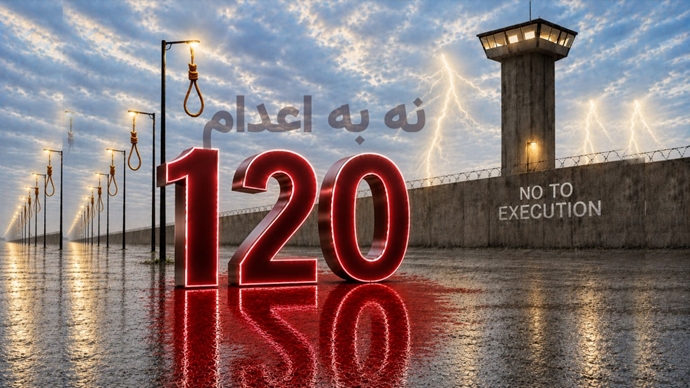

On May 12, 2026, political prisoners across 56 Iranian facilities went on hunger strike to mark the 120th week of the “No to Executions Tuesdays” campaign. The latest strike occurs as the Iranian regime uses the cover of recent foreign conflict to carry out a wave of executions targeting dissidents and protesters. The campaign’s latest statement warns that regime authorities have executed 23 political and security prisoners since the start of the Persian New Year in late March 2026.
Executing uprising protesters and escalating threats
The recent executions include individuals detained during the nationwide uprisings of December 2025 to January 2026. Last week, authorities hanged Ebrahim Dolatabadi, Mehdi Rasouli, and Mohammad-Reza Miri in Mashhad’s Vakilabad Prison. The campaign had previously warned of their imminent execution in a statement on May 5. Additionally, on May 11, authorities executed Erfan Shakourzadeh in Ghezel Hesar Prison on espionage charges.
The campaign statement highlighted that dozens of recent detainees face an imminent risk of execution. In recent days, at least 100 detainees from the uprisings were transferred to Ward 37, Unit 3 of Ghezel Hesar Prison, where they face heavy charges and severe overcrowding with limited basic amenities. Other political prisoners currently at risk of execution include Amir-Mohammad Zare and Mohammad-Reza Abdollahpour in Ghezel Hesar, Ali Pishehvar-Zadeh in Rasht’s Lakan Prison, and Baluch political prisoners Adham Narouei, Farshid Hassanzehi, Hossein Shahouzehi, Nasimeh Eslamzehi, and Soleiman Shahbakhsh, who the campaign notes were subjected to unfair and opaque judicial processes.
Withholding bodies and punishing grieving families
In addition to the executions, the regime is employing collective punishment against the families of dissidents, a practice the campaign describes as “a clear example of enforced disappearance.” Authorities have refused to return the bodies of six executed political prisoners and members of the “No to Executions Tuesdays” campaign—Vahid Bani-Amerian, Pouya Ghobadi, Babak Alipour, Akbar (Shahrokh) Daneshvarkar, Mohammad Taghavi, and Abolhassan Montazer—even 40 days after they were killed.
Families inquiring about their loved ones’ remains are facing abduction and arrest. On April 18, 2026, security forces arrested Azam and Akram Daneshvarkar, the sisters of Shahrokh Daneshvarkar, after they visited the judiciary and forensics office to retrieve their brother’s body. The sisters were transferred to an undisclosed location. Furthermore, state media reports indicate the regime is confiscating the properties of dozens of protesting citizens.
Transforming into a symbol of resistance
Despite systemic pressure, property confiscations, and executions designed to spread terror, the campaign stated these actions demonstrate the regime’s desperate bid for survival.
“Every day of the ‘No to Executions Tuesdays’ campaign is a day of keeping the collective conscience alive,” the prisoners wrote in their statement. “Days that break the deadly silence to make the cry of ‘life’ heard by the world. We, the members of this campaign, believe that true justice is not born in execution sheds; it blossoms in awakened hearts, in education, and in fair courts.”
Concluding their statement, the striking inmates emphasized that the resilience shown in prisons and on the streets proves the regime’s downfall is approaching: “The resistance and perseverance of the brave people and youth of Iran in the uprisings and prisons have proven that this regime is doomed to go, and freedom and equality are closer than ever.”
The 56 prisons participating in the 120th week of the strike include Evin Prison (men’s and women’s wards), Ghezel Hesar Prison (units 2, 3, and 4), Karaj Central Prison, Greater Tehran Prison, Qarchak Prison, Mashhad Prison, Tabriz Prison, Urmia Prison, Zahedan Prison, and Sanandaj Prison, among dozens of others across the country.