

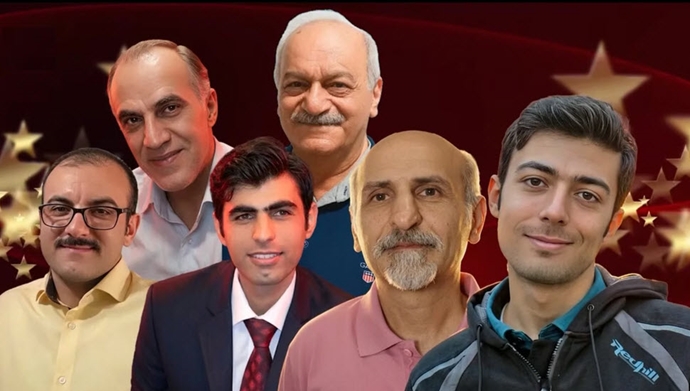

The Iranian regime relies on the gallows to project power and instill terror among the public. However, a newly obtained eyewitness report from Ghezel Hesar Prison reveals the exact opposite: the clerical dictatorship is profoundly terrified, while its political prisoners have entirely conquered the fear of death.
Following the massive nationwide uprisings of December 2025 and January 2026, the regime accelerated its campaign of state-sanctioned terror. Between March 30 and April 4, 2026, authorities in Ghezel Hesar prison hanged six political prisoners and members of the People’s Mojahedin Organization of Iran (PMOI/MEK).
Branded as “terrorists” by the ruling establishment, these highly educated professionals and veteran political prisoners did not go to the gallows as victims. As the newly smuggled testimony proves, they went as victors, showcasing a fearless spirit that renders the regime’s ultimate weapon completely useless.
https://twitter.com/en_simayazadi/status/2041830953035653443?s=20
The cowardly ambush versus unbreakable resolve
The final chapter of their lives began with a cowardly and deceptive ambush. At approximately 9:30 PM on Sunday night, March 29, 2026, more than 20 prison guards wearing black masks raided the political prisoners’ hall in Unit 4 of Ghezel Hesar Prison. The guards deceitfully claimed it was a routine cell inspection, telling inmates, “Without touching anything, come out of your rooms.”
The true intent of the midnight raid became clear once the prisoners were gathered in the corridor. When guards attempted to handcuff 33-year-old Vahid Bani Amerian from behind, he bravely resisted, prompting multiple guards to viciously beat him until his head and face were covered in blood.
The stark contrast between the regime’s cowardice and the prisoners’ bravery was perfectly encapsulated by a prison official named Kamali. Wearing a suit and a nauseating hair dye, he tried to justify the brutality like a modern-day Pontius Pilate washing his hands of a crucifixion. He told the prisoners: “We are nobodies! If we don’t carry out these orders, how will we feed our wives and children?!”
Simay Azadi Exclusive | #Iran News Alert
PMOI member Abolhassan Montazer takes an oath in 2020 before returning to prison.
A former political prisoner under both the Shah and the current regime, Montazer had been jailed multiple times before his arrest in 2024 and subsequent… pic.twitter.com/uu4kXCaTfp— SIMAY AZADI TV (@en_simayazadi) April 4, 2026
Six heroes who mocked death
According to the smuggled eyewitness account, the transfer of the six men—Vahid Bani Amerian, Abolhassan Montazer, Mohammad Taghavi, Akbar Daneshvarkar, Babak Alipour, and Pouya Ghobadi—to the prison’s crossing area (Zir-e Hasht) before their executions became a scene of profound triumph. Separated from the rest of the inmates, the six heroes embraced their imminent deaths with absolute grace.
Akbar Daneshvarkar, a 59-year-old civil engineer, had his clothes torn by the guards during the initial attack. Yet, he mocked their panic, laughing aloud and shouting: “Why are you so scared? We are the ones being executed, why are you terrified?”
Babak Alipour, a 34-year-old law graduate, stood a head taller than everyone else despite having a broken leg. Smiling calmly, he physically pushed past the three guards trying to chain him just so he could kiss and bid farewell to his fellow inmates.
Mohammad Taghavi, 59, a veteran political prisoner from the 1980s, was described by the witness as a “small-statured great man.” Even in handcuffs, he reached down to help beaten prisoners off the ground. He then led the ward in a booming chant of “Allahu Akbar” that shook the prison walls.
https://twitter.com/en_simayazadi/status/2040373872080424970?s=20
Pouya Ghobadi, a 33-year-old electrical engineer, approached his tearful friends with a bright smile. Throwing his handcuffed arms around the eyewitness’s neck, he asked: “Why?! Why the tears and crying? Isn’t our faith that ‘Among the believers are men true to what they promised Allah…’? So what room is there for regret and worry?”
Abolhassan Montazer, a 66-year-old architect, walked toward his death with the exact dignity he always spoke of, proudly dragging his captors along so he could bid his final farewells.
And Vahid Bani Amerian, a 33-year-old holding a master’s degree in management, comforted a grieving inmate despite his own brutal beating, reminding him they were simply joining fallen PMOI comrades Behrouz Ehsani and Mehdi Hassani. Kissing the eyewitness goodbye, Vahid said: “Forgive us… the time for departure has come, and the freedom of Iran and our people is worth all of this.” He was dragged out of the ward flashing a V-for-victory sign.
A force that cannot be destroyed
The eyewitness noted that seeing the PMOI prisoners face death with such magnificence brought to mind the historical words of Imam Hussein’s sister, Zeinab: “I saw nothing but beauty.”
The regime’s executioners, including Ghezel Hesar warden Allah-Karam Azizi and his deputies Hassan Ghobadi and Ghasem Sahraei, will inevitably face justice for their crimes. But their violent midnight raid entirely failed to break the prisoners’ spirits.
As the eyewitness reflected from solitary confinement later that night, addressing the martyred Vahid Bani Amerian: “If realizing a free Iran is truly a ‘Judgment Day,’ then through your uprising for Iran’s freedom, you removed the only veil and distance—the fear of death—to reach that Judgment Day.”
This fearless resolve, forged through the PMOI’s 60 years of struggle against the Shah and the mullahs, is a force the regime can never hang.
Below is the complete English translation of the smuggled eyewitness account from Ghezel Hesar Prison detailing the March 29, 2026, midnight raid.
An Eyewitness Report from the Scene of Taking Six PMOI Members for Execution in Ghezel Hesar Prison on March 29, 2026
What a dayit was!
And how magnificent is the stature of human beings who have rubbed the snout of death into the dirt!
The armies of Ibn Muljam and Harmala [historical figures of treachery and cruelty], wearing black masks and roaring, raided the ward at night to slaughter the best children of Iran. They acted as if wearing masks would hide their identities, forgetting that they cannot hide from history, the people, and God.
Their ringleader, Kamali (one of the criminals from the regime’s Prisons Organization), wore a suit on his clumsy frame, his hair smeared with a nauseating dye. Much like Pontius Pilate, the Roman governor who declared his innocence during the crucifixion of Jesus Christ, Kamali said in a disgustingly pathetic manner: “We are nobodies! If we don’t carry out these orders, how will we feed our wives and children?”
Indeed, a day of reckoning unfolded. At 9:30 PM, they descended upon us with masks, stun guns, handcuffs, chains, and batons. Right by the door was Shahrokh (Akbar Daneshvarkar). They attacked him first, tearing his clothes until they hung off his body. Yet, with mockery and laughter, he shouted at them: “Why are you so scared? We are the ones being executed, why are you terrified?” and he laughed out loud!
Tall Babak (with his broken leg), who stood a head taller than everyone else, wore his usual calming smile. He kept asking, “Are you guys all okay?” While three guards surrounded him to put him in handcuffs and chains, he shoved them aside with his body just so he could kiss and bid farewell to all the guys… and they couldn’t stop him!
They took the small-statured great man, Mohammad Taghavi, away in handcuffs to be executed. Yet, even with his hands bound, he reached out to guys like Vahid, who had been beaten to the ground with fists and batons, tending to them and helping them up. When he reached me, we kissed each other’s cheeks, and he said, “Now we must sing an anthem.” I agreed.
He said, “I can’t focus and can’t recall any anthems right now, but what anthem is more powerful than ‘Allahu Akbar’?” He then chanted: Allahu Akbar, Allahu Akbar. The echo of his voice shook all of Unit 4. It unconsciously reminded me of the words of Zeinab al-Kubra, who, upon witnessing the massacre of Imam Hussein’s companions, said: “I saw nothing but beauty.” And in this chaotic judgment day that had erupted, I saw nothing but the grandeur, greatness, and beauty of human dignity!
Vahid Bani Amerian seemed to fly. He fell from the hands of the guards. While they rained fists and batons on his head and face, the chant of Allahu Akbar never left his lips… Because I was handcuffed from behind and he was handcuffed from the front, we stood chest to chest. He took my face in his bound hands, and we kissed goodbye. He said: “Forgive us… the time for departure has sounded and our time has come… the freedom of Iran and our people is worth all of this.”
As they were dragging him away, with his feet not even touching the ground, he let himself go limp. They carried him out the door of the unit, but as he left to be put in the transfer minibus, he raised two fingers in a V-sign, signaling victory.
Pouya Ghobadi approached me with a cheerful face and a bright smile. With his hands handcuffed in front of him, he threw his arms around my neck and kissed me. When he saw my eyes full of tears, he widened his own eyes curiously and asked with a smile: “Why?! Why the tears and crying? Isn’t our faith that ‘Among the believers are men true to what they promised Allah…’? So what room is there for regret and worry?”
And the young-hearted old man, Mr. Montazer. Just as he always used to say—that one must go to an execution with pride, dignity, and certainty—he truly did. Bound by the same handcuff to another prisoner, he walked with absolute calm, pulling his captors this way and that just so he could bid farewell and kiss the rest of us!
Yes! These are the children of the land of Iran, who, for the freedom of Iran and its people from oppression and injustice, have abandoned their lives, their wealth, and their families. They go to the gallows with absolute pride. Meanwhile, lowlifes like Kamali and his ilk, using the blood of these historical legends, pathetically sought a salary raise, a way to fill their families’ stomachs, or to appease their masters.
As it says in the Ashura pilgrimage prayer: May God’s curse be upon those who paved the way and prepared the grounds for your slaughter, O Mojahedin.
That same night, in solitary confinement, as I recalled the faces of each of these guys and Vahid as they were being taken out, I spoke to him in my heart: “If realizing a free Iran is truly a ‘Judgment Day,’ then through your uprising for Iran’s freedom, you removed the only veil and distance—the fear of death—to reach that Judgment Day.”
Peace be upon you for what you endured with patience and steadfastness. Salamun Alaikum bima sabartum.