

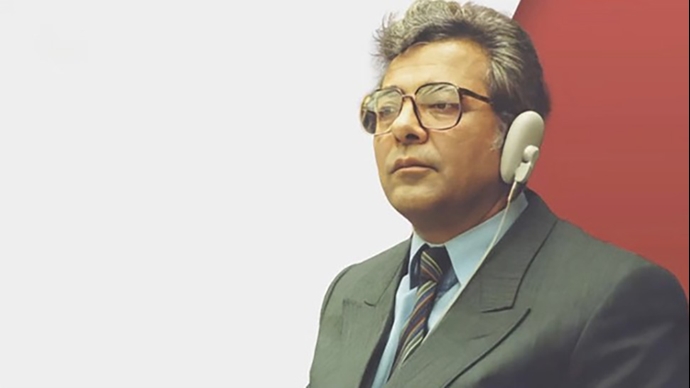

On April 24, 2026, the Iranian Resistance marks 36 years since the tragic assassination of Dr. Kazem Rajavi near his home in Coppet, Switzerland. Dr. Rajavi was not merely a victim of the Iranian regime’s state-sponsored terrorism; he is remembered by the Iranian people as the “Great Martyr of Human Rights.” Agents of Iran’s Ministry of Intelligence and Security (MOIS) assassinated him in 1990, believing bullets could permanently silence his voice. Instead, his lifelong mission to expose the clerical regime’s brutality laid the unshakeable groundwork for today’s ongoing fight for justice in Iran.
The man who chose honor over power
Dr. Rajavi possessed an unmatched intellect and global standing. Holding six doctoral degrees in law and political science from universities in France and Switzerland, he authored over 120 books and dissertations and taught at various Swiss universities. Following the 1979 anti-monarchist revolution, his stellar reputation earned him the role of Iran’s first ambassador to the United Nations in Geneva, and later ambassador to Senegal and head of the political delegation to seven West African countries.
We honor the memory of Prof. Kazem Rajavi, the great martyr for human rights, on the anniversary of his assassination on April 24, 1990, near Geneva, by terrorists sent by Iran’s ruling religious dictatorship.
Salute to Kazem Rajavi, who, as he himself said, wrote the history of… pic.twitter.com/vfBPzGPsLV
— Maryam Rajavi (@Maryam_Rajavi) April 24, 2026
Given his prestige, Dr. Rajavi could have easily retained the highest positions within the ruling establishment. Ruhollah Khomeini, the founder of the mullahs’ regime, even summoned him to Qom, implicitly offering the continuation of his diplomatic posts if he would denounce his younger brother, Iranian Resistance leader Massoud Rajavi.
Dr. Kazem resolutely rejected this manipulation, later stating, “There are moments in every person’s life where compromising means accepting dishonor.” Appalled by Khomeini’s brutal repression of opposition groups, he withdrew from his positions in 1981 and joined the National Council of Resistance of Iran (NCRI).
Dr. Rajavi’s commitment to human rights transcended shifting political eras. In August 1971, when the Shah’s secret police arrested and sentenced the founders and key members of the People’s Mojahedin Organization of Iran (PMOI/MEK) to death, Dr. Kazem launched a massive international campaign. He rallied prominent figures, including future French President Francois Mitterrand and UN Secretary-General Kurt Waldheim, ultimately forcing the Shah’s regime to commute Massoud Rajavi’s death sentence to life in prison.
During the 1980s, as the special envoy of the NCRI President to the UN General Assembly in New York, he spearheaded a historic campaign against the new dictatorship. His tireless efforts laid the groundwork for the appointment of a UN Special Representative on Iran’s human rights in 1983. By 1985, his deep political knowledge and diplomatic skills resulted in the first-ever UN resolution condemning the Iranian regime’s human rights violations.
The price of truth: State terrorism and Western appeasement
Unable to tolerate his devastating exposures, Khomeini issued a fatwa for his assassination, a directive that Ali Akbar Hashemi Rafsanjani’s government made a top priority. On April 24, 1990, Dr. Rajavi was fatally shot by MOIS terrorists.
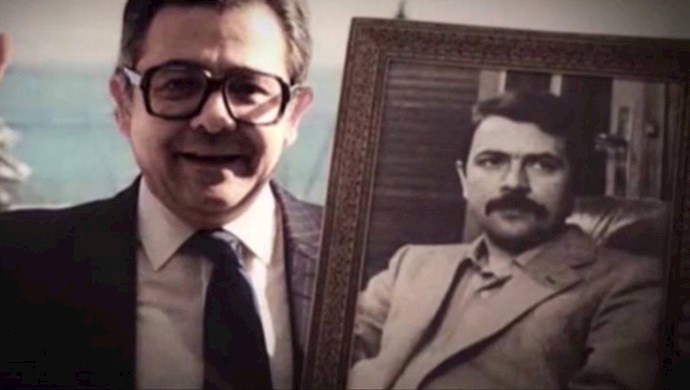
The assassination laid bare the shameful reality of Western appeasement. The passports of 13 diplomat-terrorists involved were stamped “on mission” in a single day, and they fled to Tehran on pre-booked flights. Despite the Iranian Resistance providing full details of the operation to the Swiss judiciary, a Swiss judge explicitly refused to seriously investigate, stating, “We do not want to put our hands in the snake’s nest.” Two years later, France arrested two of the murderers, but the government of Jacques Chirac extradited them back to Iran in a blatant attempt to appease the mullahs.
Despite past appeasement, the tide of justice slowly turns. In June 2020, following objections from the Iranian Resistance against closing the case, the Swiss government kept the file open, with the prosecutor of the Canton of Vaud proposing to investigate the assassination as a crime against humanity. Shortly after, the U.S. State Department issued visa restrictions for 14 Iranian regime officials tied to the murder.
Dr. Kazem Rajavi, who now rests in the soil of Karbala, foresaw the ultimate cost of his activism, famously declaring, “We write the history of human rights with our blood.” Today, his beloved face remains radiant in every call for justice. The seeds he planted are bearing fruit, evident in the growing international recognition of the 1988 massacre of political prisoners as a crime against humanity and genocide. The legacy of Dr. Kazem Rajavi will continue to fuel the Iranian people’s restless pursuit until the dawn of freedom.
As Mrs. Maryam Rajavi, the president-elect of that National Council of Resistance of Iran (NCRI), wrote on the anniversary of the martyrdom of Dr. Kazem Rajavi, “Salute to Kazem Rajavi, who, as he himself said, wrote the history of human rights in Iran with his own blood. The day is not far when, with the establishment of a democratic republic, both the masterminds and perpetrators of these crimes will be brought to justice.”