

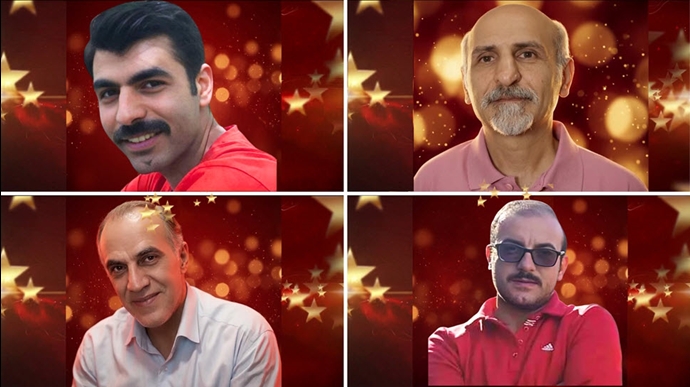

In a brutal span of just 48 hours, the Iranian regime executed four political prisoners and members of the People’s Mojahedin Organization of Iran (PMOI/MEK) at Ghezel Hesar Prison. Mohammad Taghavi and Akbar Daneshvarkar were hanged at dawn on March 30, 2026, followed immediately by the executions of Babak Alipour and Pouya Ghobadi on March 31. The men were sentenced to death on the fabricated charge of “baghi” (armed rebellion), solely based on their affiliation with Iran’s main organized opposition.
The timing of these killings exposes a paralyzed and fearful regime acting out of profound vulnerability. Following the massive nationwide uprisings of December 2025 and January 2026—which brought the clerical establishment to its knees and forced it to massacre thousands to maintain power—the regime is deeply terrified of its restive population. Now, exploiting the fog of war and the domestic chaos following the death of supreme leader Ali Khamenei in a February 2026 airstrike, the ruling clerics are quietly moving to eliminate their most capable adversaries.
In response, the international community has erupted in profound outrage, demanding concrete measures to halt the regime’s killing machine before it carries out another wider massacre.
“A moral outrage”: Lawmakers worldwide speak out
The executions have triggered an immediate backlash from lawmakers across the United States and Europe, who view the killings as a transparent and cowardly attempt to crush political dissent amid the regime’s ongoing crises.
Iran's regime recently executed four political prisoners in just two days.
It's clear that the regime is using the chaos of this ongoing conflict to accelerate its repression. I refuse to look away from what's happening to Iranian civilians seeking a better, freer life. We need…
— Rep. Laura Friedman (@RepFriedmanCA) April 1, 2026
In the United States, Representative Laura Friedman condemned the regime’s opportunistic brutality, stating, “It’s clear that the regime is using the chaos of this ongoing conflict to accelerate its repression. I refuse to look away from what’s happening to Iranian civilians seeking a better, freer life. We need a real plan that helps them achieve this, not a war that leaves the same hard-line regime in place.”
The Islamic Republic continues to brutally execute brave #Iranian dissidents, like Akbar Daneshvarkar and Mohammad Taghavi-Sangdehi who were executed after being tortured and undergoing a sham trial.
I will always stand with the Iranian people and reaffirm their inalienable… https://t.co/2S47QjvYvd
— Congressman Brad Sherman (@BradSherman) March 31, 2026
U.S. Congressman Brad Sherman emphasized the innocence and bravery of the victims, noting they were executed “after being tortured and undergoing a sham trial.” Sherman reaffirmed his support for the Iranian people, adding, “I will always stand with the Iranian people and reaffirm their inalienable human rights to protest, to determine their own government, and to overthrow tyranny.”
The Iranian regime has executed 4 members of resistance units affiliated with the PMOI. Others are being prepared for execution. The @FCDOGovUK must declare its position on this moral outrage. The UK must stand on the side of justice & condemn these acts without hesitation.
— Jim Shannon MP (@JimShannonMP) April 1, 2026
In the United Kingdom, Jim Shannon MP demanded immediate government intervention, declaring the executions a “moral outrage” and insisting that the UK “must stand on the side of justice & condemn these acts without hesitation.”
Exposing the brutality: Torture, sham trials, and echoes of 1988
Human rights organizations and European dignitaries are highlighting the sheer brutality of the regime’s judicial process, framing the executions as a gross violation of international law.
https://twitter.com/AmnestyIran/status/2038620409378050409
Amnesty International fiercely condemned the “arbitrary executions,” revealing that the prisoners were hanged following “grossly unfair proceedings.” Amnesty noted that authorities executed the men without providing advance notice to their families or allowing them to say their final goodbyes, asserting that the regime is “weaponizing the death penalty against dissidents in a desperate bid to stifle dissent and tighten their grip on power.”
Friends of #FreeIran call on the European Union and its Member States to strongly condemn these
executions and take urgent measures to protect all political prisoners, including PMOI members
currently facing execution in Iran pic.twitter.com/zmVlWCSZiF— Petras Austrevicius (@petras_petras) April 2, 2026
In a joint letter to the European Union leadership, Members of the European Parliament (MEPs) Petras Auštrevičius and Milan Zver highlighted the tragic history of 59-year-old Mohammad Taghavi. A survivor of the 1988 massacre of political prisoners, Taghavi had already endured eight years in the regime’s prisons during the 1980s, 1990s, and early 2020s. Ultimately, he was executed decades later for steadfastly continuing his opposition to the regime.
The Dutch Group of Friends of a Free Iran (FOFI) pointed out that charging dissidents with “armed rebellion” specifically “underscores the absence of an independent judiciary and the systematic denial of due process,” serving as a deliberate strategy to instill fear within society.
The looming threat: Preventing another massacre of PMOI prisoners
The current wave of condemnations is heavily focused on the immediate future, as the regime has isolated its remaining political prisoners, creating the very real threat of an impending mass slaughter.
At least 16 other PMOI members and supporters face imminent execution on the exact same fabricated charges, placing their lives in immediate and grave danger. Among them are Vahid Baniamerian and Abolhassan Montazer, who were sentenced alongside the four recently executed men.
Amnesty International has raised alarms over the chilling precursors to further killings, noting that phone lines in Ghezel Hesar prison were deliberately cut off on the morning of the executions, raising fears for the surviving inmates on death row. MEPs Auštrevičius and Zver warned that the regime’s current behavior “recalls the pattern seen during the 1988 massacre of political prisoners,” indicating a coordinated effort to empty the prisons of PMOI affiliates while the world is distracted.
Urgent policy recommendations
Given the Iranian regime’s long history of ignoring UN warnings and human rights appeals, international actors are demanding a swift shift in policy from mere condemnation to concrete accountability.
Professor Dr. Henk de Haan, Chair of FOFI Netherlands, called on the UN, the EU, and European governments to implement “concrete measures, including holding perpetrators accountable and increasing pressure to halt further executions.”
Similarly, MEPs delivered an urgent directive to EU High Representative Kaja Kallas: “Statements of concern are no longer enough. Immediate and decisive international action is urgently needed to stop the regime’s escalating use of the death penalty against political prisoners. The world must not stand by while another massacre of political prisoners unfolds.”
The blood of Taghavi, Daneshvarkar, Alipour, and Ghobadi is a testament to the regime’s inability to survive without terror. As the Iranian people continue their historic push for a democratic republic, the international community has a moral and political obligation to intervene, hold the perpetrators accountable, and stand on the side of justice.