

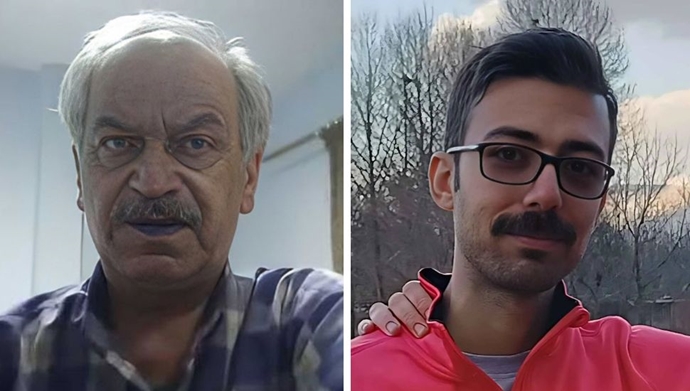

The clerical regime in Iran is accelerating its campaign of terror against dissidents, placing the lives of two political prisoners, Vahid Bani Amerian and Abolhassan Montazer, in grave and imminent danger.
This urgent threat follows the regime’s brutal execution of four PMOI/MEK members—Mohammad Taghavi, Akbar Daneshvarkar, Babak Alipour, and Pouya Ghobadi—over a bloody two-day period on March 30 and 31, 2026.
Reeling from its weakening grasp on power and the looming threat of impending uprisings, the regime is desperately using the gallows to physically eliminate its organized opposition, demanding an immediate international response. And the lives of Bani Amerian and Montazer, who have been sentenced to death, is hanging in the balance.
Flawed judicial process and a wave of brutality
The recent executions of the four PMOI members were state-sanctioned murders devoid of legal legitimacy. Following their arrests in 2024, the victims were subjected to months of severe physical and psychological torture in Evin Prison’s notorious Ward 209. The subsequent death sentences were issued by the criminal judge Iman Afshari in Branch 26 of Tehran’s Revolutionary Court. During their retrials on November 16, 2025, Afshari completely ignored defense lawyers’ pleas for a joint trial, instead holding separate hearings that lasted only a few minutes each.
The regime’s cruelty was further exposed by terrifying events inside Ghezel Hesar prison. On the night of Sunday, March 29, anti-riot guards violently raided the political prisoners’ hall in Ward 4, brutally beating inmates and transferring at least 19 political prisoners to solitary confinement. Since the morning of March 30, authorities have cut off all phone lines for political dissidents in Ward 4, holding them entirely incommunicado.
The imminent threat to Vahid Bani Amerian and Abolhassan Montazer
The international community must turn its immediate attention to Vahid Bani Amerian, 33, and Abolhassan Montazer, 66, who are co-defendants in the exact same fabricated case as the four recently executed martyrs.
Montazer’s condition is particularly critical, as he suffers from severe heart, lung, and kidney diseases. Both men were among those subjected to the brutal beatings during the March 29 raid in Ghezel Hesar and have since been transferred to an unidentified location, with authorities refusing to provide any information to their families or lawyers.
The European Parliament’s Friends of a Free Iran intergroup warned of the impending threat: “The lives of Iranian political prisoners Vahid Bani Amerian and Abolhassan Montazer are in grave danger, as the Iranian regime may carry out their executions at any moment… Immediate international attention is urgently needed.”
In a statement following the executions of four PMOI members, Amnesty International warned, “Fears have now intensified over the fate of Vahid Bani Amerian and Abolhassan Montazer, convicted in the same case following a grossly unfair torture-tainted trial. The authorities have refused to provide any information regarding their fate and whereabouts to their families or lawyers since their transfer to an unidentified location on March 30.”
A paralyzed regime acting out of fear and weakness
The timing of these consecutive executions exposes a profoundly vulnerable regime paralyzed by the fear of being overthrown. Following the massive nationwide uprisings of December 2025 to January 2026, which nearly brought the ruling establishment to its knees, the state only managed to maintain power through the massacre of thousands of protesters.
Now, exploiting the domestic chaos and the fog of war following the death of supreme leader Ali Khamenei in a February 28 airstrike, the regime is quietly eliminating its most capable adversaries. Driven by its terminal weakness, the ruling clerics are actively preparing for a new, massive purge of political prisoners to suppress a restless society, mirroring the horrific 1988 massacre.
The ruling clerics’ attempts to extinguish the flames of resistance are futile. These brutal executions will not silence the opposition; instead, they will only intensify the resolve of Iran’s rebellious youth to overthrow the regime.
However, as the lives of Vahid, Abolhassan, and other political prisoners hang in the balance, the international community cannot stand idly by. The United Nations and global leaders must take concrete, punitive actions to hold the regime accountable for its crimes against humanity and immediately intervene to save those still facing the gallows.