

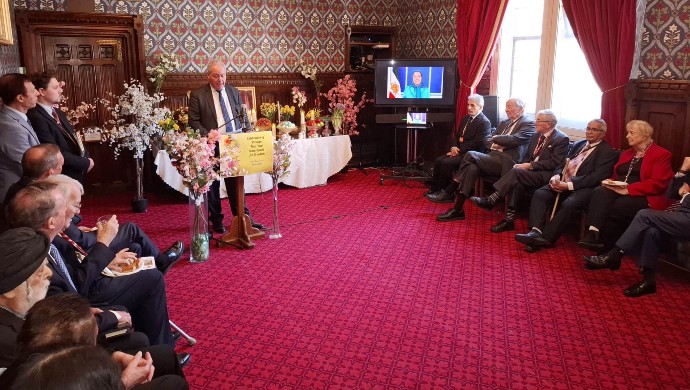

On March 26, 2026, a distinguished coalition of British lawmakers, legal experts, and human rights advocates gathered at Westminster to mark the Persian New Year (Nowruz). However, this year’s assembly carried unprecedented gravity.
The conference convened in the immediate aftermath of a massive wave of nationwide uprisings in December 2025 and January 2026 that fundamentally destabilized the Iranian regime. Furthermore, the geopolitical landscape shifted dramatically on February 28, 2026, when U.S. and Israeli airstrikes eliminated Supreme Leader Ali Khamenei and several senior regime officials.
Against this volatile backdrop, speakers at Westminster coalesced around a unified theme: the time for Western appeasement has ended, and the United Kingdom must implement a fundamental shift in policy by recognizing the Iranian people’s organized Resistance as the legitimate alternative to the clerical regime.
Endorsing the NCRI’s Provisional Government
Throughout the conference, speakers emphasized that the imminent collapse of the theocracy will not result in chaos, provided the international community recognizes the organized opposition. Parliamentarians voiced strong support for the provisional government structured by the National Council of Resistance of Iran (NCRI).
Lord Singh of Wimbledon congratulated NCRI President-elect Maryam Rajavi for “announcing a provisional government,” characterizing it as an “important and responsible step towards ensuring a democratic transition.” He stressed that change will not materialize from outside forces, but remains the “responsibility and the right of the Iranian people and their organized resistance.”
Bob Blackman MP echoed this sentiment, voicing unwavering support for the NCRI’s “provisional government for the transfer of sovereignty to the Iranian people.” Legal experts also weighed in on the legitimacy of this transition. Azadeh Zabeti, co-president of the Committee of Anglo-Iranian Lawyers, described the recognition of Mrs. Rajavi’s provisional government as an “absolutely paramount” step for the international community. Zabeti swiftly dismissed anxieties about a potential power vacuum, pointing to the organizational capabilities of the “members and the supporters of the MEK” who remain highly active on the ground.
Conference at the UK Parliament in support of the NCRI’s Provisional Government-
I sincerely hope that, at this critical juncture, you will consider implementing extraordinary measures in support of the Iranian people’s struggle. I respectfully urge that the United Kingdom:… pic.twitter.com/p87SY9qP3X— Maryam Rajavi (@Maryam_Rajavi) March 26, 2026
Leila Jazayeri, president of the Iranian Women’s Association, articulated the concrete demands of the movement. Requesting formal recognition for the NCRI’s provisional government, she noted that the Resistance forces “don’t want money, they don’t want boots on the ground.” Instead, she insisted, “everything is ready, they can take care of the regime” if they are simply granted the “recognition of the Iranian people’s right to stand up to IRGC.”
Rejection of All Tyrannies: The Shah and the Mullahs
The recent installation of Mojtaba Khamenei underscores the regime’s reliance on hereditary dictatorship, a concept the Iranian people have repeatedly shed blood to dismantle. Speakers firmly rejected the notion of returning to the monarchical dictatorship of the Pahlavi era, establishing a clear “Third Option” focused entirely on a democratic republic.
Bob Blackman MP did not mince words, declaring that the “Shah and mullahs have been partners in the oppression of the Iranian people and must not be allowed to continue.” He pointed out that the Iranian populace “firmly and unequivocally reject” monarchist remnants attempting to resurface via “TV propaganda and digital platforms.”
Councilor Robert Ward provided a historical perspective, recounting his own experiences in pre-revolution Iran. He recalled the palpable “fear on the face” of citizens living under the “regime of the Shah” and his brutal secret police, the “SAVAK.” Addressing the modern advocates of a royalist restoration, Ward stated bluntly, “Anybody who thinks that returning the Shah… these people are nuts.”
Lord Dholakia reinforced this rejection, asserting that the international community should “no longer… be impressed with the pronouncement that is made by Pahlavi regime.” He reminded attendees that the former monarchy was “responsible for this type of suppression that they suffered in earlier days and we no longer can allow that sort of situation to go again.” Councillor Matthew Goodwin similarly dismissed the Pahlavi advocates who “want to go back to someone in the past,” praising instead the “generations of wisdom and experience” driving the NCRI forward.
Support for PMOI Resistance Units and the Ten-Point Plan
The conference extensively highlighted the tangible forces driving the uprising inside Iran and the democratic blueprint guiding them. Lord Dholakia pointed to the global consensus surrounding the Resistance, noting that over 5,000 parliamentarians worldwide support the NCRI and Maryam Rajavi’s Ten-Point Plan, which “makes it very clear of the type of society we should have on Iranian soil.”
Bob Blackman MP drew attention to the physical sacrifices occurring inside Iran’s borders. He praised the bravery of the PMOI “Resistance Units” in spearheading recent “popular uprisings” against the theocracy. Referencing the broader organized movement, he lauded the “army of freedom” as the primary engine capable of dismantling the regime. Blackman defined the Ten-Point Plan as a visionary roadmap for a “democratic, non-nuclear Republic in Iran, founded on gender equality, the rule of law, respect for ethnic nationalities and religious communities.”
Dr. Liam Fox MP asserted that the “moral right to determine who governs Iran” belongs solely to its people, characterizing the current struggle as a generational battle: “this is a revolution to young people in Iran of their grandparents or even great-grandparents.” Dr. Fox emphasized that a successful overthrow requires the opposition to stay “united around the sound principles that have been set out in the Ten-Point Plan.”
Demanding a Tough Policy: Proscribing the IRGC and Expelling Agents
Following the violent domestic massacres and the recent geopolitical escalation involving strikes on regime targets, British parliamentarians urged an immediate end to diplomatic leniency. The demand to proscribe the Islamic Revolutionary Guard Corps (IRGC) as a terrorist organization was virtually unanimous.
Dr. Fox condemned consecutive British governments for failing to proscribe the IRGC, calling the hesitation “unconscionable” when dealing with a regime “kept in office by terror and brutality.” He pressed the UK to aggressively tackle “sleepers, agents, and apologists” operating on British soil.
Lord Bruce of Bennachie exposed the absurdity of maintaining diplomatic ties with a state that actively recruits terrorists within the UK. He openly questioned how London could engage with a regime “advertising on social media for British citizens to become agents of Tehran here and perpetrate acts of terrorism within the United Kingdom.”
Other lawmakers provided concrete legislative steps to cripple the regime’s international apparatus. Lord McInnes of Kilwinning called for the UK to seize IRGC assets in London, proposing they be “returned to the people of Iran when it is able to establish itself as a secular democracy.” He demanded the UK “strip them [the Iranian regime] of their power and influence by banning any access they have in this country.” Councilor Ward mirrored this frustration, criticizing “posh Oxford boys” in the Foreign Office who misguidedly believe they can negotiate with terrorists, and demanding the Iranian embassy in London be “reduced to a minimum rump.” Lord Hamilton of Epsom highlighted the economic vulnerabilities of the ruling clerics, noting that “cracks are appearing” and suggesting the international community establish a “stranglehold on all the oil coming out of Iran” to leverage the regime’s collapse.
Solidarity with the Iranian People’s Vision for a Tyranny-Free Future
Woven throughout the strategic and political discourse was a profound empathy for the immense human cost of the Iranian people’s struggle, particularly following the massacre of thousands during the winter uprisings.
Baroness Helena Kennedy KC, speaking from her extensive experience as a human rights lawyer, conveyed her deep distress over the “crushing of resolve” and the regime’s imprisonment of lawyers and women campaigning for equality. While expressing opposition to the recent war, she reaffirmed her absolute solidarity with the Iranian people and her unwavering belief that “there is going to be that moment of transition.”
Jim Shannon MP highlighted the theocracy’s severe “persecution” and “violence” against religious minorities, particularly the Baha’i community. He pledged his parliamentary colleagues’ commitment to realizing a society that protects “freedom to worship your God,” alongside fundamental rights for women, girls, and workers. Baroness Sharon Davies lamented the regime’s mismanagement of Iran’s “fantastic treasures,” noting the nation’s wealth is utilized in “the most destructive way possible.”
Representing the youth, Roza Zabeti poignantly reminded the audience of the personal sacrifices endured by activists in the diaspora. Noting she was “not able to call my family this year and get back home,” she framed Nowruz as a “timeless hope for renewal and change.”
The conference closed with a resilient outlook. Acknowledging the bloody path ahead, Lord Hacking drew historical parallels to the “dark days” of the Second World War when Europe succumbed to fascism, reminding the Resistance of the old British adage to “stay calm and carry on.” As Dr. Fox noted, while the night for the Iranian people is not yet over, the “first cracks of dawn are coming.” Through their courage on the streets and the clarity of their organized political vision, the Iranian people are proving that their victory over tyranny is not a matter of if, but when.