

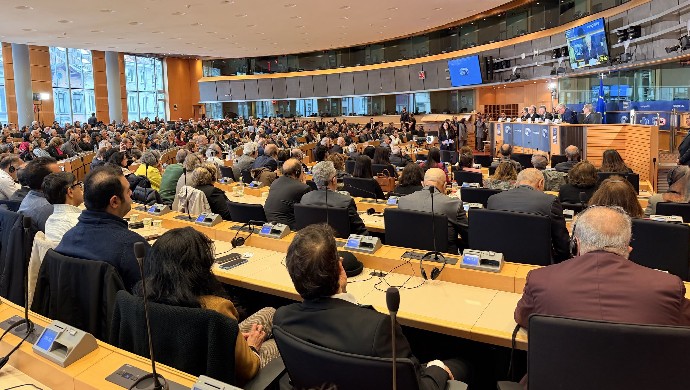

On December 10, 2025, marking International Human Rights Day and the 77th anniversary of the Universal Declaration of Human Rights, a high-level conference convened to address the escalating human rights crisis in Iran. The event, held at the European Parliament in Strasbourg, hosted Mrs. Maryam Rajavi, President-elect of the National Council of Resistance of Iran (NCRI), and Members of the European Parliament (MEPs), former Prime Ministers, and distinguished political and human rights figures.
Against the backdrop of a regime in Tehran grappling with unprecedented internal dissent and the collapse of its regional proxies, the conference served as a platform to articulate a decisive shift in policy. Speakers unanimously condemned the staggering rise in executions under the clerical regime, rejected the failed policy of appeasement, and voiced robust support for the “Third Option”—democratic change brought about by the Iranian people and their organized Resistance movement. The gathering underscored that the struggle for freedom in Iran is not merely a domestic issue but a pivotal battleground for global democracy and security.
Maryam Rajavi: The Inevitability of the Regime’s Downfall
In her keynote address, Mrs. Maryam Rajavi outlined the rapidly shifting dynamics within Iran and the region. She argued that the past six months have accelerated the regime’s decline, citing the collapse of the regime’s “Axis of Resistance” and the regime’s loss of strategic depth following developments in Syria and Lebanon. Mrs. Rajavi emphasized that the regime is now “exposed, without any external support, against the Iranian people’s drive to overthrow them.”
Mrs. Rajavi detailed the catastrophic state of Iranian society, noting that 90 percent of the population opposes the regime’s laws, while the economy faces uncontrollable inflation and structural collapse. She posited that the regime has reached an “existential deadlock,” unable to reform and relying solely on repression to survive.
Conference at the European Parliament featuring European lawmakers and distinguished public figures#HumanRightsDay#StandUp4HumanRights pic.twitter.com/Us1zc3FT2e
— Maryam Rajavi (@Maryam_Rajavi) December 10, 2025
Central to her address was the validation of the Resistance’s strategy. Mrs. Rajavi declared:
“The developments of the past six months have not only made the regime’s downfall clearer and beyond doubt; they have also exposed and discredited all pseudo-solutions and false paths. The era of manufactured ‘alternatives’ has come to an end.”
She articulated the “Third Option” as the only viable path forward—distinct from foreign military intervention or appeasement. This option relies on “the overthrow of the regime by the people of Iran and the Iranian Resistance.” She further stressed the unity of the Iranian people around three fundamental principles: the overthrow of the Velayat-e Faqih regime, the rejection of both the Shah and the mullahs, and the separation of religion and state.
Mrs. Rajavi concluded with a direct challenge to the Supreme Leader and a vision of the future:
“The path ahead for Khamenei has already been mapped by the Shah and Bashar Assad. If he refuses, an even worse fate awaits him… Only one path stretches ahead: a democratic revolution, the transfer of power to the Iranian people through democratic means, and, ultimately, the establishment of a democratic republic in Iran.”
The Execution Spree: A Regime at War with its People
A predominant theme of the conference was the alarming surge in state-sponsored executions, used by Tehran as a tool of terror to quell the rising tide of dissent. Speakers provided harrowing statistics and highlighted the imminent danger facing political prisoners, particularly supporters of the People’s Mojahedin Organization of Iran (PMOI/MEK).
Mrs. Rajavi revealed that the regime has executed over 1,950 people in the current year alone, a figure she noted is “twice the number of those executed last year, and is the highest number in the past 37 years.” She drew particular attention to 18 political prisoners currently facing death sentences solely for their alleged membership in the PMOI.
Guy Verhofstadt, former Prime Minister of Belgium, contextualized these atrocities within the tenure of the regime’s so-called “moderate” president. He noted, “In that period of sixteen months, more than 2,600 people have been killed.” He emphasized the courage of those behind bars, stating that the 18 prisoners on death row have “reiterated their support for a democratic republic, even under the threat of execution.”
MEP @guyverhofstadt: In the last 16 months under the so-called reformist, more than 2,600 people have been killed. As Mrs. Rajavi noted, 18 political prisoners are now on death row, all charged with supporting the Iranian Resistance. #StopExecutionsinIran https://t.co/HbmDKcvnhn
— NCRI-FAC (@iran_policy) December 10, 2025
Francisco Assis, MEP, cited the execution of political prisoners Behrouz Ehsani and Mehdi Hassani as a “heartbreaking reminder” of the regime’s brutality. He condemned these acts as a direct mockery of European resolutions demanding their release. Assis highlighted the resilience of the prisoners, noting:
“This is what courageous political prisoners behind bars are doing by defying the regime and its execution policy. The ‘No to Executions Tuesdays’ campaign goes beyond protest. It constitutes a demonstration of force against the regime’s terror and intimidation tactics.”
Ryszard Czarnecki, former Vice-President of the European Parliament, described the situation as “state-run terror,” noting that in just two weeks, 161 people were hanged, some in public squares reminiscent of the Middle Ages. He warned that dictatorships “grow bolder when the free world remains silent.”
.@DZalimas40196: The EU must act as a crucial advocate for human rights. It can mobilize partners at the @UN to establish an accountability mechanism and refer Iran’s appalling human rights dossier to the Security Council. #HumanRightsDay https://t.co/7mT7nXBLYr
— NCRI-FAC (@iran_policy) December 10, 2025
Dainius Žalimas, MEP and legal expert, argued that these executions should be assessed as crimes against humanity, potentially with genocidal intent. Citing the UN Fact-Finding Mission, he stated that when executions are part of a widespread attack against a civilian population, international law demands accountability.
Historical Accountability: The 1988 Massacre and United Nations Action
Multiple speakers drew a direct line between the current wave of executions and the 1988 massacre of 30,000 political prisoners, framing the current violence as a continuation of that unpunished crime against humanity.
Petras Auštrevičius, MEP, emphasized that the regime is paving the way to repeat past atrocities. He noted that the recent death sentences echo the 1988 massacre when the regime sought to “eliminate independent opposition.” He welcomed the recent resolution by the UN General Assembly’s Third Committee, which formally recognized the massacre, but insisted that recognition alone is insufficient.
“The United Nations Special Rapporteur has stated that these mass executions were carried out with genocidal intent, and could have been prevented with timely international action and intervention. We are in the same situation today, and the European Union cannot fail.”
.@LeolucaOrlando1: @Mojahedineng has fought for democracy for 60 years, opposing the Shah’s and the mullahs’ tyranny. Thousands in the PMOI & NCRI, led by @Maryam_Rajavi, show they embody the Iranian people’s struggle, with women leading the resistance.https://t.co/R4SHlctX4H
— NCRI-FAC (@iran_policy) December 10, 2025
Andrey Kovatchev, MEP, congratulated the Resistance for their tireless efforts in raising awareness about the 1988 massacre, calling its recognition in the UN resolution a “crucial first step.” However, he urged the European Council to support the referral of the regime’s human rights record to the UN Security Council to secure the prosecution of those responsible.
Francisco Assis also urged the EU not to repeat its “historic inaction” of 1988, calling for a “verifiable halt to executions and a moratorium on the death penalty” as a precondition for any diplomatic relations.
The Failure of Appeasement and the Demand for a New Strategy
The conference served as a scathing indictment of Western policy toward Iran. Speaker after speaker argued that decades of appeasement have not only failed to moderate the regime but have emboldened its domestic repression and regional aggression.
Guy Verhofstadt delivered a blistering critique of European and American strategy. He argued that the “appeasement strategy of Western Europe” continues despite resolutions to the contrary.
“The strategy of appeasement has solved nothing the last ten years. Nothing. It certainly, colleagues, didn’t stop the killings: 2,600 in the last sixteen months. It didn’t produce a nuclear-free Iran because the opposite is true; the mullahs’ regime simply cannot be trusted.”
Verhofstadt called for the formation of a coalition to demand a strategic shift from European leadership, including the recognition of the Islamic Revolutionary Guard Corps (IRGC) as a terrorist organization and the implementation of escalating sanctions linked to the number of executions.
Matteo Renzi, former Prime Minister of Italy, reflected on his own experience attempting diplomacy with Tehran while in office. He admitted, “We made every type of effort to try to use diplomatic ways and moderate this regime. And now we have to admit that it is impossible.” Renzi argued that the regime is currently at its weakest point, making it the “time to act.”
Senator @matteorenzi: The weakness of the Iranian regime is incredible today. This is the moment to act and to call for action, because Tehran is at its weakest point. #HumanRightsDay https://t.co/giiPFtJPmz
— NCRI-FAC (@iran_policy) December 10, 2025
Milan Zver, MEP, opened the session by stating that hoping the regime could be moderated is a pattern Europe has fallen into for too long. “The events of recent years have shown that this approach does not work,” he declared, calling for a “more serious and principled European policy.”
Rasa Juknevičienė, MEP, warned against the “mistaken approach” of making deals with dictatorships. Drawing parallels to the fight against fascism in World War II, she urged the West to “stay on the right side of history” and defeat the modern “Axis of Evil.”
Endorsing the Democratic Alternative: The Ten-Point Plan
A significant portion of the conference was dedicated to voicing support for the NCRI and Mrs. Rajavi’s Ten-Point Plan as the viable roadmap for a future Iran. Speakers emphasized that the alternative to the current theocracy is not chaos or a return to monarchy, but a democratic republic.
Leoluca Orlando, MEP, praised the PMOI and NCRI for their six-decade fight for democracy, opposing both the Shah’s dictatorship and the mullahs’ tyranny. He highlighted the leadership of women in the movement as a powerful counter to the regime’s misogyny.
“The Iranian Resistance rejected both appeasement and war, advocating instead for a third option: a democratic change by the Iranian people and their organized resistance… The European Union must stop its silence today, and must change policies and support the Iranian people and their representatives.”
.@PToveri: Amid this hardship, the #MEKResistanceUnits are expanding rapidly, especially among the young. These disciplined networks operate under lethal risk, coordinating actions in dozens of cities and supporting nationwide strikes. https://t.co/tInU46jkI0
— NCRI-FAC (@iran_policy) December 10, 2025
Petras Auštrevičius stated that while accountability is an urgent fix, a long-term solution is necessary. He described Mrs. Rajavi’s Ten-Point Plan as embodying “the democratic aspirations of the Iranian people,” enshrining the Universal Declaration of Human Rights and the rule of law. He urged EU leaders to “officially recognize this democratic alternative.”
Pekka Toveri, MEP and former soldier, stated with absolute clarity that change will come from within. He endorsed the “Third Option” as the only responsible policy.
“Iran will not be liberated by foreign armies nor by trade deals. Change will come from within, from the Iranian people and the organized resistance that has endured sixty years of sacrifice.”
Dainius Žalimas noted that the NCRI platform expresses the “true aspirations and will of the Iranian people for democracy, justice, and the rule of law,” and deserves the EU’s full endorsement.
.@DZalimas40196: The EU must act as a crucial advocate for human rights. It can mobilize partners at the @UN to establish an accountability mechanism and refer Iran’s appalling human rights dossier to the Security Council. #HumanRightsDay https://t.co/7mT7nXBLYr
— NCRI-FAC (@iran_policy) December 10, 2025
Rejection of All Dictatorships: No Return to the Past
The speakers were emphatic that the future of Iran lies in a forward-looking republic, firmly rejecting any return to the monarchical dictatorship overthrown in 1979.
Mrs. Rajavi stated that the Iranian people “do not want a monarchical dictatorship, nor a clerical one.” She asserted that while remnants of the previous regime may dream of reviving dictatorship, Iranian society will “neither return to the past nor remain stagnant in the present.”
Pekka Toveri reinforced this point, arguing that the Iranian people have no desire to go backward “to any form of autocracy, whether wearing a crown or turban.” He affirmed that “Iran is for the democratic secular republic, nothing less.”
Leoluca Orlando also noted the PMOI’s consistent history of opposing “both the Shah’s dictatorship and the mullahs’ religious tyranny,” validating the movement’s democratic credentials.
The Expanding Resistance: PMOI Units and Social Unrest
Despite the intense repression, speakers acknowledged the growing strength and organizational capability of the Resistance Units inside Iran.
Ryszard Czarnecki highlighted that the young generation and women are at the forefront of the struggle. He noted that PMOI Resistance Units have expanded across the country, sending a clear message that the people will not surrender.
.@LeolucaOrlando1: @Mojahedineng has fought for democracy for 60 years, opposing the Shah’s and the mullahs’ tyranny. Thousands in the PMOI & NCRI, led by @Maryam_Rajavi, show they embody the Iranian people’s struggle, with women leading the resistance.https://t.co/R4SHlctX4H
— NCRI-FAC (@iran_policy) December 10, 2025
Pekka Toveri described the Resistance Units as “disciplined networks operating under unimaginable surveillance and lethal risks.” He observed that their ability to encourage coordinated actions and strikes demonstrates “organizational capability,” proving that the unrest in Iran is not spontaneous but a “structural struggle for democratic change.”
Mrs. Rajavi confirmed that the Resistance network is expanding across various provinces and that the new generation is joining the movement in growing numbers. She identified this organized uprising as “the most dangerous crisis confronting the clerical regime.”
A Call for “Interdependence” and Action
The conference concluded with a sense of urgency and a call for European unity in supporting the Iranian cause. Leoluca Orlando proposed a re-imagining of the date, suggesting that Human Rights Day should also be considered “Interdependence Day,” symbolizing the shared destiny of global democracies and the Iranian people.
Paulo Casaca, former MEP, called for specific mechanisms to target the perpetrators of crimes in Iran, urging a blacklist and sanctions regime for judges and prosecutors implicated in executions. He expressed confidence that Mrs. Rajavi would eventually “revive this old Cyrus Cylinder in your country and will make of your country a symbol of humanity all over the world.”
.@paulocasaca1: One urgent tool we must use is blacklisting and sanctioning all those implicated in these crimes—judges, prosecutors, anyone involved. They are criminals against humanity and must be targeted worldwide. You have been killing people; you will face trial.…
— NCRI-FAC (@iran_policy) December 10, 2025
The consensus among the diverse group of international leaders was clear: the Iranian regime is in a terminal phase of decline, fueled by internal isolation and economic ruin. The “Third Option” offered by the NCRI represents the only viable path to stability. As Guy Verhofstadt envisioned, the goal of the international community must be to support the democratic opposition so that, in the near future, International Human Rights Day can be celebrated in a free Tehran.